The Gallery After Nine
Selene agreed to the fundraiser because a quiet dare felt easier to survive than another evening alone with her own thoughts.
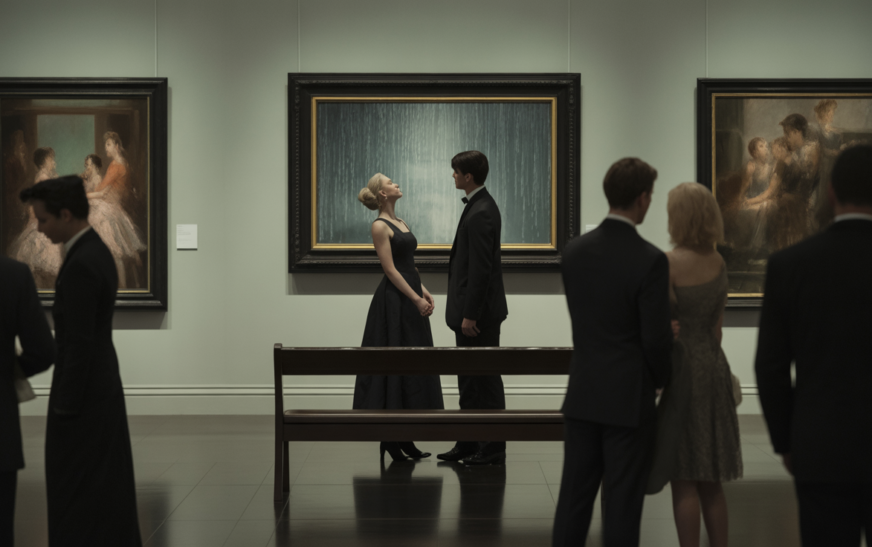
The invitation had come from a colleague who loved cultural events mostly because they allowed expensive people to perform modesty in public. Selene almost refused. However, the week had already been too full of deadlines, polite disappointments, and the strange exhaustion that arrived when a person spent too many evenings being sensible. Therefore, by nine fifteen, she was standing beneath the high white ceilings of the Marrow Gallery with a glass of champagne she did not want and a black dress she trusted more than her mood.
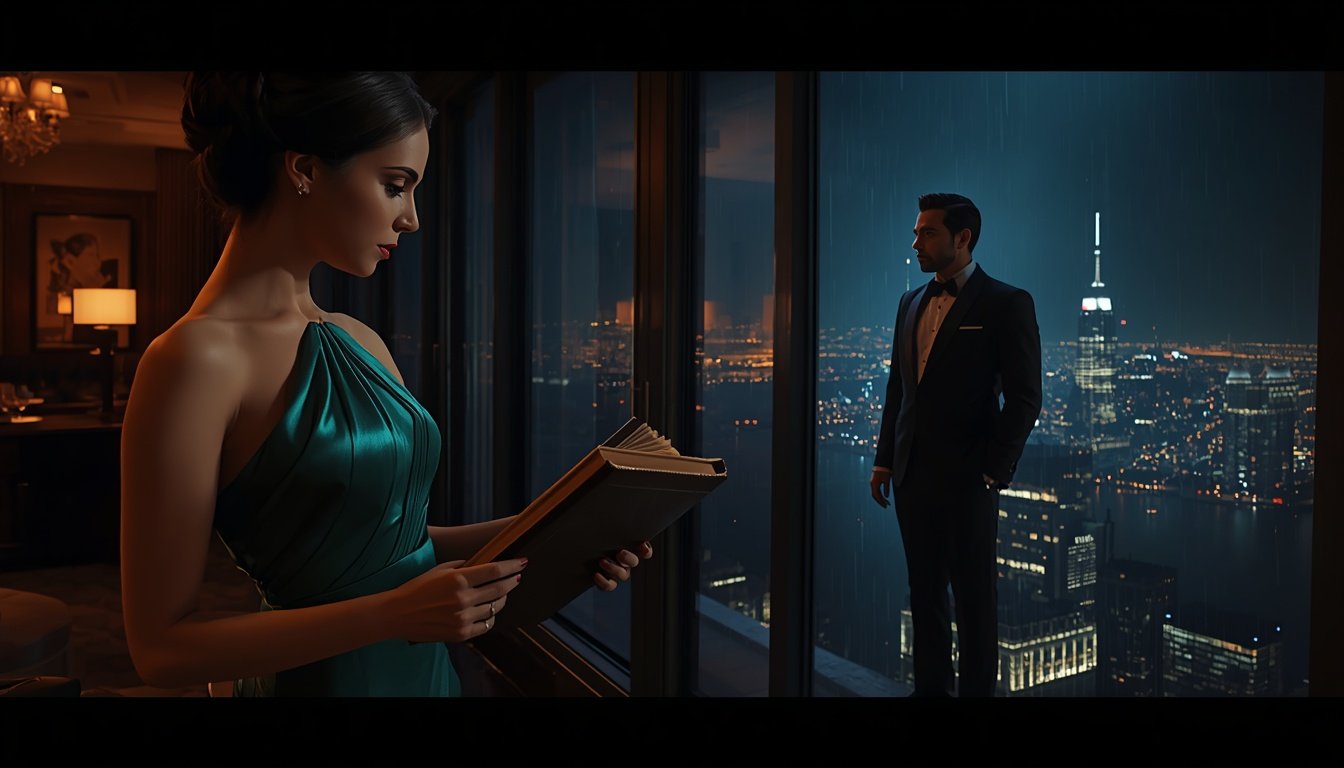
The rooms were all softened light and careful voices. Paintings in dark frames watched from the walls with varying degrees of accusation. Meanwhile, a string trio near the staircase moved through something classical enough to flatter the donors without demanding real attention.
Selene drifted past landscapes, portraits, and one enormous canvas full of gold leaf and visible ego.
She was considering escape when a voice behind her said, “Choose the saddest painting in the room.”
The Man by the Staircase
She turned slowly.
The man standing beside her held his drink low and looked as though he belonged to the evening without quite respecting it. Dark suit. Open collar. No tie. He had the composed face of someone used to being invited into polished places and deciding for himself whether they were worth entering.
“That is an unusual opening line,” Selene said.
“It’s not a line,” he replied. “It’s a request.”
“From a stranger.”
“Temporarily.”
That almost earned him a smile.
“Why would I do that?” she asked.
He glanced toward the nearest wall of paintings. “Because everyone else here is pretending to admire technique, and you look like you’d rather tell the truth.”
“That is either flattering or very manipulative.”
“It can be both and still be useful.”
His honesty arrived too neatly to dismiss.
Selene took a measured sip of champagne. “All right. Which one do you think is saddest?”
“No,” he said. “That would make it my evening.”
“And heaven forbid.”
His mouth curved. “Exactly.”
The Quiet Dare Begins
She should have walked away then.
The event was full of safer men. Men who would have asked what she did, where she lived, whether she liked the city, and other questions designed to sound personal without risking anything real. Instead, this one had offered a quiet dare in a room that already felt too careful to trust.
“Fine,” Selene said. “If I answer, what do I get?”
“A better conversation than the one you were having with yourself.”
She laughed despite herself. “That assumes it was poor company.”
“Only difficult company.”
The remark landed close enough to truth to interest her.
She studied the nearest paintings again. There was a portrait of a woman in pale blue who looked mildly offended by her own century. Beside it hung a winter river under a gray sky, then a small interior scene showing an empty dining table with one chair slightly pulled back.
Selene pointed to the empty table.
“That one,” she said.
He followed her gaze. “Why?”
“Because someone left in the middle of being expected.”
For the first time, he looked at her with less amusement and more attention.
“That is very specific,” he said.
“So was your question.”
The Room of Better Lies
They moved into the next gallery together because standing still had begun to feel too intimate.
Here the walls were darker and the paintings stranger. One abstract looked like a cathedral dissolving in wine. Another held a field of black flowers beneath a silver sky that seemed designed for people who liked grief only when it matched the furniture.
“I’m Julian,” he said.
“Selene.”
“Good,” he replied. “I was beginning to think you intended to stay hypothetical.”
“I still might.”
“That would be disappointing. However, it would also be elegant.”
She glanced at him. “You talk as if every sentence has been polished in advance.”
“Only in rooms that demand it.”
“And does this room?”
“No,” Julian said. “This one prefers better lies.”
A couple brushed past them on the way to the sculpture hall. The woman laughed too brightly. The man touched her elbow as if helping her through a dangerous crossing rather than a gallery doorway.
Selene watched them go. “Do you attend many events like this?”
“Enough to know there are always three parties,” he said. “The public one, the private one, and the one people rehearse in their heads while pretending to listen.”
“And which one are you at tonight?”
He looked toward the painting of the black flowers. “That depends whether you answer a second question.”
The Portrait Without Mercy
They stopped before a portrait of a man seated in a velvet chair, his expression so calm it almost became cruel.
“All right,” Selene said. “What is the second question?”
Julian kept his eyes on the portrait. “Which painting would you never want in your house?”
“That one,” she answered at once.
He laughed softly. “You didn’t even consider the others.”
“I didn’t need to.”
“Why not?”
“Because he looks like the sort of man who would become more truthful at night.”
Julian turned to her then. “That is a very dark answer.”
“You sound pleased.”
“I sound interested.”
They stood in silence for a moment longer. Around them, glasses touched lightly. Shoes moved over polished floors. Meanwhile, the trio downstairs slipped into a slower piece that reached the room in softened echoes.
“Your turn,” Selene said. “Which one would you never keep?”
He nodded toward a small seascape hung alone on the far wall. At first glance, it looked harmless enough: pale water, low horizon, two figures near the shore. However, the longer she looked, the more the distance between those figures became the subject.
“That one,” Julian said.
“Because?”
“Because it’s trying too hard to look peaceful.”
She considered that. “You distrust calm things.”
“No,” he said. “Only arranged calm.”
The Sculpture Hall
By then, the evening had altered shape.
Selene no longer felt trapped by donor smiles or professional small talk. Instead, the gallery had narrowed to a sequence of rooms, paintings, and Julian’s voice arriving at her shoulder with careful timing. That should have been enough warning. However, the danger in him was not pressure. It was precision.
In the sculpture hall, white marble figures stood beneath pools of light like people remembering how stillness could be weaponized.
“Third question,” Julian said.
She looked at him sideways. “Was that always your plan?”
“No. But now I’m developing ambitions.”
“How alarming.”
“Only modest ones.”
He stopped before a statue of a woman with one hand raised to her throat.
“Which person in this room,” he asked, “is pretending hardest not to be lonely?”
Selene should have refused. Instead, she scanned the hall.
An older man in a velvet jacket was speaking too closely to a younger curator. A woman in silver stood alone with perfect posture, looking at her phone as if it were delivering emotional instructions. Near the archway, a dark-haired donor nodded through a conversation he had clearly stopped hearing several minutes earlier.
Selene chose the woman in silver.
“Her,” she said. “Because she’s standing like she expects absence to be photographed.”
Julian was quiet for a beat. “You do this better than I hoped.”
“You hoped?”
“Of course.”
“That sounds dangerously selective.”
“It is.”
The Dare She Returned
Selene set down her empty glass on a passing tray.
“Now I have a question,” she said.
Julian inclined his head. “That feels fair.”
“You arrive beside strangers and ask them strange things in beautiful rooms. Do you do that often?”
“Not often.”
“Convenient answer.”
“True answer.”
“And why tonight?”
This time he did not answer quickly.
The pause mattered. Until then, his composure had seemed effortless. Now it looked chosen.
“Because,” he said at last, “most people here are determined to sound impressive. You looked like you’d rather sound accurate.”
“That is still a polished answer.”
“Yes,” he said. “But it’s mine.”
She should have found that less compelling than she did.
Instead, she pointed toward a narrow bench beneath a large painting of rain over rooftops. “Sit,” she said.
He blinked once. “That sounded like a command.”
“Think of it as a returned dare.”
Julian sat.
Selene remained standing for another second, long enough to enjoy the shift. Then she took the other end of the bench, close enough for conversation and far enough for judgment.
“All right,” she said. “No more questions about paintings. Tell me one true thing you would not usually say on a first meeting.”
The Rain on the Canvas
He looked up at the painted rooftops before answering.
“I leave most evenings before they improve,” Julian said.
Selene did not speak.
“Why?” she asked finally.
His thumb traced once along the edge of his glass. “Because if I stay too long, I begin to feel expected. I’ve never liked the personality people build for me after the first hour.”
That answer was quieter than the rest of him.
“And what personality is that?” she asked.
“Interesting enough to invite back,” he said. “Steady enough to trust too early. Distant enough to regret later.”
She watched him carefully. “That is an unflattering self-portrait.”
“The accurate ones usually are.”
For a moment, the room around them blurred into low sound and expensive light. Selene understood then that the attraction had sharpened not because he was mysterious, but because he was disciplined with what he revealed. Restraint, in the right person, could feel more intimate than confession.
“My turn,” she said.
Julian nodded.
She looked at the rain in the painting rather than at him. “I stay too long,” she said. “Not in relationships. In moods. In places. In versions of myself that should have been temporary.”
He was silent for just a second. Then he said, “That sounds expensive.”
She laughed softly. “It has been.”
The Last Room Before Closing
An announcement moved through the gallery at ten forty-five.
Guests began drifting toward the entrance hall with the deliberate reluctance of people who wanted the night extended without appearing needy. The trio downstairs stopped playing. In the sudden absence of music, every voice seemed slightly more honest.
Julian stood when Selene did.
“Are you leaving before the evening improves?” she asked.
“It may have improved already,” he said.
“That sounds evasive.”
“It’s careful.”
Together, they crossed the last room, where a series of smaller paintings lined the wall in gilt frames. One showed a woman reading beside an unlit fire. Another showed an empty street after rain.
Selene slowed before the street scene.
“There,” Julian said softly. “That one is lonely.”
She glanced at him. “You’re changing your answer now?”
“No. I’m adjusting it.”
“That sounds suspiciously like revision.”
“I prefer refinement.”
She shook her head, smiling. “You are very pleased with yourself.”
“Not always.”
“Tonight?”
His gaze held hers for one measured moment. “More than when I arrived.”
The answer settled between them with enough warmth to be dangerous.
The Steps Outside the Gallery
The rain had thinned to a cold silver mist by the time they reached the front steps.
Cars waited at the curb with engines low and patient. Guests disappeared into coats, umbrellas, and chosen versions of goodbye. The city beyond the gallery looked dark and expensive in the way only wet streets could manage.
Selene paused beneath the stone arch above the doors.
“So,” she said, “was this your whole method? Ask inconvenient questions until a stranger becomes memorable?”
Julian slipped one hand into his coat pocket. “That depends. Am I memorable?”
“Unfortunately.”
“Then perhaps the method works.”
“That is intolerable.”
“A little.”
She should have asked for certainty then. A number. A plan. Something with edges she could carry home. Instead, she found herself reluctant to reduce the evening too quickly. Some forms of attraction looked better before being explained.
Julian seemed to understand that.
“There’s another late opening next Thursday,” he said. “Different gallery. Worse donors. Better paintings.”
Selene watched the rain gather along the curb. “Is that an invitation?”
“No,” he said. “It’s a possibility. Invitations can make people behave.”
“And possibilities don’t?”
“Not the interesting ones.”
She let the silence stretch, mostly because it suited them and partly because she wanted to see whether he would rush to fill it. He did not.
That made the answer easier.
“All right,” she said. “A possibility, then.”
After the Dare
Selene walked home without hurrying.
The mist cooled her face. Streetlamps shimmered over the pavement in pale gold lines. Behind her, the gallery kept its lighted windows and expensive quiet. Ahead, the city unfolded in darker blocks that felt more honest after ten.
She knew very little about Julian in any practical sense. No full biography. No reassuring history. No declarations disguised as charm. Still, the evening remained vivid because of what it had risked. Not confession exactly. Precision. He had entered the room with a playful challenge and left it with something closer to uneasy chemistry, which was often more lasting.
Later, when she reached for fiction shaped by Romance, the charged restraint of Flirty Stories, and the uncertain beginnings inside Dating, she understood why those stories endured. They were rarely built on spectacle. Instead, they turned on timing, language, and the danger of liking someone who noticed too much without asking for ownership. Some nights darkened into Psychological tension or brushed the emotional edge of Drama, because attraction could sharpen into vulnerability with very little warning.
In the end, the most memorable evenings often begin with dangerous charm, then deepen through elegant attraction, conversation suspense, and the hush of quiet attraction that neither person fully trusts. Sometimes they hold the ache of a late night romance. Other times they leave behind only dangerous charm, a room full of paintings, and the feeling that one carefully chosen question can alter an entire night.