The Reception She Almost Skipped
Iris arrived late because punctuality felt too much like enthusiasm.
The wedding had belonged to a cousin she liked in the abstract and avoided in person. Family events tended to produce the same old performance: warm greetings, subtle comparison, and the faint violence of being remembered inaccurately by people who loved her theoretically. However, attendance had been requested with enough sweetness to make refusal expensive. Therefore, by eight twenty, Iris was crossing the hotel ballroom in a black dress softened only by pearls and carrying the expression she reserved for elegant obligations.
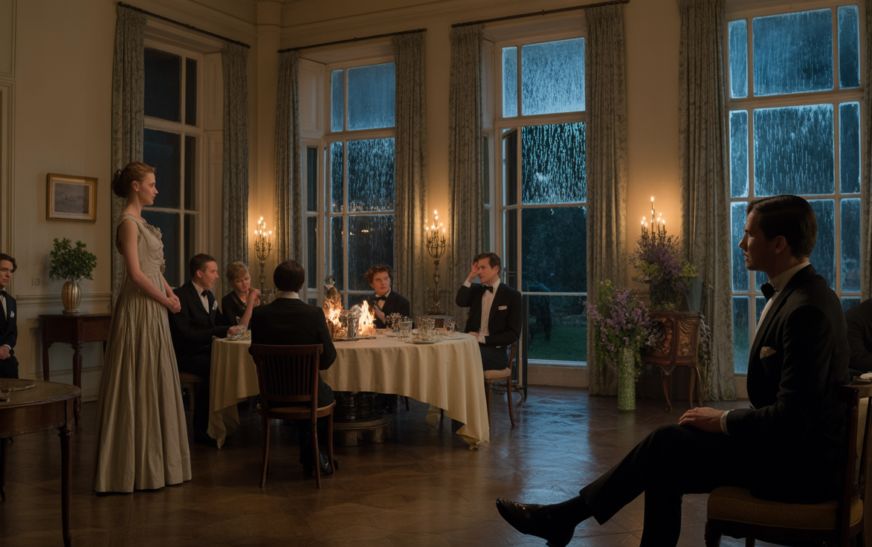
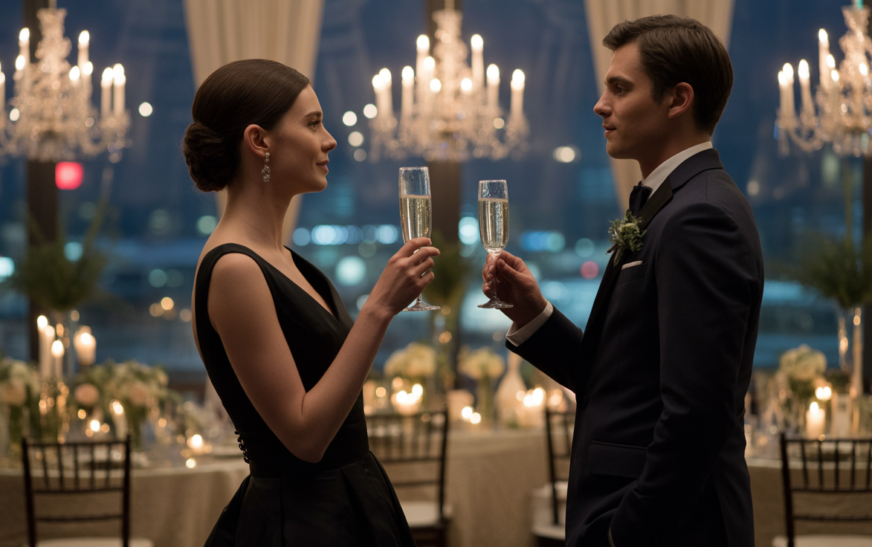
The reception room glowed beneath chandeliers and suspended greenery. Candlelight trembled across glassware. A jazz trio in the corner adjusted the edges of the evening into something polished enough to excuse the sentiment. Meanwhile, wedding guests moved between tables with the bright exhaustion of people determined to call themselves joyful until midnight made liars of them.
Iris found her seat near the back.
That was deliberate. She preferred a full view and an easy escape.
The Man Across Two Tables
At first, she noticed him only because he was not trying to be noticed.
Most men at weddings either leaned into charm or disappeared into furniture. This one did neither. He sat across two tables near the windows, dark suit, no tie, one hand curved loosely around his glass. His posture suggested ease, yet there was nothing careless in him. If anything, he looked like a man listening to the room rather than competing with it.
Iris looked away before he could become interesting.
That lasted perhaps four minutes.
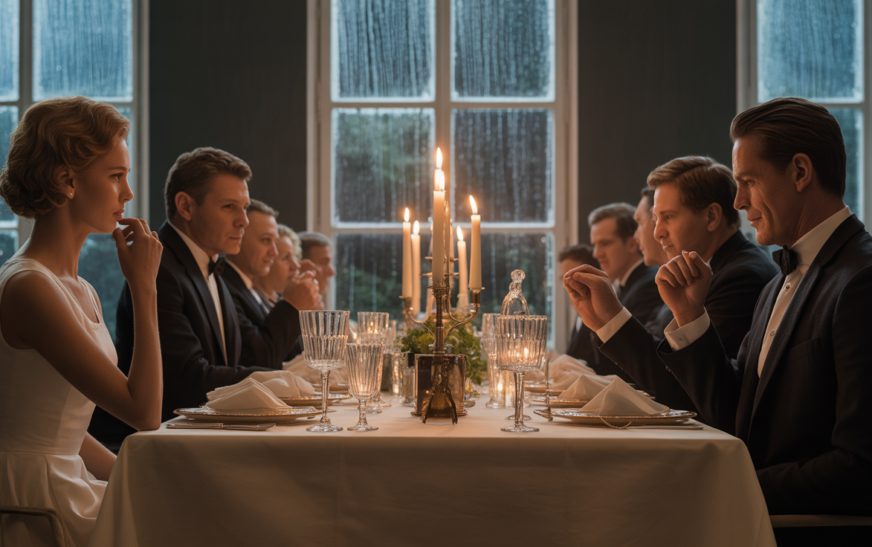
The first toast began with the bride’s father and too much emotion. Guests stood. Glasses rose. Laughter and applause arrived at the expected intervals. Iris lifted her champagne with everyone else, already half absent in her head.
Then, across the room, the man by the windows raised his glass a fraction too late.
Not enough for others to notice. Enough for her to see.
The timing made it feel less like participation and more like reply.
His gaze crossed the room at the same moment.
There it was: the delayed toast, precise enough to unsettle her and too slight to accuse.
The Smile He Did Not Use
Iris distrusted men who smiled too early. Fortunately, he did not smile at all.
Instead, he lowered his glass and returned his attention to the speaker as if nothing at all had passed between them. That should have ended the matter. However, small disturbances often linger longest because they leave so little to resist.
Her cousin Leah slipped into the chair beside her a few minutes later, flushed with dancing and secondhand romance.
“You came,” Leah said.
“Try to contain your astonishment.”
Leah laughed and stole a sip from Iris’s untouched champagne. “You look dangerous tonight.”
“That may just be the lighting.”
“No,” Leah said. “Lighting usually makes you look expensive. This is different.”
Iris glanced toward the window tables before she could stop herself.
Leah followed the glance immediately. “Ah.”
“Do not start.”
“I said nothing.”
“Your face did.”
Leah’s grin widened. “Do you know him?”
“No.”
“Would you like to?”
“That depends whether he keeps speaking in delayed gestures.”
Leah stared for one beat, then laughed harder. “That sounds promising and exhausting.”
The Walk to the Bar
By the second round of speeches, Iris needed distance more than champagne.
She crossed the ballroom toward the temporary bar set beneath an arch of white roses and low amber lamps. The line was short. The bartender looked bored in a highly professional way.
“Something dry,” Iris said.
“That narrows nothing tonight.”
The voice came from her right.
She turned and found the man from the window tables standing beside her with one hand in his pocket and a look of mild apology that did nothing to make him less deliberate.
“You followed me to the bar,” she said.
“Technically,” he replied, “I was already walking here. Your timing complicated the optics.”
The answer was dangerous because it nearly made her laugh.
“And your usual strategy is what?” she asked. “Quiet surveillance followed by grammatical defense?”
“Only at weddings.”
The bartender set down two drinks, one amber, one clear. The man took the amber glass and inclined his head.
“Jonah,” he said.
“Iris.”
“I know.”
She lifted a brow.
“Your cousin said your name three times during seating chaos,” he added. “I’m observant, not supernatural.”
“A pity,” she said.
His mouth shifted faintly, not quite a smile. “For the story, perhaps.”
The Delayed Toast Again
They moved a few steps from the bar because standing still among floral arrangements and family optimism felt unnecessarily theatrical.
“Why were you late on the toast?” Iris asked.
Jonah looked genuinely surprised. “You noticed that.”
“Yes.”
“I was watching you decide whether to lift your glass at all.”
The honesty of that landed harder than flirtation would have.
“That is an alarming thing to admit to a stranger.”
“I thought so too. However, it was already true.”
She studied him over the rim of her drink. “And what exactly did you conclude?”
He glanced toward the dance floor where the bride was being hugged by three relatives at once. “That you mistrust group emotion. Also that you dislike insincere rituals unless they’re beautifully staged.”
“That sounds unkind.”
“No,” he said. “It sounds specific.”
She should have stepped away then. Instead, she felt that quiet shift she always disliked and rarely resisted: the moment attraction stopped being visual and became conversational.
“You’re very comfortable making judgments,” she said.
“Only provisional ones.”
“How modest.”
“Not modest,” he replied. “Careful.”
The Table of Relatives
A new speech began. Applause rose and fell. Waiters circulated with miniature desserts too delicate to satisfy anyone honest.
Iris and Jonah found themselves temporarily exiled beside a table occupied by elderly relatives who had turned marriage into a spectator sport long before either of them were born.
“So how do you know the couple?” Jonah asked.
“The bride is my cousin.”
“Close?”
“Biologically.”
That earned him a brief, low laugh.
“And you?” she asked.
“The groom was my flatmate for two years.”
“You hide that surprisingly well.”
“I’ve had practice surviving emotional architecture.”
She looked at him more directly. “That sounds like a story.”
“It is,” he said. “Just not one for minute twelve.”
A silver-haired aunt at the nearby table gave them a knowing smile meant to feel benevolent and instead achieved surveillance. Iris ignored it on principle.
“You speak as if every conversation has a timeline,” she said.
“Most do.”
“And what minute are we in now?”
He glanced at his watch. “The dangerous one. The point where leaving would be sensible and staying would be better written.”
She laughed before she could stop herself.
The Dance Floor Without Them
Later, the band replaced the trio and the room surrendered to louder intentions.
Guests moved toward the dance floor in clusters of courage, wine, and public affection. Iris did not dance at weddings as a rule. The rule had survived several offers and one regrettable exception at twenty-three. Jonah, mercifully, did not ask.
Instead, they stood near the windows where the city spread beyond the glass in wet reflections and softened lights.
“You dislike weddings,” he said.
“I dislike what people become at them.”
“Hopeful?”
“Performative.”
Jonah nodded once. “Fair.”
“You agree too easily.”
“No,” he said. “I’m selecting my disagreements.”
That answer made the silence after it feel more intimate than it should have.
Below them, taillights moved through the rain-slick street like patient signals. Behind them, the bride spun under warm lights while her new husband applauded too hard and everyone forgave him because joy makes excess look temporarily noble.
“What about you?” Iris asked. “Why were you really late on that toast?”
He took his time answering.
“Because I dislike automatic gestures,” Jonah said at last. “I prefer to know what I’m agreeing to before I raise my glass.”
“At a wedding?”
“Especially at a wedding.”
The answer was too thoughtful to be casual and too calm to be a confession. She understood then that his restraint was not shyness. It was curation.
The Quiet Challenge
Iris set her empty glass on the windowsill ledge.
“All right,” she said. “One honest thing, then.”
Jonah turned toward her. “About what?”
“About why you came over.”
He did not answer immediately. That pause told her more than a quicker answer would have.
“Because,” he said, “you looked like the only person here refusing to be softened by the room.”
She held his gaze. “That is either very precise or very rehearsed.”
“It can be both,” he said. “Precision often requires revision.”
“And the less polished version?”
His expression shifted by a fraction. “I was curious whether the woman who nearly refused the toast would say something worth missing the speeches for.”
That was better. Worse too.
“You did miss the speeches,” she said.
“I noticed.”
“And?”
“I regret none of them.”
Heat moved through her more quickly than she liked. Not because the line was perfect. Because it was not. It sounded chosen late, not earlier. That made it feel earned enough to trouble her.
“Your turn,” Jonah said gently.
“That sounds dangerous.”
“Probably.”
She looked back toward the dance floor. “I kept noticing you because you were not asking anything from the room. Everyone else here is devouring the occasion. You seemed willing to leave it partly untouched.”
For the first time that night, he smiled fully. It changed him in a way that made her wish he had not saved it.
The Corridor by the Coat Room
The ballroom grew louder as the hour deepened. Meanwhile, wedding energy tipped from elegance into endurance.
“Walk with me,” Jonah said.
“That depends where.”
“Somewhere with less public choreography.”
Against her better judgment, she followed him through a side corridor lined with framed black-and-white photographs of the hotel in earlier decades. The carpet was darker there. The lighting softened. Music from the ballroom reached them only as a distant pulse.
“This is very nearly a bad decision,” Iris said.
“Only nearly?”
“Do not sound encouraged.”
“I wouldn’t dare.”
They stopped near the coat room door, where the hall narrowed beside a tall mirror and a brass lamp. The quieter space altered the distance between them. Nothing had changed physically, yet the air felt more exact.
“Tell me something true,” Jonah said.
“You first.”
He nodded. “I nearly didn’t come tonight. Weddings have a way of making every old mistake look ceremonial.”
She waited.
“And you?” he asked.
Iris glanced at her reflection in the mirror. “I came because people have started mistaking my absence for preference.”
His eyes stayed on hers in the glass. “That sounds lonelier than you intended.”
“Yes,” she said. “It usually does.”
The Last Toast
When they returned to the ballroom, someone had begun organizing a final group toast before the cake was cut.
Guests clustered near the head table with fresh champagne and diminishing dignity. The bride was laughing too hard. The groom looked overwhelmed in the open, helpless way good men often do when joy becomes public property.
Iris found herself beside Jonah again in the shifting crowd.
Glasses rose.
This time, she waited.
So did he.
Then, together and without looking at each other, they lifted their glasses at the same moment.
The second delayed toast belonged to no one else in the room. That was what made it dangerous. It felt like agreement without language, and language would have been safer.
Afterward, Jonah leaned slightly closer, not touching, not asking, only altering the scale of the moment.
“There,” he said quietly. “Better timing.”
“For what?” Iris asked.
“For honesty.”
The answer could have been unbearable from someone smoother. From him, it only made her more careful.
After the Wedding
Iris left before cake, which felt like mercy for everyone involved.
Jonah walked with her as far as the hotel steps. Rain silvered the street outside. Cars waited at the curb with patient engines and dim reflections. Behind them, the reception continued in softened bursts of music and applause.
“Will I see you again?” he asked.
The question arrived cleanly. No performance. No false reluctance. That simplicity was harder to answer than charm would have been.
“Possibly,” Iris said.
He nodded once. “That sounds fair.”
“It was meant to.”
“I know.”
She should have disliked how calmly he accepted uncertainty. Instead, she found it unexpectedly elegant.
Later, as she rode home through the wet city, she understood why certain stories endured. They were not built on declarations. Instead, they turned on timing, withheld ease, and the quiet danger of meeting someone whose restraint felt more intimate than pursuit. That was why she kept reaching for fiction shaped by Romance, the charged uncertainty inside Dating, and the playful tension of Flirty Stories. Some evenings brushed the emotional edge of Drama or darkened into Psychological tension, because attraction rarely arrived alone.
In the end, a delayed toast can deepen into romantic tension, sharpen through quiet attraction, and leave behind the ache of uneasy chemistry or the pull of dangerous charm. Sometimes a wedding ends exactly as expected. Other times it leaves one stranger remembering the fraction of a second before another stranger chose to raise her glass.