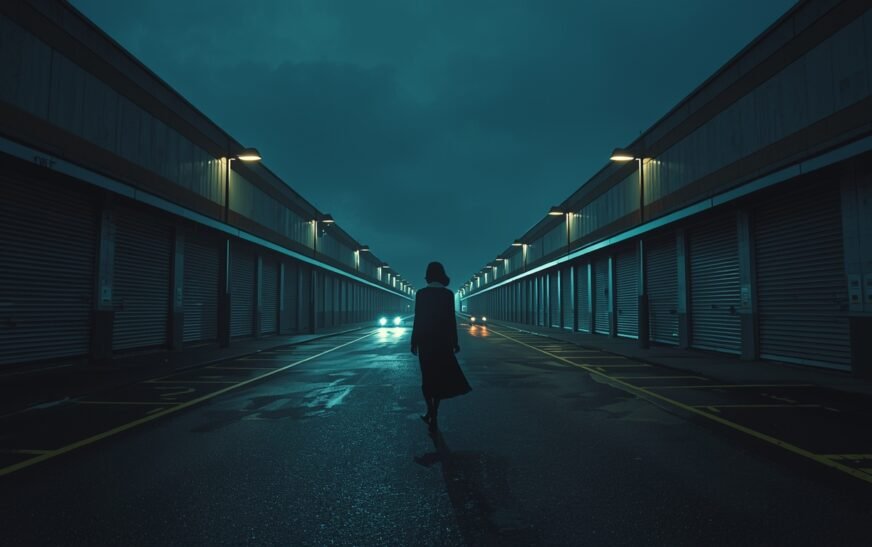
By the fourth night, Nora had started measuring the walk home by the service road.
At first, it was only a shortcut.
The buses were unreliable because of the strike, taxis cost too much after midnight, and the path behind the retail park cut twenty minutes off the journey to her flat. Therefore, practicality chose the route before fear had time to object. She left the call center at 11:08, crossed the employee car park, passed the locked pharmacy loading bay, and entered the narrow lane that ran behind the shuttered stores toward the canal bridge.
Nothing dramatic happened on the first night.
On the second, she noticed how quickly the city disappeared once she turned the corner. Traffic sound dimmed. Music from the ring road dissolved. Even the wind seemed to move more carefully there, as though the blank rear walls of the stores kept ordinary noise out.
By the third night, the quiet had acquired structure.
It waited for her at the mouth of the service road like something punctual.
“You still walking behind the park?” her colleague Dev asked on Thursday while they shut down their terminals.
Nora pulled on her coat. “Until the buses remember they’re public transport.”
He made a face. “I’d rather sleep under my desk.”
“That option remains available.”
Dev laughed. However, when she mentioned the lane behind the loading bays, his expression changed by a fraction.
“Don’t cut past the old delivery road if the lights go out,” he said.
“That sounds like a story invented to improve punctuality.”
“Maybe,” he replied. “Still, don’t.”
Behind the Retail Park
The retail park looked exhausted at night.
By day it sold discount furniture, pet food, flat-pack kitchens, and cheerful things no one needed urgently. After closing, the place lost its performance. Signs went dark. Window displays became ghostly reflections. Metal shutters flattened every shop into the same expressionless face.
The service road ran behind all of that, narrow and functional, bordered on one side by concrete walls and on the other by chain-link fencing beyond which lay the canal path, a strip of brush, and then the black back gardens of houses she never saw clearly. Security lights hung above the loading docks at measured intervals. Painted arrows pointed delivery vans toward bays that slept empty after ten.
Meanwhile, Nora’s footsteps always sounded too loud there.
On Friday night, she entered the lane at 11:16 and felt the air change immediately. The temperature did not drop exactly. Rather, the warmth of the city fell away behind her. In its place came a stillness that felt arranged.
She told herself that empty places always exaggerate thought.
Even so, she kept checking over her shoulder.
Once home, she made tea and opened stories in the Horror and Dark Fear archives, mostly to mock her own nerves. Reading about invented dread should have reduced the real thing. Instead, the mood of those pages only made the walk feel more legible.
The Night the Sound Changed
On Saturday, rain had just finished when Nora left work. The asphalt behind the retail park shone under the loading-bay lights in long silver strips. Somewhere far off, a siren lifted and faded. Then the city sealed itself again.
She walked faster than usual.
Halfway down the service road, she heard another set of footsteps.
Not behind her.
Ahead.
The sound arrived faintly at first, almost hidden under her own pace. Then it became impossible to mistake: a second rhythm striking wet ground several yards in front of her, matching her speed while remaining just beyond the next cone of light.
Nora stopped.
The footsteps stopped too.
She stood very still, listening for breath, movement, fabric, anything human enough to reduce the moment into sense. Nothing came. Only the hum of a high security lamp and the distant knock of something loose against metal fencing.
When she started walking again, the steps resumed ahead of her.
This time she reached the canal bridge almost breathless. At the far end she turned, expecting to see someone emerge from the lane behind the pet warehouse.
No one did.
What Dev Said Later
“You’re overtired,” Dev told her the next evening.
Nora stirred powdered creamer into a machine coffee she did not want. “That diagnosis lacks imagination.”
“Good. Imagination is expensive at 2 a.m.”
She nearly dropped the subject. Then again, dread grows worse when spoken only in the head.
“I heard footsteps,” she said. “In front of me.”
Dev did not laugh.
Instead, he looked toward the blank office windows where their reflections floated over the dark parking lot. “My uncle used to drive deliveries there,” he said. “Before they rebuilt the canal access. He said the back route was longer at night.”
Nora waited.
“Not longer on a map,” Dev added. “Longer while you were on it.”
“That is an extremely useless distinction.”
“I know.”
She wanted him to grin then and admit the joke. He did not.
Later, while waiting for her system to restart, Nora clicked through the Psychological and Secrets & Suspense sections on her phone, looking for words that belonged to what she felt. Nothing fit cleanly. Anxiety was too small. Paranoia was too clinical. What she feared had less to do with madness than with place.
The Camera Above Bay Three
On Sunday night, she almost took the long route home.
Instead, irritation made the choice for her.
Fear had begun to feel embarrassing, and embarrassment is often stronger than caution. So she zipped her coat to the throat, crossed the employee lot, and entered the service road with the deliberate pace of someone refusing to be corrected by a lane of asphalt.
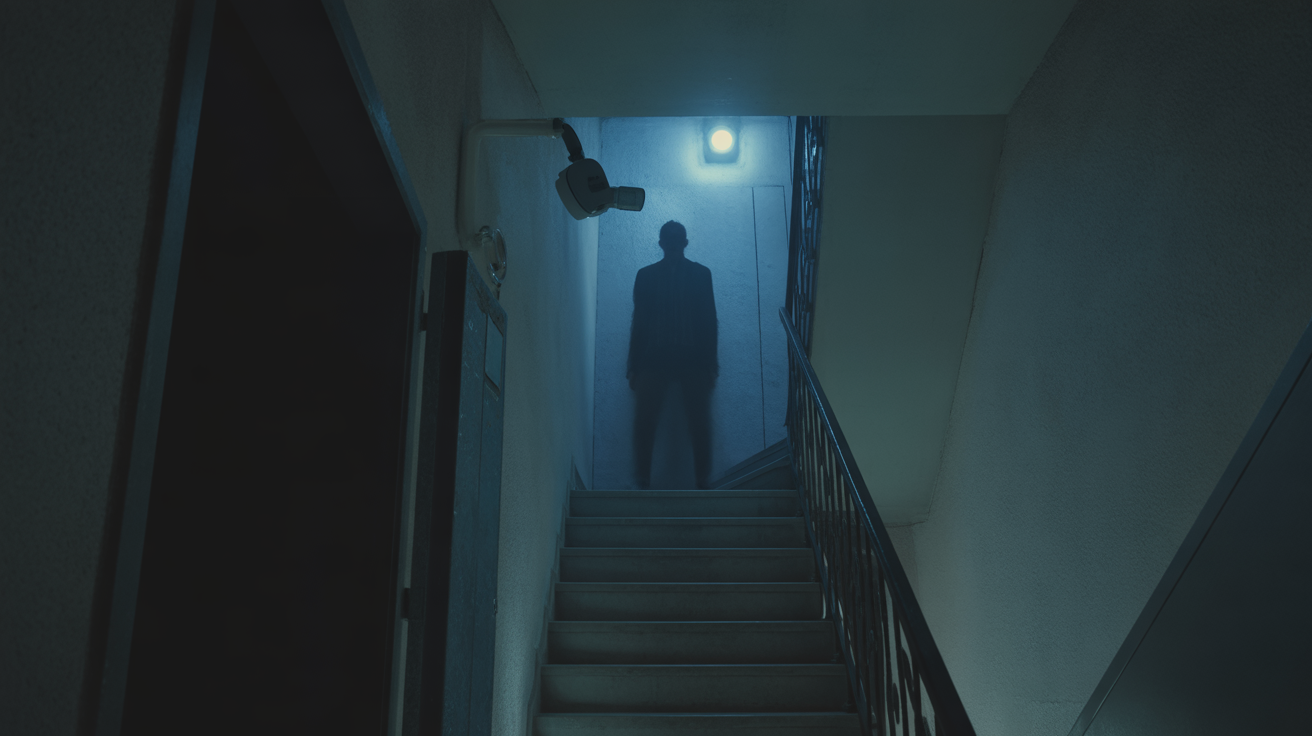
The security camera above Bay Three was pointed down.
She stopped under it and looked up.
The other cameras along the loading bays faced outward at useful angles, each one aimed to watch doors, fencing, or van access. This one was different. Its lens tilted almost directly at the ground, as if it had spent the evening studying where feet were supposed to fall.
Nora told herself that maintenance workers adjusted equipment badly all the time.
Still, she moved on with her shoulders tight.
Near the dark rear wall of the furniture store, she heard the footsteps again. Ahead. Steady. Patient.
Light from the next lamp showed nothing except rain marks on concrete and weeds pushing through cracks near the fence posts. However, the sound remained specific enough to make denial feel childish.
Step. Step. Step.
Her pace shortened.
The sound shortened too.
At the canal bridge, she checked the time. 11:24.
That was impossible. The walk should have taken at least fourteen minutes. Even hurrying, she never reached the bridge before 11:29.
She stared at the screen until her reflection took over the glass.
The Map App
Back in her flat, Nora opened her map history.
She had used the walking route on the first night because the bus strike had rerouted half the city. The app still held the journey in recent searches. Yet when she entered her work address and home again, the suggested path no longer used the lane behind the retail park.
Instead, it sent her along the ring road, over the bright main bridge, and past the late-night supermarket.
She zoomed in.
The buildings were there. The canal was there. The employee car park was there. However, the narrow strip she had been using all week did not appear as a named road at all. It looked like a blank seam behind the stores, service space without access.
Nora searched directly: service road retail park.
No result.
For a moment, she considered messaging Dev. Instead, she opened pages tagged missing time, place-based discomfort, and quiet dread. The terms were irritatingly accurate. Worse than that, they offered no instructions.
The Long Way Refused
Monday brought freezing fog.
Nora left work determined to avoid the shortcut. She crossed the lot, turned toward the main road, and walked as far as the bus shelter before stopping under its clouded plastic roof.
Something was wrong with the sound of the traffic.
The ring road was visible. Headlights moved. A lorry passed. Yet the noise reached her in a muffled way, as though she were listening from indoors. By contrast, the silence behind the retail park felt sharply available, almost nearer than the street she stood beside.
She hated the logic of what happened next.
Instead of continuing toward the bright bridge, she turned back and entered the service road again.
The relief was immediate.
That frightened her more than the footsteps had.
The lane seemed to receive her. The pressure in her chest eased. Her breathing slowed. Even the cold felt more structured there, cleanly arranged between the fences and the loading docks.
Then the first security light went out.
Not with a pop or flicker.
It simply ceased to exist the moment she walked beneath it.
Nora looked back. The lamp behind her still glowed. The one above her remained dark.
Ten paces later, the next light died too.
Where the Road Lengthened
After that, she did not run.
Running would have admitted that the lane wanted something from her, and she was not yet ready to believe in wanting. So she walked quickly, eyes fixed on the bridge she knew should appear after the loading bays ended.
It did not appear.
Bay Seven passed. Then Bay Eight, though she was almost certain there were only six. A shuttered garden-supply unit followed, then a blank wall she did not remember, then another fenced section full of pallets wrapped in black plastic.
The service road kept going.
Meanwhile, the footsteps stayed ahead, always at the edge of hearing, never fast enough to catch, never slow enough to let her overtake.
Nora took out her phone and tried to call Dev. The screen lit her face in a weak blue square. No signal bars appeared. The time read 11:18.
She stared at it.
11:18 had been the time when she entered the lane.
For several seconds, nothing in her body worked properly. Her hands went cold first. Then her mouth. Then thought itself seemed to slip on something invisible, the way shoes skid over wet leaves before the fall registers.
Up ahead, the footsteps stopped.
So did she.
The silence that followed was so complete it seemed almost vocal.
The Space Between the Lights
“Keep walking,” said a voice behind the fence.
It was not loud.
In some ways, that made it worse. Loudness would have made the moment theatrical, and theatre can be resisted. This voice sounded practical, patient, nearly tired.
Nora turned toward the canal side. Fog pressed against the chain-link mesh. Beyond it she could make out only brush, black water, and the pale suggestion of a maintenance path lower down the embankment.
“Who’s there?” she asked.
No answer came at first.
Then, from somewhere parallel to her own position, the voice said, “Not too slowly.”
She backed away until her shoulders touched concrete.
Something moved beyond the fence, not crossing toward her, only keeping pace with the space she occupied. Branches shifted once. Then stillness returned. No face showed. No hand reached through. Yet the certainty of a presence settled over the lane with intimate precision.
Nora began walking again because standing still suddenly felt like a choice she would regret.
The security lights ahead did not turn on. One by one, however, they woke behind her.
After the Bridge
She reached her flat at 4:12 a.m.
That was what the oven clock said when she stumbled into the kitchen with wet shoes, numb fingers, and the taste of metal at the back of her throat. Her phone battery was nearly dead. The call-center lanyard around her neck had cut a red line into her skin. Gravel lay in the cuffs of her trousers as though she had walked somewhere rougher than asphalt.
At first, she thought she had fainted and invented the rest.
Then she checked her notifications.
Seven missed calls from Dev.
Two messages from her supervisor.
The first read: Where are you? You left over four hours ago.
The second, sent later: Call me when you get in. Please.
Nora sat at the kitchen table until dawn bleached the window.
By morning, the city looked brutally ordinary. School traffic formed at the crossing. Delivery vans blocked half the side street. Somewhere downstairs, a child practiced the same six notes on a keyboard with impressive persistence. Ordinary noise had returned, and yet it seemed thinner than before.
She did not go to work that night.
Instead, she searched the retail park on three different maps. None showed a walkable road behind the stores. One satellite view suggested only fencing and service yards. Another displayed a strip of dark ground where the lane should have been, blurred as though the image had stitched badly.
Later, unable to stop herself, Nora opened stories in Thriller and Mind Games, hoping genre might insult what had happened into unreality. It did not.
The Following Night
On Tuesday, the buses resumed.
Dev texted twice asking whether she was alive, then once more to say he was serious. Nora almost answered honestly. Instead, she wrote that she had been ill and needed another day. He sent back a thumbs-up and, a minute later, Don’t take the back way again.
At 11:18 p.m., she stood at her kitchen window.
From the sixth floor, she could not see the retail park itself. However, the glow above that side of the district was visible beyond the rooftops: a low commercial haze, white and indifferent. Rain touched the glass in small diagonal lines. Somewhere far off, a siren moved toward the canal and away again.
Nora should have felt safe. After all, she was indoors. The buses were running. The route home had returned to public existence.
Nevertheless, she found herself listening.
At first, she heard only the building. Pipes settling. A distant television. The muted lift motor rising and falling through the shaft.
Then another sound reached her, thin but exact.
Footsteps.
Not in the corridor.
Not on the stairs.
They were coming from outside, far below, keeping a patient rhythm along the pavement no map would name. Step. Step. Step. Then, just for a moment, they stopped directly beneath her window.
Nora did not move toward the glass.
She remained where she was, hands flat on the sill, while the city held its breath around her.
Finally, the steps resumed and went on into the dark, heading nowhere she could see.