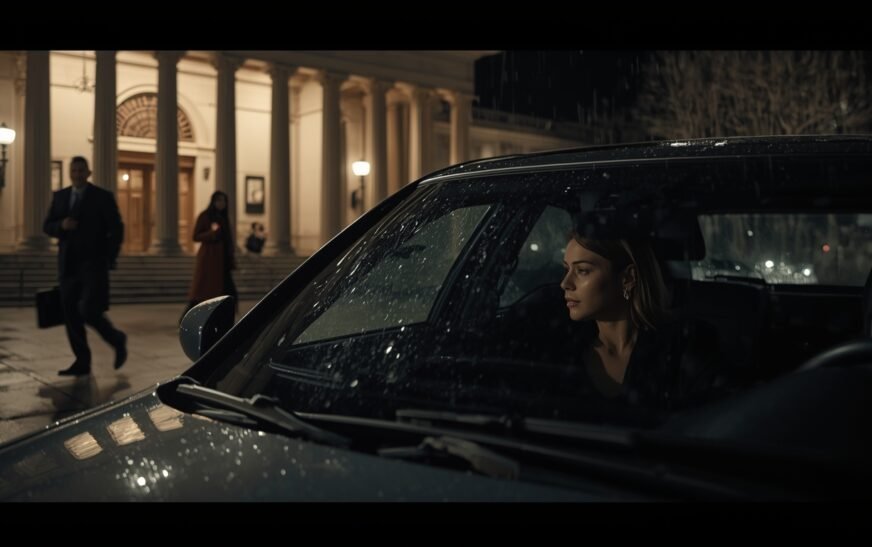
Mara noticed the missed signal before she admitted what it meant. It happened outside the civic hall on a windy Thursday, while folding chairs scraped the polished floor and the volunteers laughed too loudly for the late hour. Nothing had shattered. No secret had fallen from a pocket. Still, by the time she reached the car, the evening felt split cleanly in two.
For six years, Owen had driven her home after every planning meeting for the neighborhood arts fund. He always waited by the side entrance with the patient look of a man who understood her tiredness before she named it. That night, however, he stayed inside beneath the warm lights, speaking to Celia from the sponsorship committee as if time belonged to them both.
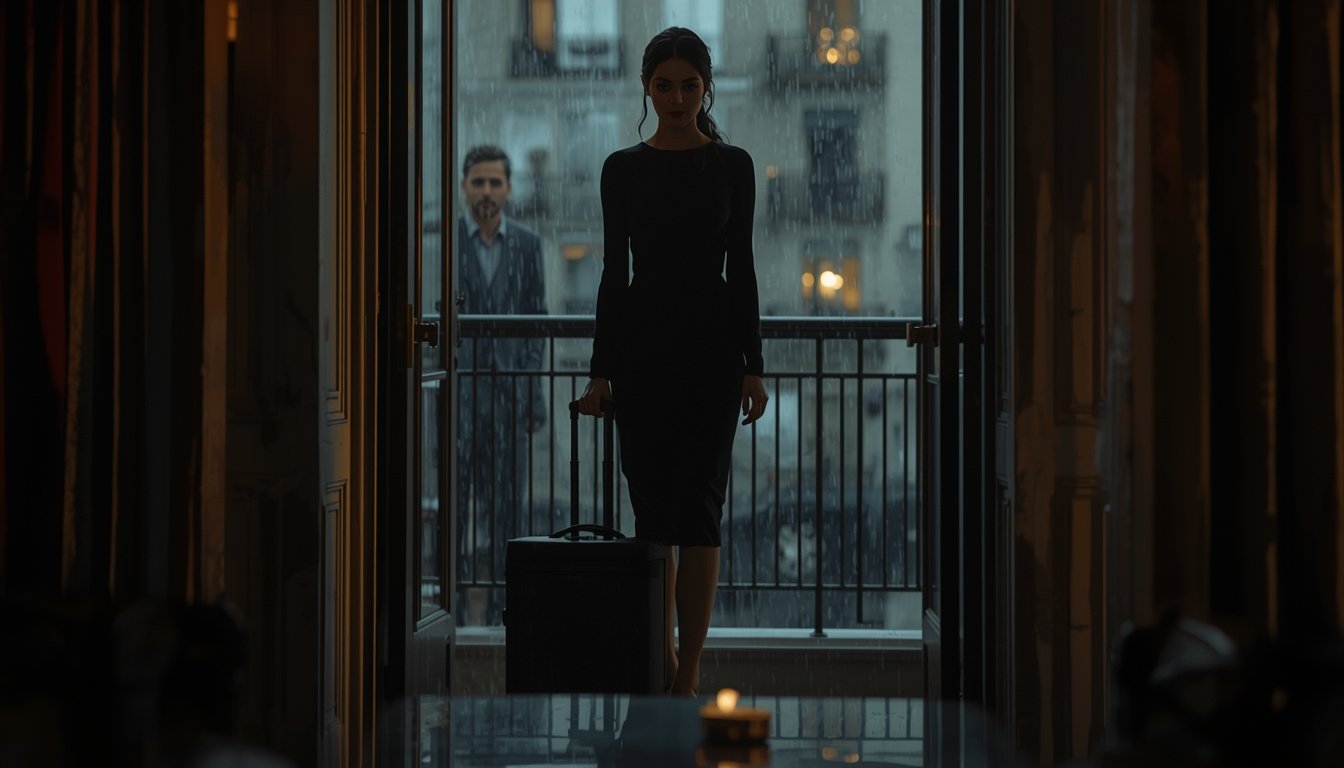
Mara stood under the awning for a moment longer than pride allowed. Meanwhile, rain threaded down the curb in thin silver lines. Someone behind her locked the hall doors. Across the lot, Owen glanced up once, saw her, and lifted a hand in apology that never became movement.
When the missed signal arrived
At first, Mara told herself not to be dramatic. People lingered after meetings. Weather delayed everyone. A harmless conversation could stretch. Nevertheless, something in Owen’s face unsettled her. He looked comfortable in her absence.
That was new.
Usually, his attention found her even across crowded rooms. He checked whether she had eaten, whether she had her umbrella, whether the strap of her bag was cutting into her shoulder. Small gestures had built their life more than declarations ever did. Therefore, the lack of one simple movement—walking toward her—felt heavier than it should have.
Her phone buzzed.
Two minutes, he wrote.
Mara read it, then looked through the glass doors again. Celia was smiling, one hand resting against the edge of the registration table. Owen leaned in to hear her over the noise, and Mara felt a strange chill because the room itself was warm.
Two minutes became seven.
By then, most of the volunteers had gone. The florist from Main Street passed Mara with a sympathetic smile and said, “Long night?” Mara answered with a small laugh she did not recognize as her own.
The ride that did not begin
Later, Owen came out carrying both his coat and hers, as if that canceled the waiting.
“Sorry,” he said. “Celia needed the final donor numbers.”
Mara took her coat from him. “You looked busy.”
Rain tapped the awning above them. Somewhere down the block, a bus sighed to a stop. Owen unlocked the car, yet he did not open her door the way he usually did.
That, too, should have meant nothing.
Instead, she heard herself ask, “Why didn’t you just tell her it could wait?”
He paused with his hand on the handle. “Because it was quick.”
“It wasn’t.”
For a moment, he seemed more tired than guilty. “Mara, do you want to do this in the rain?”
She almost said no. After all, they had mastered postponement in recent months. Small hurts were tucked into later, then buried under errands, dinner reservations, utility bills, and kind voices. However, the night felt too sharp to waste.
“I want to know why I was standing out here,” she said, “while you kept talking.”
Owen looked past her toward the street. “You’re making it bigger than it is.”
That sentence landed harder than the delay.
Inside the car
The heater clicked on when they started driving. Warm air filled the silence, but it did not soften it. Mara watched the wet reflections of traffic lights stretch across the windshield like torn ribbon.
Owen drove with both hands on the wheel. He had a careful face when he was thinking, and once she had loved that expression because it made the world seem solvable. Then again, care could resemble distance if held too long.
“You’ve been elsewhere for weeks,” she said.
“I’ve been busy.”
“Busy isn’t the same thing.”
He exhaled. “You want me to say I’m distracted? Fine. Work is ugly right now. The board keeps changing direction.”
Mara looked out at the dark storefronts sliding past. “This isn’t about the board.”
He did not answer. Meanwhile, the wipers moved back and forth with a patient rhythm that felt almost mocking.
At the next intersection, the light turned yellow. Owen usually accelerated through that one because the timing was short. Instead, he slowed too early and let it go red.
Mara stared at the signal overhead.
“Interesting,” she said quietly.
“What?”
“You never stop there.”
“I did tonight.”
“Yes,” Mara said. “Tonight you did.”
Neither of them mentioned the phrase in her mind: missed signal. Still, it stayed between them with a presence of its own.
The new kindness
By contrast, the worst changes in love were rarely cruel at first. They became kinder. They became polished. They became so careful that honesty started to look indecent.
Owen had been kind all month.
He remembered to buy the tea she liked. He texted when meetings ran late. He asked about her sister’s migraine, her editor’s mood, the plumber’s estimate, the dry cleaning. However, he had stopped arriving with appetite. Desire, annoyance, curiosity, impatience—those rough living things—had flattened under a gentleness too controlled to trust.
Mara finally said, “Are you trying not to hurt me, or are you trying not to say something?”
His grip tightened on the wheel. “That’s not fair.”
“No. Fair would have been leaving with me when you saw me waiting.”
The car rolled through another slick intersection. A late train sounded somewhere beyond the river, low and mournful.
“Celia is easy to talk to,” Owen said, so softly she almost missed it.
Mara turned toward him. “That’s what this is?”
“I didn’t say that.”
“You didn’t have to.”
He shook his head, frustrated now. “Nothing happened.”
“You think betrayal begins after something happens?”
This time, he had no answer.
A stop under white lights
Later, Owen pulled into a twenty-four-hour pharmacy lot because the rain thickened and visibility blurred. The sign above them cast a cold wash over the dashboard. For a moment, Mara could see both of them clearly: two careful adults sitting inside a lit box, speaking as if volume might break whatever still looked intact.
“Look at me,” she said.
He did.
“Have you been telling her things you don’t tell me?”
“Sometimes.”
Honesty should have been noble. Instead, it felt late.
Mara folded her hands in her lap because she did not trust them to stay still. “What things?”
“That I’m tired. That I don’t know what I’m doing next year. That I feel…” He looked down, then back up. “That I feel calmer around her lately.”
The pharmacy lights hummed above the rain.
“Calmer,” Mara repeated.
“I know how that sounds.”
“Do you?”
His expression changed then. Regret moved across his face, but it did not look new. It looked practiced.
Mara understood something cold and exact: the real wound was not Celia. The wound was duration. He had been living beside her while stepping away in private, choosing softer places to set down parts of himself that once belonged at home.
What he would not name
“Did you want me to notice?” Mara asked.
“No.”
“Did you think I wouldn’t?”
Owen laughed once, without humor. “I thought I had more time.”
The sentence seemed to darken the whole car.
“Time for what?”
He leaned back against the seat. “To understand it before I hurt you with it.”
“You are hurting me with it.”
“I know.”
For a moment, neither moved. Rain climbed and collapsed down the windshield. A woman in a red coat hurried across the lot carrying a paper bag against her chest. Meanwhile, life continued around them with an almost indecent steadiness.
Mara thought of all the evenings that had felt slightly misaligned lately. The dinners where Owen had smiled a second too late. The mornings when he kissed her forehead instead of her mouth. The way he had started volunteering for errands alone. Small shifts. Quiet edits. A whole emotional migration hidden inside ordinary days.
“Are you in love with her?” she asked.
“I don’t know.”
“That means yes enough.”
The route they always took
When they started driving again, Owen turned toward home by habit. The familiar route passed the river, the shuttered bookshop, and the corner bakery that opened before dawn. Mara had loved that route because it meant an evening was ending in known hands.
Tonight, however, every landmark felt rearranged.
They passed the old cinema, and Mara caught sight of a poster case lit from within. It reminded her of the kinds of stories she loved on quiet, emotionally charged drama, where collapse happened through timing rather than spectacle. She almost laughed at the thought. Life had less style and more damp upholstery.
At the river light, Owen said, “I never meant to humiliate you.”
“That’s generous,” Mara said. “Humiliation implies an audience. This was lonelier than that.”
He looked stricken, and she hated that part of herself still softened at the sight. Still, pity was not repair.
“I kept waiting for us to feel normal again,” he said. “I thought if I pushed through work and kept things steady, it would pass.”
“Instead, you practiced leaving.”
His silence accepted the sentence.
Mara stared ahead and thought of the kinds of stories buried in marriage and secret vows, where people imagined betrayal as locked drawers and hidden names. Her life had given her something plainer. It had given her absence with excellent manners.
The place where the truth settled
Owen parked outside their building but did not turn off the engine.
Streetlight slid across the hood in pale bands. Upstairs, one apartment window glowed gold behind half-closed blinds. Somewhere in the alley, a bottle rolled and hit brick.
“Say the whole thing,” Mara told him.
He closed his eyes briefly. “I don’t know if I can stay and keep pretending I’m fully here.”
The engine idled between them.
Mara expected tears, rage, some dramatic surge. Instead, a strange calm moved in. Perhaps it arrived because the waiting was over. Perhaps clarity always felt colder than fear.
“Thank you,” she said.
Owen turned sharply. “For what?”
“For finally speaking in a language that matches your behavior.”
He flinched.
Later, she would remember that expression with a tenderness she did not yet want. For now, she looked at the building entrance and imagined climbing the stairs alone. The thought frightened her. Even so, it also felt cleaner than another month of interpretation.
“Was tonight the first time you let me stand outside on purpose?” she asked.
He swallowed. “No.”
That answer hurt more because it was not theatrical. It was simply true.
After the missed signal
The missed signal had not happened at the traffic light. It had happened long before, in every withheld glance and every delayed reply. It had lived in his gentleness, his softened voice, his tidy concern. Therefore, the moment outside the civic hall only made the pattern visible.
Mara touched the door handle but did not open it yet.
“I won’t compete with a version of you that has already gone elsewhere,” she said. “Not with Celia. Not with your confusion. Not with your politeness.”
“Mara—”
“No.” She looked at him then, finally without searching for what might return. “This is where I stop helping you leave me kindly.”
Rain eased to a fine mist. The windshield no longer needed the wipers. Across the street, a couple hurried beneath one umbrella, shoulders pressed together, laughing at nothing she could hear.
Owen’s voice broke on her name again, but she had already reached the point beyond persuasion.
There were stories of romance under pressure and stories of dangerous attraction in passing moments. This was neither. This was the quieter architecture of loss.
What she carried upstairs
Mara took her bag, stepped out, and closed the door without slamming it. The night air smelled of wet stone and distant diesel. Behind her, the engine kept running for several seconds, then finally went silent.
She did not turn around.
Inside the building, the stairwell light flickered once before settling. Her hand trailed along the rail as she climbed. The familiar walls looked different, not haunted exactly, but newly honest. By contrast, the apartment above felt uncertain only because she would now have to occupy it without illusion.
Halfway up, she stopped and let herself breathe.
Her thoughts moved strangely, collecting fragments. The old ache of emotional distance. The sting of quiet betrayals. The kind of fracture found in relationship fallout and late-night arguments. Somewhere in that list was the shape of her life tonight, though none of the phrases captured the exact weather of it.
At her door, she unlocked the apartment and entered the dim front room. The lamp near the sofa threw a soft amber pool over the rug. Owen’s book still lay open on the armrest. A half-watered fern drooped by the window. Nothing had changed, and therefore everything had.
The room without performance
Mara set down her keys and stood in the quiet. She thought of all the stories people told themselves to survive endings. Maybe there had been warning signs. Maybe love could recover through discipline. Maybe loyalty counted more than feeling. Then again, maybe one honest rupture was kinder than a season of managed tenderness.
She crossed to the window and looked down at the street. Owen’s car was gone.
For a moment, grief rose so quickly it bent her forward. She let it come. No audience waited. No graceful line needed delivering. Her face crumpled; her breath caught; the apartment received it all without judgment.
After that, she straightened and wiped beneath her eyes with the heel of her hand.
The night would be long. Later, she would call her sister. Tomorrow, she would decide whose name stayed on the lease and whether the coffee mugs should remain together in the same cabinet. Meanwhile, the first necessary act was simpler.
Mara walked through the apartment, turning on lights one by one.
In the kitchen, in the hall, in the bedroom doorway, brightness gathered slowly against the dark. It was not triumph. It was not relief. Ultimately, it was only refusal—the quiet refusal to keep living inside someone else’s hesitation.
And that, finally, was enough for the night.
She stood in the lit apartment and understood the shape of the missed signal with painful clarity. Love had not ended in one confession. It had ended in the long interval before it, while she was still waving from the curb and believing he would cross the room.
Outside, rain began again, soft as breath against the glass.
Inside, Mara did not wait for anyone to come downstairs.