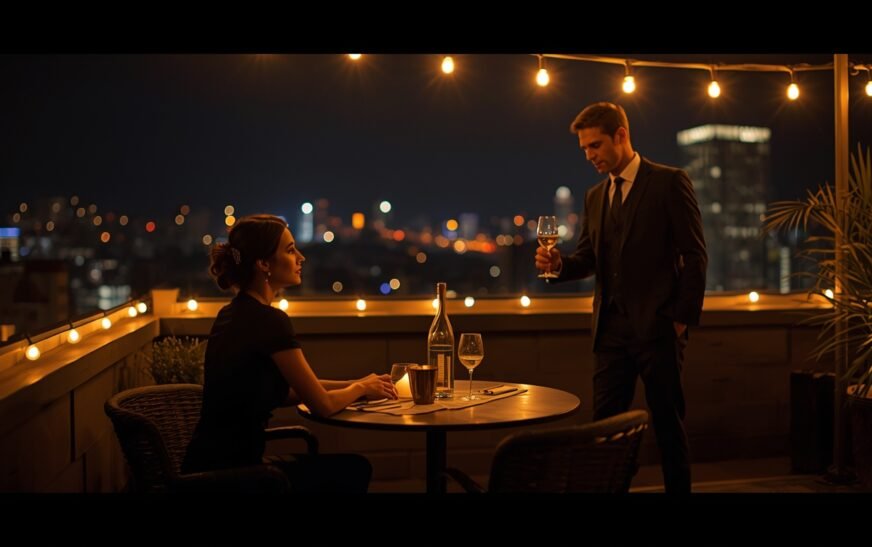
Mara first noticed the balcony table because it was the only place at the rooftop engagement party where no one seemed to be performing happiness too loudly. Beyond it, the city spread in wet gold under a warm June haze. Behind it, guests clustered around the bar in satin dresses and dark jackets, balancing cocktails and opinions with equal care. Mara had come to celebrate her friend Lila, smile through two hours of polite questions, and survive another late message from Jonah explaining why he would “try to make it soon.” Instead, by the time the candles were lit near the cake, the empty chair across from her began to feel more honest than the relationship she had spent six months defending.
The invitation had said plus one welcome. Jonah had said he would come after a client dinner. Then he had pushed the time back twice, each delay arriving in a warm, efficient message that made absence sound almost considerate. Therefore, Mara kept checking her phone with the quiet shame of someone helping a bad pattern continue.
At 8:41, a server paused beside her chair. “This balcony table is reserved for two from the host list,” he said apologetically. “Would you mind if I seated someone here until the speeches begin?”
Mara glanced at the empty place setting opposite her. “That depends. Is the someone difficult?”
The server smiled. “He seems too calm for that.”
The man who arrived with no performance
A moment later, the man appeared carrying his own drink rather than letting the server return with it. That detail should not have mattered. Even so, it made him seem separate from the rest of the evening.
He was not flashy enough to dominate a room. Black suit, open collar, no tie, hair still slightly damp as if he had arrived in a hurry and refused to look theatrical about it. However, his stillness had its own kind of gravity. He set down his glass, nodded once, and said, “I’m told I’m temporarily borrowing half your table.”
“Only until the speeches,” Mara replied.
“That sounds almost diplomatic.”
“I came prepared for diplomacy.”
A quieter smile touched his mouth. “Elias.”
“Mara.”
He sat without crowding the air between them. Meanwhile, the party behind them swelled with laughter near the string lights. Somewhere by the bar, someone dropped a spoon and three people reacted as if it were an anecdote.
“How do you know Lila?” Mara asked.
“Her fiancé is my cousin.”
“Then you’re on the family side.”
“Reluctantly represented,” he said. “And you?”
“Bride side. Also reluctant, but for different reasons.”
That earned a real laugh, brief and low. It changed his face more than she expected.
Why she had chosen the edge of the party
At first, Mara had taken the table because the rooftop crowd felt overlit. She knew enough people there to be visible and not enough to feel held by them. Lila’s colleagues from the design firm were stylish in a way that made every simple sentence sound curated. The groom’s relatives seemed kind but observant. By contrast, the outer edge of the terrace offered distance, city air, and one uninterrupted view of the skyline.
Elias followed her glance toward the rail. “You picked the only quiet place.”
“I prefer parties in theory.”
“Most elegant rooms are better from the perimeter.”
Mara smiled despite herself. “That sounds practiced.”
“It sounds learned.”
He lifted his glass but did not drink. She noticed then that his cuff button had come loose on one side. Not enough to seem careless, only enough to make him real.
Her phone lit.
Still at dinner. Don’t wait to eat.
Jonah, again.
Mara locked the screen face down on the table. For a moment, she hoped Elias had not seen her expression. Then again, something in his manner suggested he would have the decency not to use it against her.
“Bad news?” he asked.
“Predictable news,” she said.
He nodded as though that distinction needed no translation.
The speech before the speeches
Before either of them said more, Lila appeared in a white silk dress with one heel already in her hand and kissed Mara’s cheek with breathless affection.
“You made it,” she said. “You look devastatingly composed, which I assume means you’re irritated with someone.”
Mara laughed. “You should probably go host your own engagement party.”
“In a minute.” Lila turned to Elias. “Oh, good, you’ve met. He’s one of the only people here who can survive my fiancé’s family without needing a corridor break.”
“That sounds like an insult disguised as praise,” Elias said.
“Exactly.” Lila squeezed Mara’s shoulder. “Jonah still coming?”
The question landed too openly.
“Apparently later,” Mara replied.
Lila’s face softened for one brief second. Then she said, “Well, later is still a time,” with the false brightness of a friend trying not to ruin her own party by noticing too much.
After she left, the silence at the balcony table changed texture.
“You’re allowed not to defend him to a stranger,” Elias said.
Mara looked at him. “That is a strangely precise thing to say.”
“It seemed useful.”
For a moment, she considered denying everything out of habit. Instead, she asked, “Do I look that obvious?”
“No,” he said. “You look practiced.”
The man she kept explaining away
Jonah was not cruel. That had become the problem. Cruel men were easier to leave because the evidence arranged itself. Jonah specialized in polished delays. He forgot nothing essential. He sent flowers after hard weeks, remembered her sister’s exam dates, and used endearments exactly often enough to keep tenderness looking available. However, he had started arriving at the relationship the way some people arrived at parties they were not sure they wanted to attend: late, charming, and prepared to leave before helping stack chairs.
Mara had spent months translating him into a kinder language.
He’s tired.
Work is brutal right now.
He’s just distracted.
Those sentences had once felt loyal. Lately, they had begun to taste like self-erasure.
Elias was looking at the skyline again, giving her room to remain silent. That restraint affected her more than attention would have.
“What about you?” she asked. “Did you come alone out of principle or scheduling failure?”
“Principle,” he said. Then he added, “And recent evidence.”
“That sounds either wise or bitter.”
“A polite mixture.”
The answer invited no pity. Therefore, Mara trusted it more.
When the music lowered
Later, the rooftop band shifted from bright covers to slower instrumentals while guests moved toward the center of the terrace for speeches. Servers replaced empty glasses with new ones before anyone could ask. The whole party became more golden, more flattering, and somehow less believable.
Mara and Elias remained at the edge.
“You’re not joining the family cluster?” she asked.
“They become emotional in groups.”
“And you dislike emotion?”
“I dislike public choreography,” he said. “Private emotion is usually clearer.”
She turned that over for a moment. “That sounds true enough to be dangerous.”
“I was hoping for useful rather than dangerous.”
“Useful is rarely why people say true things at parties.”
He met her gaze then. String lights caught briefly in his eyes before the city took them back. “Why are you still waiting for him tonight?”
The question should have offended her. Instead, it felt almost merciful because it arrived without mockery.
“Habit,” she said.
“That’s honest.”
“No,” Mara replied. “That’s the edited answer.”
A pause opened between them, soft rather than strained. Finally, she said, “I’m still waiting because admitting I’m embarrassed would force me to decide what the embarrassment means.”
Elias nodded once. “That sounds more expensive.”
What he noticed from the next chair
The speeches began. Lila’s fiancé thanked everyone with the luminous sincerity of a man too in love to sound rehearsed. Lila cried halfway through her own toast, laughed at herself for crying, then cried harder when the crowd applauded. Even the groom’s severe aunt pressed a handkerchief to one eye.
Mara clapped when everyone else did. Meanwhile, her phone remained dark on the table.
“He won’t come before the cake,” Elias said quietly.
She exhaled once through her nose. “That is a bold prediction.”
“No. It’s timing.”
“You sound confident.”
He glanced toward the stairwell entrance where late guests usually appeared. “Men who still intend to arrive make their delays feel urgent. Men who want credit for trying send calm messages.”
Mara looked at him fully then.
“That is devastatingly specific.”
“I was once very calm while disappointing someone,” he said. “I dislike recognizing the method.”
There it was again, that quiet refusal to flatter himself. She felt a dangerous warmth move through her chest, not because he was offering rescue, but because he was refusing performance.
Then her phone lit at last.
Don’t wait up if it runs too late. I’ll make it up to you tomorrow.
No apology. No hour. No actual plan.
The cake under the lights
A cheer rose as the cake appeared beneath sparklers. Guests crowded inward with their glasses raised. The city beyond the terrace looked farther away now, as if the party itself had drawn a bright circle around its chosen happiness.
Mara read Jonah’s message twice, then set the phone down with a steadier hand than she expected.
“There it is,” Elias said.
“Yes.”
“Do you want me to say something reassuring and false?”
Despite everything, she laughed. “No.”
“Good. I’m out of stock.”
The band began a slow song that encouraged couples toward the open space near the rail. Lila and her fiancé moved first, clumsy and pleased, while cameras lifted around them like a field of patient mechanical flowers.
“You should go congratulate your friend,” Elias said.
“I will.”
“And then?”
Mara looked toward the dance floor, toward the clustered brightness, toward the life she had thought she was still negotiating with Jonah. “And then I stop calling lateness a personality trait.”
Something in Elias’s expression gentled. “That sounds overdue in the healthiest possible way.”
The dance she did not expect
After the cake was cut and the first round of photographs ended, Lila pulled Mara into a fierce one-armed embrace.
“He’s not coming, is he?” she asked softly against Mara’s hair.
“No.”
Lila drew back. “I’m sorry.”
“Don’t be. It’s your party.”
“That’s not how friendship works.”
Mara smiled with more effort than grace. “Then give me sixty seconds to be dignified, and we’ll discuss it tomorrow.”
Lila glanced over Mara’s shoulder toward the quiet edge of the terrace where Elias still stood near the balcony table, one hand around his glass, not watching too obviously. “I support any decision that makes tonight less awful,” she murmured, and let her go before Mara could answer.
When Mara returned to the outer rail, the band had moved into something slower and lower, more intimate than celebratory.
“Your friend seems observant,” Elias said.
“That’s a generous word for meddling.”
He set down his glass. “Then allow me one small act of strategic interference.”
Mara raised a brow. “Which is?”
“One song,” he said. “No promises attached.”
She should have refused. Instead, the night had already clarified itself too cleanly for politeness to remain useful.
“All right,” she said.
One song at the edge of the terrace
He did not pull her into the center where the engaged couple shimmered under cameras and approval. Instead, he led her only a few steps from the balcony table, close enough to the rail that the city remained visible beyond his shoulder.
His hand at her waist was careful, almost formal. Her own fingers rested lightly at his sleeve. They were not close enough to cause a scene. Even so, the space between them felt charged because neither was pretending the moment was innocent.
“You dance like a man who hates being watched,” Mara said.
“I dance like a man attempting not to waste a useful exception.”
“That is an absurd line.”
“Still here, though.”
The music moved around them with elegant restraint. Warm air carried the scent of citrus, candle wax, and summer rain not yet fallen. Somewhere behind Mara, glasses clinked. Somewhere below, traffic slid through the city with patient indifference.
“You’re very calm,” she said.
“No,” Elias answered. “I’m careful.”
The distinction reached her with disarming force.
Because careful was not the same as detached. Careful implied effort. Careful implied he understood the edge of the moment and had no intention of using it cheaply.
What the song clarified
When the music thinned toward its ending, Mara realized the night had split into two clean versions. In one, Jonah arrived late with an apology smooth enough to delay consequences until Monday. In the other, she finally stopped translating absence into something flattering. The dance had not created that distinction. It had only lit it more clearly.
Elias loosened his hand at her waist before the song fully ended, leaving her space to step back first.
“Thank you,” she said.
“For the dance?”
“For not making it into something cheap.”
His expression changed, warming without losing its restraint. “That was never the plan.”
Behind them, another cheer rose from the bar. Someone called for more champagne. The rooftop had gone deeper into celebration, while Mara felt herself moving in the opposite direction, toward something colder and more accurate.
After the balcony table
When the song ended, neither stepped back at once. Then again, neither crossed the final inch either. That restraint made the whole exchange feel more dangerous than a kiss would have.
Mara’s phone buzzed one last time in her clutch. She did not reach for it.
“That seems important,” Elias said quietly.
“No,” she replied. “It only seems repeated.”
The answer surprised them both.
At last she took out the phone and looked. Another message from Jonah. Another smooth arrangement of regret and tomorrow.
She turned the screen dark again.
The city below the terrace looked sharper now. Lights held their edges. Music no longer blurred anything worth seeing clearly. Ultimately, the evening had given her less romance than precision, and precision was rarer.
Readers who love flirty stories often stay for the tension in dating fiction, the ache of romantic restraint, the pull of dark romance, and the quiet pressure inside secrets and suspense.
Meanwhile, this night carried traces of social pressure, quiet attraction, late arrival, party night tension, emotional awakening, restrained desire, and relationship doubt that had little to do with temptation and everything to do with timing.
The choice at the stairwell
Mara slid the phone back into her clutch and looked once more at the balcony table, the two glasses, the empty chair that had told the truth before anyone else did.
“What happens now?” Elias asked.
She let the summer air settle against her skin before answering. “Now I go home alone,” she said. “And for once, I mean it in a useful way.”
His expression changed, not toward disappointment, but toward respect. That, more than anything, made her trust the choice.
Then she smiled, touched two fingers briefly to the back of the chair she had occupied all evening, and walked toward the stairwell without waiting for Jonah to revise the night again.