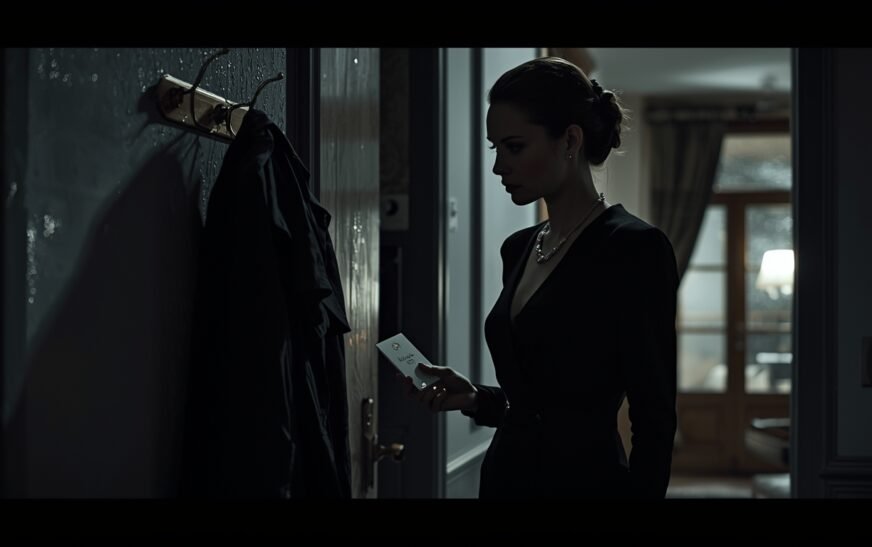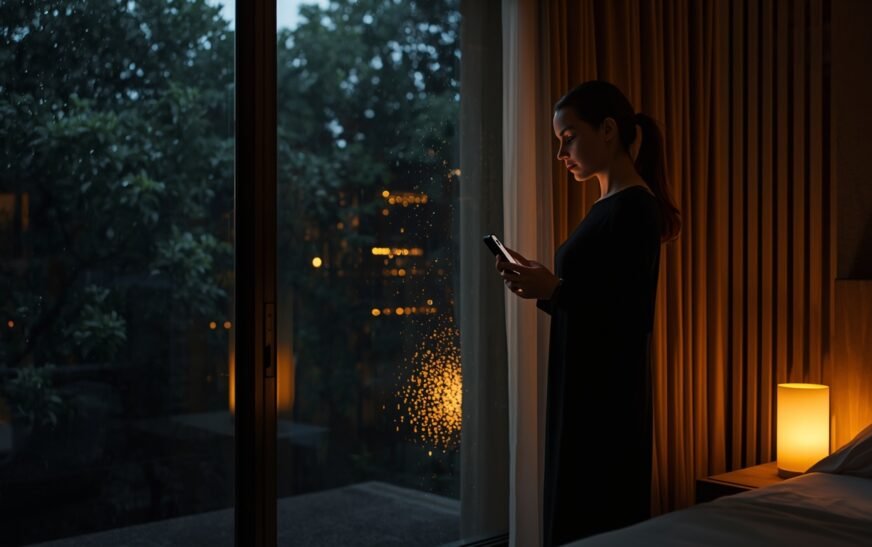
Elara first noticed the sleep score at 6:11 on a gray Saturday morning, when the retreat app lit her phone with a soft chime and informed her that she had slept poorly in the most elegant language possible. She was at Vesper Pines, a luxury wellness hotel built deep in cedar country for couples with expensive stress and carefully collapsing communication. Rowan had booked the weekend after one too many gentle arguments about distance, timing, and the way he had begun speaking to her as if everything difficult in their relationship needed better framing rather than truth. Therefore, when the app displayed her low sleep score beneath a calm blue circle, Elara almost laughed. The hotel had found a prettier way to tell her she was tired.
Outside their suite, rain moved through the trees in silver threads. Inside, everything had been designed to lower a person’s pulse: limestone floors warmed from beneath, cream curtains, herbal tea lined up on a lacquered tray, a handwritten card welcoming them to “restorative honesty.” Even so, Elara had barely slept. Rowan had fallen asleep quickly beside her, breathing with enviable steadiness while she lay awake listening to the ventilation system and thinking how strange it was that he could still look peaceful inside a life that lately felt arranged rather than shared.
At first, the retreat seemed harmless. There had been yoga mats, cedar steam, low voices in the lobby, and staff members who spoke as if every sentence had already been approved by a physician and a poet. Still, the sleep score sat on her screen with more authority than it deserved. By contrast, her own body felt less simple: alert, guarded, and unwilling to be translated into clean numbers.
Why Rowan booked the weekend
He called it a reset.
Two weeks earlier, Rowan had come home from work with a brochure folded into his coat pocket and the polished determination he often mistook for tenderness. He worked in brand strategy, which meant he trusted language more than almost anyone Elara knew. Over the years, that had once made him witty, attentive, and unusually good at saying the right thing in crowded rooms. Recently, however, it had made him dangerous in smaller spaces.
“We keep circling the same arguments,” he had said at their kitchen island. “Maybe we need help stepping outside them.”
Elara had looked at the brochure. Forest retreat. Couples recalibration. Rest metrics. Guided trust sessions.
“That sounds expensive,” she said.
“It sounds structured.”
There it was. Not comfort. Structure.
Because she was tired of trying to explain why his new calm unsettled her more than open frustration ever had, she agreed. Then again, exhaustion often signs what instinct would reject in daylight.
The first meal in silence
Breakfast was served in a glass dining room overlooking wet pines and a pond too still to be natural. Guests wore soft cashmere, pale sneakers, and the peculiar expressions of people trying to appear receptive without revealing too much about what had brought them there.
Rowan arrived dressed already, his hair still damp from the shower, his retreat wristband sitting neatly beside his watch.
“How did you sleep?” he asked.
Elara lifted her coffee. “Poorly enough to receive a digital judgment.”
He smiled. “Mine said eighty-nine.”
“Congratulations on your medical excellence.”
Instead of laughing, Rowan glanced at her phone. “What did yours say?”
“Low enough to feel insulted.”
He paused, and that pause mattered.
“That explains last night,” he said.
Elara looked up. “Explains what?”
“You seemed tense.”
The sentence was mild. Nevertheless, it altered the table.
Rain tapped softly at the glass. Meanwhile, a server set down poached pears and oat cakes as if no one had just introduced diagnostic language into breakfast.
“I seemed tense because we were at a retreat designed by people who think breathing should be curated,” she said.
“Or because you’re more tired than you realize.”
The softness in his tone made the remark worse. A harder version could have been argued with. This sounded like care while functioning as dismissal.
What the retreat app collected
After breakfast, a wellness guide named Mara took their group through orientation in a cedar-paneled studio lined with folded blankets and bowls of sliced citrus. She was dressed in dove gray, spoke in a low measured voice, and moved as if sudden gestures had been removed from her life by contract.
“Your devices help us support your stay,” she said. “Sleep patterns, mood check-ins, reflective journaling, and stress readings give us a fuller picture.”
Elara looked down at the app on her phone. She had tapped through setup too quickly the night before, half listening while Rowan unpacked. Now she saw the sections more clearly: sleep, meals, pulse variation, emotional log, partner insights.
Partner insights.
Her thumb hovered over the screen.
Mara continued, “If you choose to share, your paired guest can see selected patterns that improve communication.”
Rowan glanced at Elara, then back to the front. That small movement made something cold and exact settle in her chest.
Because she knew his habits, she knew what had happened. He had read every line of setup. He had probably enabled everything that sounded useful, collaborative, and optimized.
The session on reflective language
Later that morning, they sat opposite one another in a private consultation room with a therapist called Simon, whose office overlooked a stand of black firs and contained no visible books that might suggest unpredictability. A brass diffuser released lavender into the air with oppressive discipline.
“Tell me how conflict usually appears,” Simon said.
Rowan folded his hands. “I think we struggle when Elara feels overwhelmed.”
Not when we disagree. Not when I withdraw. Overwhelmed.
Elara crossed one leg over the other. “I struggle when he narrates me before I’ve spoken.”
Simon smiled in professional neutrality. “Can you give an example?”
Rowan answered first. “This morning, for instance. Her sleep score was very low, and she was more reactive at breakfast.”
Elara turned to him slowly.
“You cannot submit me as supporting evidence,” she said.
“I’m trying to be accurate.”
“No. You’re trying to sound clinical.”
Simon shifted in his chair. “It might help if we separate data from interpretation.”
“That would help me enormously,” Elara said.
Rowan did not look embarrassed. Instead, he looked patient, which was worse.
For a moment, she understood how a person could be quietly erased in rooms full of therapeutic language. It happened through tone, not force. Through concern, not accusation. Through a hundred sentences that made one version of reality sound more stable than the other.
When the score changed again
By afternoon, the rain had cleared. Guests moved between the spa wing and the meditation paths in white robes and low conversations. Elara walked alone to the edge of the reflecting pond, opened the app again, and saw that her new sleep score had been joined by another metric: emotional volatility, elevated.
She stared at the phrase.
Then she clicked into the detail screen and found timestamped notes from the morning check-in. Rest disrupted. Defensive in dialogue. Resistance to co-regulation.
Her breath shortened.
There were only two possibilities. Either the retreat staff had formed immediate conclusions from one session, or Rowan had already been feeding them a steadier narrative than she had realized.
A couple passed nearby on the gravel path. The woman laughed too brightly. The man touched her elbow as if guiding someone through delicate weather.
Elara closed the app without meaning to. Then, a second later, she reopened it and found the sharing permissions buried under three menus. Her profile had been fully paired with Rowan’s.
She had never agreed to that in any conscious way.
The message he should not have sent
That evening, before dinner, Rowan left his phone charging on the suite desk while he showered. Elara had no intention of touching it. Then again, intention had become less useful than timing.
The screen lit with a preview banner from Mara, the wellness guide.
Thank you. Your notes about her patterns were helpful before the session.
Elara did not pick up the phone. She did not need to.
The line remained visible for several seconds before dimming away. In those seconds, the whole weekend reorganized itself. The orientation. The paired metrics. Simon’s careful language. Rowan’s patience. The app was not only collecting her. It had been shaped around her in advance.
When Rowan came back from the bathroom with damp hair and a towel looped around his neck, he knew at once that something had changed.
“What happened?” he asked.
Elara stood by the window. “Apparently, my patterns are useful.”
His face went still. Not confused. Still.
The sentence he chose first
“You looked at my phone,” he said.
Of all the available openings, that was the one he chose.
Elara almost smiled. “That is an astonishing first instinct.”
He set the towel down on the chair. “Lena—” He stopped, corrected himself. “Elara, I was trying to help them understand how we get stuck.”
“You mean how I get translated.”
“That’s unfair.”
“Is it?” she asked. “Because you seem very comfortable letting my sleep score explain me to strangers.”
He came closer, though not close enough to touch her. “You’ve been on edge for months.”
“And you’ve been narrating it for months.”
Outside, the forest was turning blue with evening. Lights along the path came on one by one, each glow reflected perfectly in the pond below. Meanwhile, the suite seemed to narrow around the desk, the bed, the folded robes, the serene cruelty of everything designed to look healing.
What the retreat really offered him
At first, Elara had thought the retreat was meant to repair them. However, standing there in the softened lamplight, she understood the truer arrangement. Rowan had not booked Vesper Pines because he wanted less confusion. He had booked it because he wanted an expert setting in which confusion could be managed in his preferred language.
“This place lets you sound reasonable while making me smaller,” she said.
He opened his mouth, then closed it again.
That silence helped her more than any answer.
Because once he stopped performing calm, she could finally see the structure underneath it: he had not wanted a wife; he had wanted a version of her that could be measured, improved, and explained back to herself.
“I sent one message,” he said at last. “I told Mara you don’t like being pushed in group settings and that you struggle with sleep when you feel cornered.”
“So before I entered the room, I had already been professionally translated.”
“I was trying to protect you.”
“No,” she said. “You were trying to pre-frame me.”
After the sleep score
Dinner was served in the main lodge under low amber sconces and a ceiling crossed with dark beams. Rowan went downstairs alone. Elara stayed in the suite long enough to change, pack half her bag, and turn every sharing permission in the app to off.
The final notification still found her before the settings fully took effect.
Your sleep score may improve with co-regulated breathing and guided partner reflection.
She stared at the screen until the sentence lost dignity.
Then she laughed once, quietly, because the retreat had finally said the ugliest thing aloud. Improve. Co-regulated. Partner reflection. It all belonged to the same grammar of elegant control.
Readers drawn to psychological fiction, the quieter pressure inside mind games, the relational strain of emotional drama, the ache within marriage secrets, and the polished unease of secrets and suspense will recognize the shape of a weekend that mistakes observation for intimacy.
Meanwhile, the deeper fracture lived in wellness retreat unease, private data anxiety, partner control, behavioral shifts, curated calm, controlled language, and subtle manipulation that never need shouting to become devastating.
She left the suite before Rowan returned from dinner.
At reception, the night clerk asked whether she needed assistance with checkout. Elara looked once through the lobby windows at the path lights reflected in the pond and thought of all the versions of herself the weekend had tried to produce: tired, elevated, defensive, difficult, measurable.
“No,” she said. “I only need my own account back.”
Then she handed over the room key, silenced the app, and walked out into the cold cedar dark while the retreat still believed it was helping her sleep.