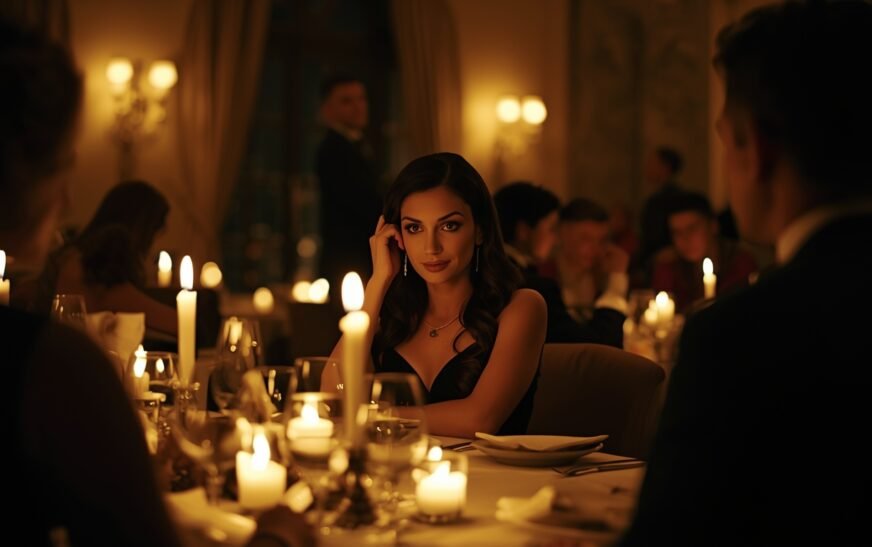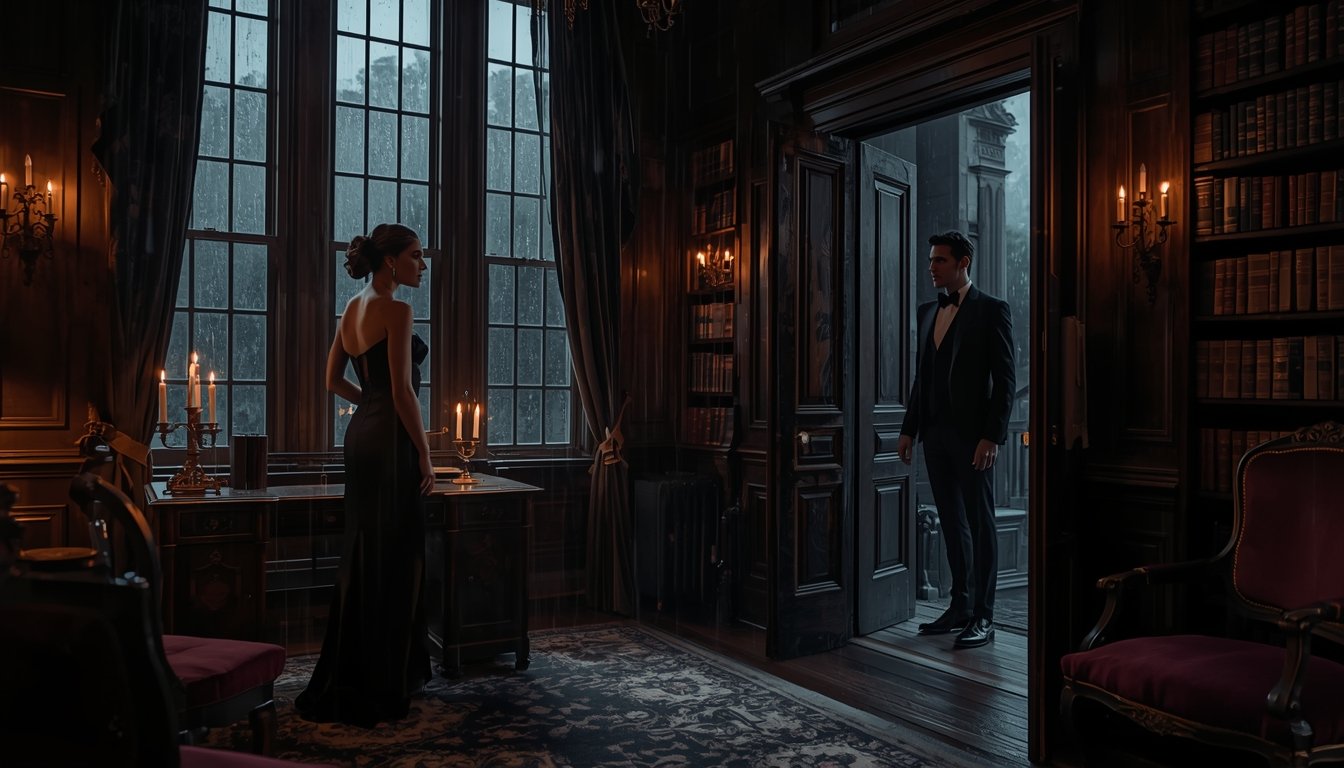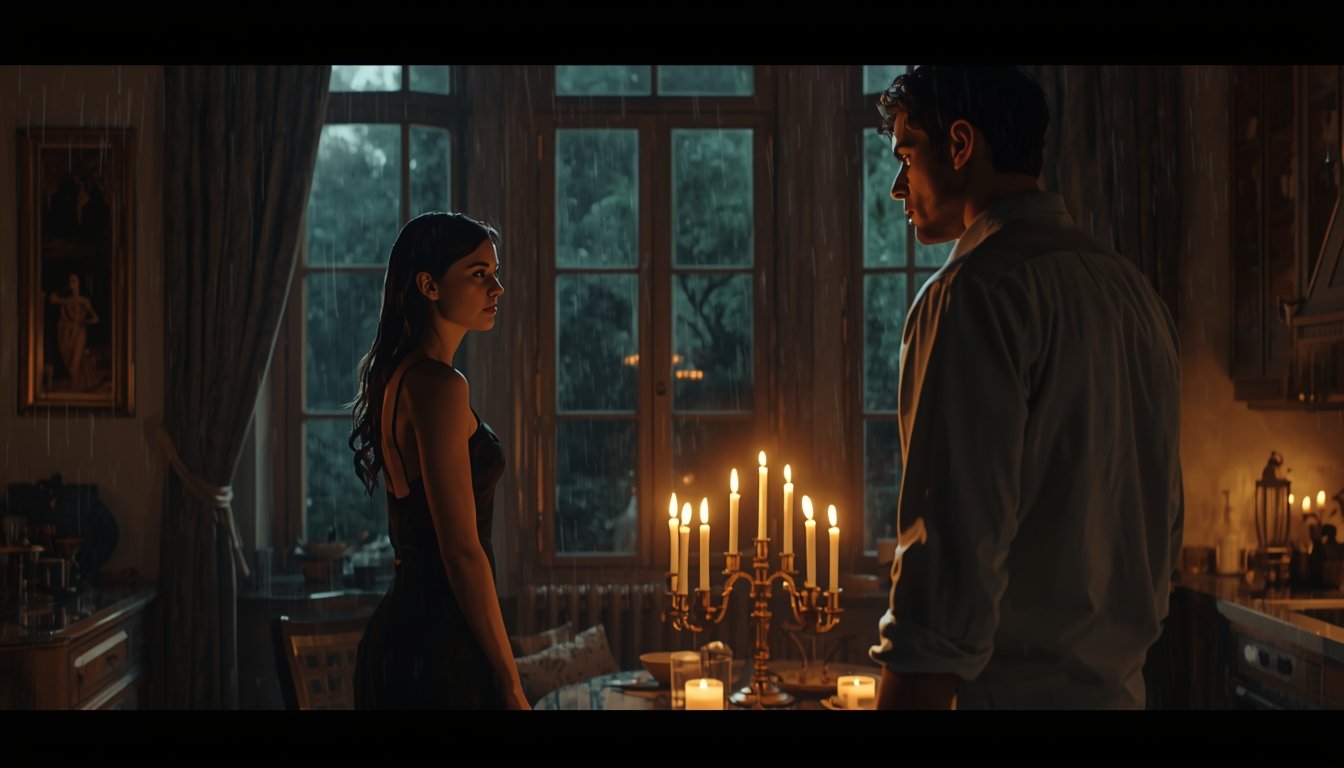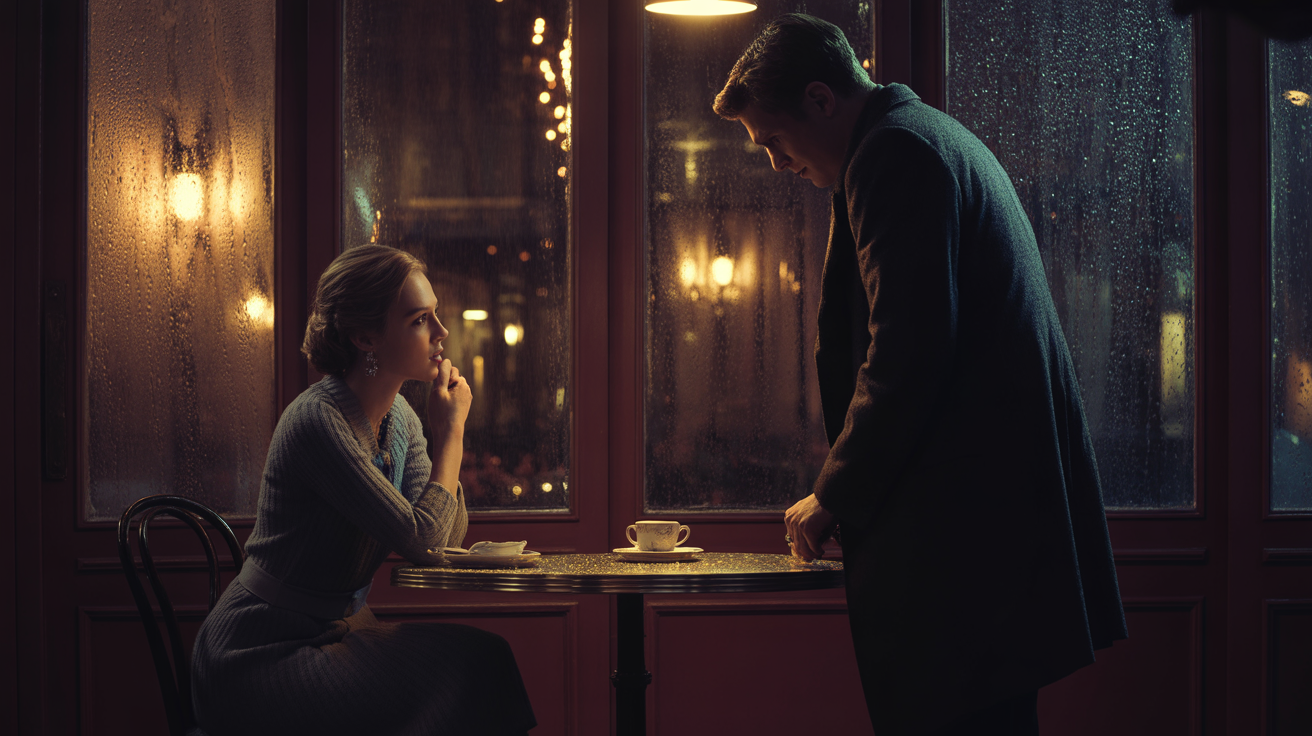
Mira accepted the courtesy seat because the platform announcement had already apologized twice and because the rain had reduced everyone to practical decisions. At 11:42 p.m., Northbound service had been cut to one delayed train with fewer working carriages than promised. People stood under the station lights with damp collars, hard expressions, and the fragile civility of strangers forced too close by weather. Mira had spent the evening at a gallery dinner she should have declined and was still wearing the black dress her husband said made her look “appropriately unforgettable,” which was the sort of compliment Adrian preferred because it sounded intimate while belonging mostly to his own taste. Therefore, when the carriage attendant touched the brass plate above a half-empty compartment and said, “There’s one courtesy seat left if you don’t mind sharing,” she said yes before caution fully arrived.
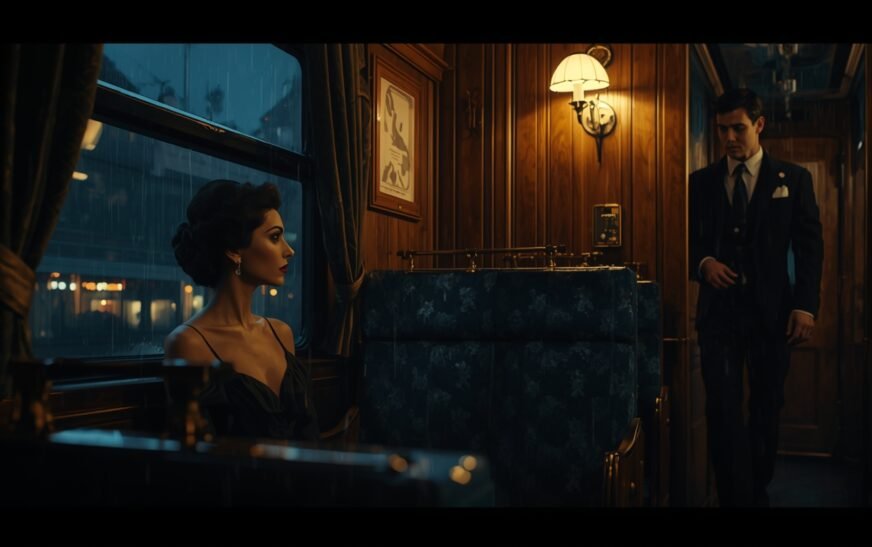
The compartment held four seats, a rain-fogged window, a brass luggage rack, and one man already sitting opposite the empty place by the door. He looked up when she entered, then stood at once to move his coat from the seat beside him.
“Please,” he said. “I think that one’s yours.”
Mira almost smiled. “That sounds unusually official.”
“The attendant used the phrase courtesy seat like a legal ruling.”
The train lurched before she could answer. Outside, platform lights slid into streaks. Meanwhile, the compartment door clicked shut behind them with the softly final sound of the night closing one option after another.
The man across from her
At first, he seemed easy to summarize. Mid-thirties, perhaps. Dark coat, dark tie loosened slightly, travel bag too plain to be expensive and too well kept to be careless. Yet nothing about him invited a quick reading. His face was composed without looking practiced. More importantly, he did not fill the first silence simply because it was there.
Mira set her umbrella carefully on the floor grate and folded her hands over her clutch.
“Long night?” he asked.
“Longer than promised.”
“That seems to be the theme of northbound travel.”
His voice was low, with no attempt at charm inside it. That made her more alert than overt charm would have.
“Do you take this route often?” she asked.
“Only when meetings run late enough to become personal,” he said. Then he added, “Jonah.”
“Mira.”
The train curved out beyond the city’s last office towers. Rain tracked silver against the glass. A conductor passed in the corridor. Somewhere farther down the carriage, a child protested sleep with determined outrage before being soothed back toward silence.
“You’re dressed for something better than rail disruption,” Jonah said.
“That suggests an optimistic view of my evening.”
A small laugh escaped him then, brief and real. It changed his face just enough to unsettle her.
Why she was traveling alone
Adrian was not supposed to let her travel alone after late events. He liked systems, car services, and plans that made him feel like the most reliable person in any room. However, he had left the gallery early for what he called “a necessary conversation” with a client from Singapore, then texted at ten-fifteen to say he could not make it back across the city in time.
Take the train if the driver app is impossible, he wrote. You’ll be fine. Tell me when you’re on.
She had told him. He had replied with a thumbs-up and then nothing more.
The absence should not have mattered. Married life often thinned into practical gestures by midnight. Still, she had spent the cab ride to the station with the odd sensation of being managed rather than accompanied. By contrast, the stranger in front of her had moved his coat without acting as if courtesy created debt.
“You’ve gone quiet,” Jonah said.
Mira looked up. “I’m deciding whether this train feels unlucky or efficient.”
“Those are not mutually exclusive.”
“You say that like a person who has survived several disappointing Thursdays.”
“A fair number,” he admitted.
The town after midnight
At the first rural stop, no one got on. The platform outside was almost empty, just one sodium lamp, one closed kiosk, and the wet dark outline of parked bicycles. The world beyond the glass looked less inhabited with every mile.
Jonah checked his watch and then seemed to regret the gesture.
“Someone waiting?” Mira asked.
“No,” he said. “Not anymore.”
The answer arrived without self-pity, which made it harder to ignore.
“Bad night?” she asked.
“Complicated one.”
“That’s usually a bad sign.”
He rested his head briefly against the seat back. “I had dinner with a woman I should probably stop seeing.”
There were simpler men, Mira thought, and likely safer ones. Yet his honesty entered the compartment without demanding equal confession in return.
“Then why are you still seeing her?” she asked.
He looked toward the rain-veiled window. “Because endings can feel arrogant when you’re not sure you were ever promised a beginning.”
The sentence sat between them with more intimacy than the night had earned. Still, it was not intimacy exactly. It was recognition moving quietly toward shape.
What she did not say about Adrian
At first, Mira intended to leave his admission unanswered. Then again, truth had a way of inviting its own mirror in enclosed spaces.
“I’m married,” she said.
Jonah did not appear surprised. “I assumed there might be someone.”
“That sounds calm.”
“Observation often does.”
She could have laughed. Instead, she looked down at the thin gold band on her hand, suddenly too bright beneath the carriage lamp.
“My husband is good at appearing where he is expected,” she said. “Lately, he has become less interested in the parts of me that exist outside expectation.”
Jonah said nothing.
That silence helped. So did the fact that he did not lean toward her, did not soften his face into sympathy, did not offer the cheap intimacy of immediate understanding.
“I’m not complaining,” she added.
“No,” he said. “You’re editing.”
She turned to him fully then.
The train passed a line of flooded fields reflecting fragments of moonlight through cloud. Inside the compartment, the air seemed to tighten by one careful degree.
The conductor with the clipboard
Later, the conductor returned to check tickets. He was a narrow man with silver hair and a clipboard that appeared older than either passenger.
“Sorry for the arrangements,” he said. “Short train tonight.”
Mira handed over her phone screen. Jonah produced a paper ticket from his wallet.
The conductor glanced at the seat map. “You’ve got the last courtesy seat in first class, madam. Lucky timing.”
“That remains under review,” Mira said.
The conductor smiled politely, clipped the paper ticket, and moved on. Yet after he left, the phrase lingered in the compartment with a faintly absurd power. Last courtesy seat. Lucky timing. As though the night had briefly documented itself.
“Do you always talk to railway staff as if they’re witnesses in a civil case?” Jonah asked.
“Only when trapped in transit with strangers.”
“And am I still a stranger?”
She answered too quickly. “Yes.”
That made him smile, though not unkindly. “Reasonable.”
The stop where she could have left
Forty minutes into the journey, the train paused at Ashwell, a town closer to Mira’s home than the final station. She could have gotten off there and ordered a car for the remaining distance. The thought arrived with startling clarity.
She did not move.
Outside, the platform was empty except for a cleaner in fluorescent orange moving a mop bucket beneath the shelter. The doors remained open for twenty seconds. Then they closed again.
“This is where sensible people leave,” Jonah said quietly.
“Are you trying to help me?”
“I’m trying not to pretend this is simpler than it is.”
She watched the platform slide away into darkness. “And what is it?”
He considered before answering. “A train ride. A conversation. A dangerous amount of relief in both.”
There it was, finally said with no embroidery at all.
Mira looked at her phone. Adrian had not messaged again. The screen remained politely blank.
The way he noticed things
Beyond Ashwell, the line narrowed through woods and sleeping towns. Reflections in the window began to outweigh the landscape outside. Mira could see herself now more clearly than the rain-soaked fields: dark hair loosened slightly at the neck, tired eyes, the formal line of her dress made stranger by travel.
“You keep checking your phone like you expect permission from it,” Jonah said.
“That’s invasive.”
“True.”
“Then why say it?”
He folded his ticket and slipped it back into his wallet. “Because I think you’re waiting for someone to re-enter the night and make your choices ordinary again.”
She should have shut the conversation down there. However, the train had become its own kind of weather, and weather altered judgment.
“Do I seem that transparent?” she asked.
“No,” he said. “You seem practiced.”
The answer landed more softly than flattery would have. It also felt more intimate.
Mira turned back toward the window. For a moment, her reflection and the blurred trees outside became one moving dark shape.
What he admitted before her stop
Jonah’s stop came first. Greycourt. Two stations before hers.
As the announcement sounded overhead, something in the compartment changed tempo. The night became measurable again.
He picked up his bag and placed it on his knee, though he did not stand yet.
“I should say this badly before the train does it for me,” he said.
Mira said nothing.
“I haven’t enjoyed a conversation this much in a long time,” he continued. “That feels relevant even if it changes nothing.”
The carriage lights flickered briefly as the train crossed a junction. Meanwhile, the station lamps ahead appeared through rain like a row of softened verdicts.
“Nothing should change,” she said.
“I know.”
“That isn’t the same as agreeing.”
He looked at her then, without performance and without retreat. “No,” he said. “It isn’t.”
The honesty in that answer was the most dangerous part of him. Not desire. Not charm. Honesty stripped of convenience.
After the courtesy seat
When the train slowed into Greycourt, Jonah stood. He reached for his coat, then stopped with one hand resting on the brass rack above them, as if one final movement required more thought than luggage usually deserved.
“You don’t owe the night a better version of itself,” he said.
Mira looked up. “That sounds like advice you should keep.”
“Probably.”
He opened the compartment door, then turned back once. “Goodnight, Mira.”
“Goodnight.”
He left without asking for her number, without offering his, without dropping some polished line intended to survive after the platform. Even so, when the door shut behind him, the compartment felt abruptly overlarge.
The train pulled away. Greycourt became light, then reflection, then nothing.
The station where Adrian waited
By the time Mira reached North Arden, the rain had gentled to mist. The platform held only three passengers and one station porter closing the kiosk shutters. To her surprise, Adrian was waiting near the barrier in his dark overcoat, one hand in his pocket, the other raised as soon as he saw her.
“I thought you’d still be thirty minutes out,” he said, taking her umbrella before asking whether she wanted him to. “Was it dreadful?”
Mira stepped onto the platform. “No.”
“Crowded?”
“Not especially.”
He glanced at her face then, more carefully. “You look tired.”
There was concern in the sentence. There was also distance, precise and familiar.
As they walked toward the car park, he told her about Singapore, shifting timelines, and a client who could not understand urgency unless it belonged to him. Mira listened. Meanwhile, some quieter part of her remained in the compartment, staring at a rain-blurred window and an empty seat across from it.
Readers drawn to dark romance, the ache inside forbidden love, the restraint of romantic tension, the uncertainty of dating fiction, and the quiet pressure within secrets and suspense will recognize the danger of a night that does not become scandalous, only clarifying.
Meanwhile, the deeper current lived in late train, rainy platform, married distance, quiet attraction, empty compartment, restrained desire, and dangerous timing that never need a touch to become unforgettable.
At the car, Adrian unlocked her door first, as he always did. Mira thanked him, as she always did. Yet while the heater warmed the windshield and the station lights shrank behind them, she understood the real shape of the courtesy seat. It had not given her a stranger. It had given her a cleaner view of the life waiting at the end of the line.
And once seen, that view refused to blur again.