Mara first heard the rule about the cliff path at 5:38 in the evening, while the last grocery van pulled away from Larkhaven Point and left the village to its wind. She had arrived that afternoon to close her aunt’s guesthouse for the winter, a task that sounded practical from the city and faintly punitive once the sea came into view. The house stood above the black shoreline with six guest rooms, a gravel drive, and a narrow cliff path running behind the back gate toward the headland light. According to the woman at the bakery, nobody local used it after the foghorn. She said this while wrapping Mara’s loaf in brown paper, and because her tone remained so matter-of-fact, the warning entered the evening more deeply than melodrama would have.
“Why not?” Mara asked.
The baker folded the paper twice with dry hands. “Because something on the inland side keeps pace.”
Then she smiled as if she had only commented on weather.
At first, Mara assumed the village fed itself on old stories the way coastal towns often do when summer visitors leave. Even so, the phrase stayed with her while she unlocked the guesthouse, turned on lamps in rooms no one would sleep in, and listened to the sea push itself against the rocks below the cliff in long indifferent breaths.
The house above the water
Aunt Eleanor had called the place practical, which was generous. Lark House smelled of old linen, lemon polish, and damp wood that never fully accepted drying. By contrast, the online listings described “windswept charm” and “heritage coastal atmosphere,” which sounded less like property details than controlled lies.
Mara moved from room to room opening windows, checking radiators, and gathering the small evidence of other people’s departures. A pearl earring under a bedside table. A children’s sock behind the lounge sofa. Two postcards left unsent near the hallway mirror.
Meanwhile, evening gathered fast. The guesthouse windows turned from gray to black. Sea grass bent flat beyond the back garden wall. Farther out, the warning light at the headland clicked on and off in patient white pulses.
Her aunt had died in September. Since then, the task of sorting the property had fallen to Mara because she was “the sensible one,” a phrase relatives used when they wanted labor wrapped as character. Therefore, she came alone for the final week before winter closure, telling herself she preferred efficiency to company.
Still, when the first foghorn sounded from the bay at six-ten, the whole house seemed to listen with her.
The path behind the gate
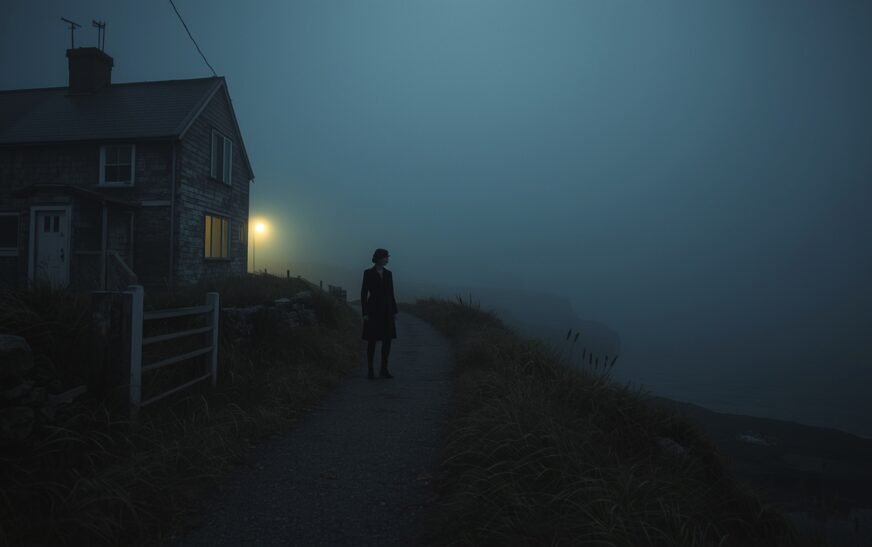
Later, while carrying a box of laundry tags to the shed, Mara saw the cliff path properly for the first time. It began just beyond the rusted back gate, edged by low stone and winter-thinned gorse, then narrowed toward the headland in a pale line of chalk and crushed shell. On one side lay the drop to the sea. On the other stood rough grassland sloping upward toward a wire fence and a stand of bent pines.
Nothing moved there.
That should have reassured her.
Instead, the emptiness looked too complete, as if the path had been cleared of ordinary uses and left waiting for something less visible.
Mara locked the shed, went inside, and made tea she did not want. After that, she tried to work through invoices at the reception desk. The lamp threw a yellow circle over old booking ledgers. However, each time the sea wind tapped a loose branch against the side of the house, her mind returned to the baker’s sentence with irritating loyalty.
Something on the inland side keeps pace.
By nine, she was annoyed enough with herself to call her brother. He did not answer. Therefore, the silence of the house had to do all the talking alone.
What the neighbor said next
The following morning brought low cloud, gulls, and a knock at the kitchen door. Mara opened it to find Mr. Vane from the adjoining cottage holding a bucket of coal in one hand and looking as if he had been carved from rope and salt.
“For the front room stove,” he said. “Your aunt always ran through the first bucket too fast.”
Mara thanked him and stood aside. He set the coal by the pantry, glanced toward the back windows, and seemed to decide something.
“You heard about the cliff path, then,” he said.
She laughed lightly. “News travels fast.”
“Warnings faster.”
That removed the humor from the room.
Mara leaned against the counter. “You don’t actually believe that story.”
Mr. Vane took longer than necessary to button his coat. “Belief is for church and elections. I only know the path is wrong after the horn.”
“Wrong how?”
He looked toward the window over the sink, where the sea light had gone suddenly flat. “It starts with sound. Then timing. After that, people make the mistake of checking whether they’re alone.”
Before she could ask more, he left through the kitchen door and pulled it firmly shut behind him.
The first walk
At first, Mara had no intention of testing anything. Then again, rules issued without explanation have always offended practical people more than danger itself. By late afternoon, the sky had cleared into a hard pale blue, and the cliff path looked almost ordinary in the slanting light.
So she walked it before dusk.
The air smelled of salt and wet stone. Grass hissed against her boots. Below the cliff, the sea moved in dark green panes with white breaking edges. Far ahead, the headland light stood on its concrete base like a thought someone had forgotten to stop having.
The path itself was narrow but sound. Mara reached the light, stood there for a minute with wind lifting her hair from her collar, and turned back toward the guesthouse. Nothing followed. Nothing waited. By contrast, the whole place looked disappointingly beautiful.
She told herself the village liked its folklore polished and coastal. That was all.
Even so, when the foghorn sounded again shortly after six and darkness came down much faster than reason preferred, she closed the back curtains before the second blast arrived.
The steps outside
Night in Lark House had its own language. Pipes clicked. Floorboards settled. The front sign creaked once each time the wind shifted seaward. Meanwhile, the sea kept moving below everything, a patient black body too large to care.
Mara read in bed until eleven and then switched off the lamp. Five minutes later, she heard footsteps.
Not on the drive.
Not at the front door.
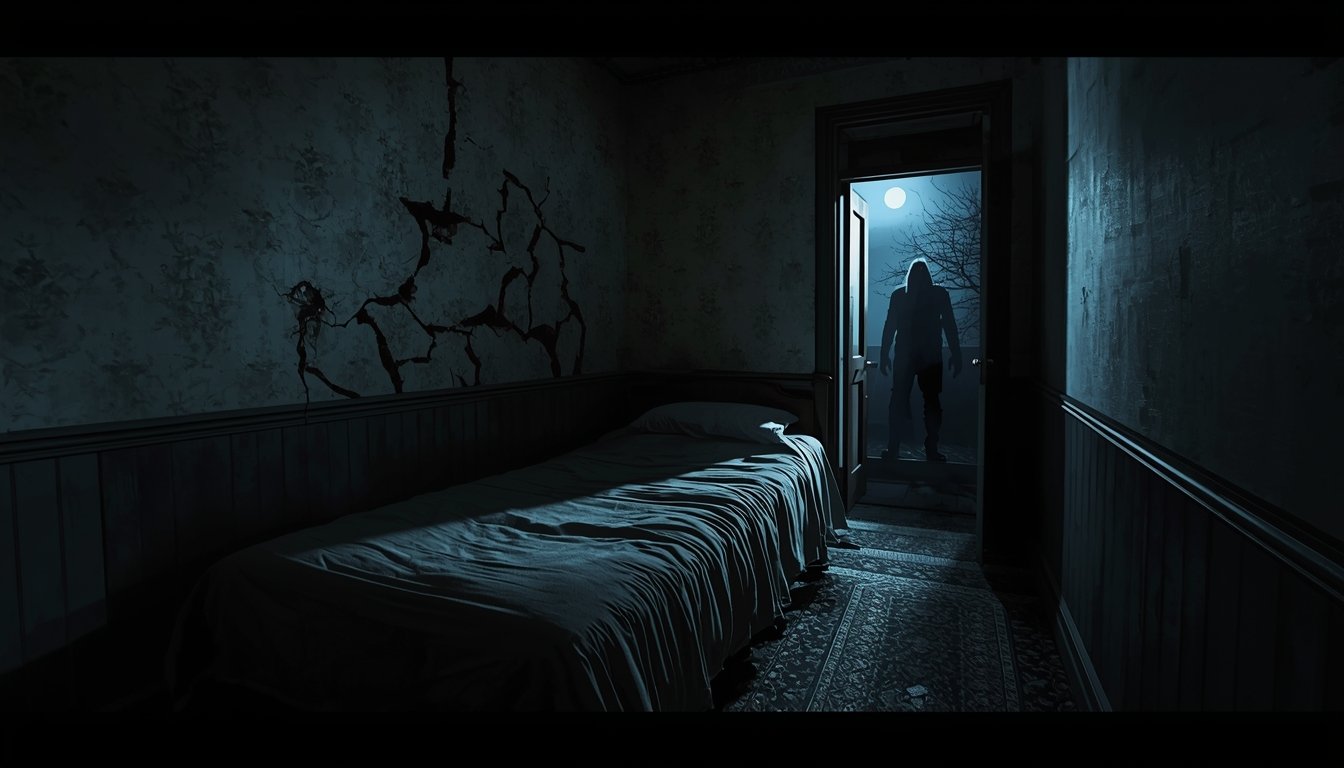
They were outside the back wall, measured and dry, moving along the cliff path at the exact speed of a person who knew where the gate was but had no intention of entering through it.
She held still and counted eight steps before they stopped.
Silence followed. Then, very softly, came four more.
She got out of bed, crossed to the curtain, and stopped with her hand on the fabric.
Mr. Vane’s sentence returned at once. After that, people make the mistake of checking whether they’re alone.
Mara let the curtain fall unopened. She stayed there listening until the wind rose enough to blur everything into one continuous shore sound.
The printless ground
Morning made fear look ornamental, which was perhaps its most humiliating quality. The back garden was wet with blown mist. Soil around the gate had turned soft overnight. If someone had been walking there, the ground should have recorded it clearly.
It had not.
Mara crouched by the latch and examined the mud anyway. Her own prints from the previous day remained visible near the stone edge. A gull had left two thin tracks across the herb bed. Yet beyond the gate, the strip beside the cliff path lay undisturbed as if nothing with weight had touched it.
She told herself the steps might have carried oddly from the road. The sea might have thrown sounds upward. Wind might have produced rhythm where none existed. However, explanation began to feel like paperwork done after the result had already changed.
By noon, she had cleaned the upstairs landing, stripped two beds, and boxed a shelf of cracked mugs for donation. Still, the house no longer felt merely empty. It felt attentive.
The second evening
Rain came in low and silver after dusk. The headland light blurred. The foghorn sounded earlier than the night before, deep enough to vibrate faintly in the stair rail when Mara touched it.
She had just fastened the front door when the kitchen bell rang.
Lark House had an old mechanical service bell system, once used by guests to summon tea, towels, or assistance. Most of it no longer worked. Yet one bell remained wired to the back porch, and now it shivered once in the hall, a thin metallic note.
Mara stood with the towel still in her hand.
No one rang a second time.
She crossed to the kitchen, switched on the outside lamp, and looked through the small glass pane in the door. The yard was empty. Rain moved slantwise through yellow light. Beyond the wall, the cliff path was only a pale interrupted line between darkness and darker grass.
Then, from the inland side of the wall, she heard steps begin again.
They matched the speed of her breathing at first. After that, they adjusted to the speed of her fear.
The line Mrs. Thorn used
The next day, Mara went back to the bakery partly for bread and mostly because silence had stopped being useful. Mrs. Thorn, the baker, was icing buns no tourist would ever see until spring. She did not look surprised by Mara’s face.
“You listened at the gate,” she said.
Mara set coins on the counter harder than necessary. “What exactly is on that path?”
Mrs. Thorn wiped sugar from one knuckle with her thumb. “Nothing anyone can prove.”
“That isn’t enough.”
“It keeps to the inland side,” the woman said. “That’s enough for most people.”
Mara lowered her voice. “You say ‘it’ as if everyone agrees.”
“Everyone agrees about the timing.”
“And if someone goes out there after the horn?”
Mrs. Thorn finally met her eyes fully. “Then they hear their own pace improved.”
The phrase made no sense. That was what made it stay.
The mistake of testing it
That evening, Mara lasted until the second foghorn before anger outweighed good judgment. She put on boots, buttoned her coat to the throat, took the yard torch from the pantry, and unlocked the back gate with a hand that shook only from cold, she told herself.
The cliff path lay pale under low fog. Sea air hit her face at once, raw and mineral. The torch beam reached only a short distance before being swallowed by whitened dark.
She stepped onto the path.
One stride. Then another.
On the inland side, beyond the strip of wet grass, came a second set of steps.
They were not late. They were not early. They landed in exact parallel, hidden by fog and slope from sight but not from certainty.
Mara stopped.
The other steps stopped.
Wind pushed cold through her coat. Somewhere below, water struck rock in hollow intervals. She wanted, with sudden humiliating force, to call out and make the thing answer in a form language could manage. Instead, she remembered Mr. Vane’s warning and kept her eyes fixed on the path ahead.
Then she walked again.
So did it.
The place where the path narrows
Halfway to the headland, the cliff path narrowed between a gorse thicket and a drop where the rail had rusted away years earlier. Mara knew the section from daylight. At night it became something else entirely: not a route, but a test of balance performed above black water.
Her torch flickered once.
Meanwhile, the hidden steps on the inland side moved with obscene steadiness, never slipping, never catching, never varying with mud or stone.
Mara understood then why looking was the mistake. Sight would only have confirmed or denied a shape. Sound was worse because it forced imagination to do the carrying.
She reached the narrowest point and heard the steps draw closer, though the distance between them should have remained fixed. Not nearer in space. Nearer in intent.
Then, just above the wind, something breathed out one line in a voice that sounded almost like her own.
“Faster.”
Mara did the only sensible thing available: she did not obey.
The return to the house
Instead of running, she turned at once and walked back the way she had come, steady as she could manage, torch low, eyes on the chalk line of the path. The parallel steps kept pace with terrible courtesy. They neither rushed nor lagged. Yet with each yard toward the gate, Mara felt them pressing harder at the edge of her balance, as if impatience itself had learned to walk.
The back lamp of Lark House appeared through fog like a small domestic lie.
She reached the gate, fumbled the latch twice, and stumbled into the yard. The steps stopped immediately on the other side of the wall.
No final sound followed. No knock came at the kitchen door. That, more than anything, undid her.
Because what waited beyond the gate did not want entry. It wanted company in motion.
After the cliff path
Mara left Lark House three days later with the guest rooms closed, the accounts boxed, and the keys delivered to the solicitor in town. She told her relatives the weather had turned too rough to stay alone, which was true in the way careful lies often are.
Readers drawn to atmospheric horror, the lingering dread of dark fear, the subtle pressure inside psychological unease, the hush within secrets and suspense, and the controlled tension of quiet thriller fiction will recognize the kind of terror that does not chase, only accompanies.
Meanwhile, the deeper dread lived in coastal horror, night footsteps, foghorn fear, lonely guesthouse, path in the fog, place-based dread, and eerie silence that never need a face to become unforgettable.
She did not return in winter.
In spring, the solicitor wrote to say the property had sold to a couple from Leeds who planned tasteful renovations and summer packages. Mara wished them luck and did not mention the cliff path. After all, warnings are less effective once they sound like stories.
Still, on certain city nights, when rain moves along the buildings in slow silver lines and traffic falls into measured gaps, she wakes convinced that something just beyond the bedroom wall has adjusted itself to match her pace exactly.
Then she lies still until morning, unwilling to offer even her footsteps the comfort of repetition.