The Violin Case in Her Mother’s Closet
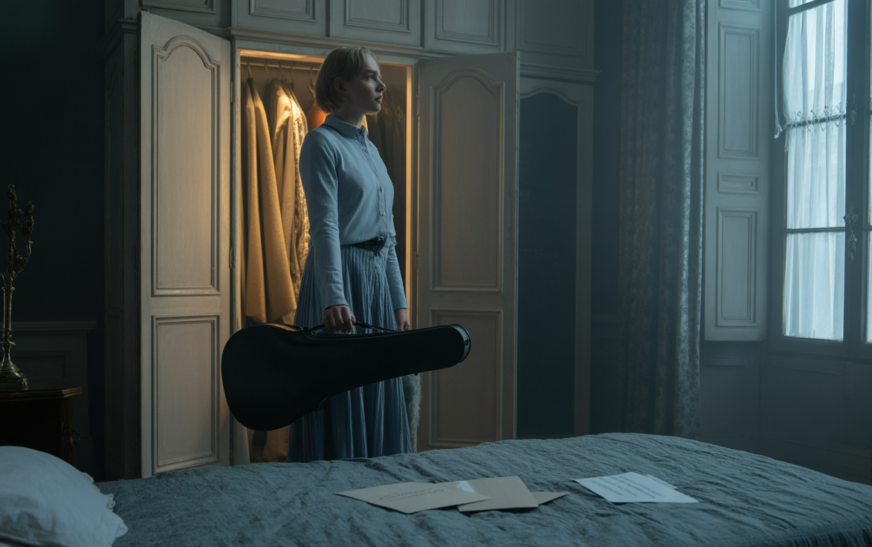
Elara found the violin case on a Thursday afternoon, behind three winter coats and a garment bag her mother had not opened in years.
The closet smelled faintly of lavender, cedar, and the sort of careful order that only existed in homes where feelings were folded before they were spoken. Outside the bedroom windows, rain moved softly over the garden wall. Inside, the house on Ashbourne Lane held its usual silence, polished and practiced.
Her mother was selling it within the month.
That alone should have been impossible.
For twenty-three years, Marianne Vale had treated the house as if it were a second spine. In her hands, the curtains, the silver, the chipped blue vases, and even the cold guest room were defended with the same stiff devotion she used on everything else she refused to discuss. Yet now, only six months after Elara’s father died, she had decided the place was suddenly too large, too expensive, and too full of maintenance to keep.
Elara had not believed that explanation for a second.
Still, she had come to help.
“Put anything damaged in the hall,” Marianne called from the next room. “And leave the top shelf alone. Those are formal pieces.”
Elara almost smiled. Even now, her mother could make old cardigans sound ceremonial.
Then her hand touched the case.
It was black, narrow, and elegant, with brass corners worn pale by time. For one strange second, she simply stared at it. No one in their family played the violin. Her father preferred silence to music, and her mother had once called string instruments “too intimate for dining rooms.”
Yet there it was, hidden behind old clothes like a private life packed away by mistake.
She pulled it free.
It was locked.
That was when she knew it mattered.
The Closet Her Mother Guarded
Marianne appeared in the doorway before Elara could say a word.
Her mother’s gaze dropped to the case at once. For the smallest moment, something unguarded crossed her face. It vanished almost instantly. However, Elara had already seen it.
Fear.
“Put that back,” Marianne said.
Not please. Not later. Not I’ll explain.
Just that.
Elara leaned against the wardrobe. “What is it?”
“Nothing that concerns you.”
The sentence would once have ended the conversation. When Elara was younger, her mother’s voice could close doors without touching them. Now, though, the old authority only sharpened her curiosity.
“It’s locked,” she said. “Why?”
“Because it is private.”
“That usually means important.”
Marianne folded a blouse over her arm with unnecessary precision. “It means old.”
Rain tapped harder against the glass. Somewhere downstairs, a grandfather clock sounded the half hour. Their house had always performed calm beautifully. Even then, while tension tightened the air between them, the room remained spotless, tasteful, and almost offensively serene.
Elara looked at the case again. “Was it Dad’s?”
Her mother’s silence answered too slowly.
“No,” Marianne said at last.
That single word changed everything.
The Key That Was Missing
Elara set the case on the bedspread. “Then whose was it?”
“Leave it alone.”
“You want to sell the house, pack up his study, erase half the rooms, and I’m supposed to believe this is just clutter?”
Marianne’s posture hardened. “Do not confuse grief with permission.”
The cruelty of that might once have wounded Elara. Instead, it gave her clarity.
Her mother was not offended.
She was cornered.
“Where’s the key?” Elara asked.
“Gone.”
“Convenient.”
Marianne turned away then, but not before Elara noticed the tremor in her fingers. That, more than the locked case itself, unsettled her. Her mother did not tremble. She judged, withheld, endured, and rearranged. She did not shake.
“There are boxes in the attic,” Marianne said. “You can help me there if you need something to do.”
Elara almost laughed. “You say that as though I’m the one behaving strangely.”
Her mother paused at the doorway. “Some things survive in a family only because no one insists on opening them.”
Then she left.
The line lingered in the room like a draft.
The Name Inside the Lining
That evening, while her mother took a call in the garden room, Elara carried the violin case to her old bedroom and locked the door.
She told herself she only meant to inspect it.
That lie lasted less than a minute.
The brass clasp resisted at first. Then, with the help of a hairpin and more impatience than skill, it sprang loose. The lid opened with a sigh of stale velvet air.
No violin lay inside.
The Letters Beneath the Velvet
Instead, the case held a stack of letters tied in dark ribbon, a faded concert program, and a flat envelope thick enough to contain legal papers. Beneath them all, stitched into the lining, were two initials in silver thread.
L.M.
Not Marianne Vale.
Marianne’s maiden name had been Ashdown.
Elara frowned. Then she unfolded the concert program first.
The paper was old enough to feel fragile. A winter recital, twenty-seven years earlier. The lead performer was listed in elegant serif type.
Lucien Marrow, violin.
Her heartbeat shifted.
She knew that surname.
Not from family stories. Those were too carefully edited for such details. She knew it because, during the final months of her father’s illness, a man named Gabriel Marrow had twice come to the house on professional business. He was a reserved estate solicitor with kind eyes and an air of old tiredness. Her father disliked him immediately. Her mother, meanwhile, had gone so still in his presence that the room had seemed to lean around her.
Marrow.
Not common. Not forgettable.
She opened the letters.
The first was dated three months before her parents’ wedding.
If you still choose him, I will not come again. But do not tell me this is peace when I know what it is costing you.
There was no signature. There did not need to be.
Elara sat down slowly on the edge of the bed.
The second letter was gentler, and therefore far more devastating.
I asked only once for honesty. You gave me silence instead. I will try to respect it, Marianne, but silence has never been the same thing as innocence.
Outside her door, the house remained quiet. Inside, the past began rearranging every room she had ever trusted.
The Marriage No One Explained
Her parents had never looked like a love story.
That truth felt disloyal even to think, yet it had always been there. Her father had been dignified, competent, and difficult to know. Her mother had been beautiful in a way that never invited comfort. They hosted elegantly, argued rarely, and moved around each other with the precise caution of people protecting a structure rather than a feeling.
As a child, Elara had mistaken that for adulthood.
Later, she had called it compatibility.
Now, with love letters hidden in a violin case on her lap, she had to consider a darker possibility.
Perhaps their marriage had not been built to hold love at all.
Perhaps it had been built to bury it.
That kind of revelation belonged to Drama, to Marriage & Secrets, and to the colder edges of Psychological stories. A family did not always crack under one dramatic betrayal. Sometimes it survived for decades by teaching everyone which silence counted as loyalty.
Elara opened the legal envelope next.
Inside was a photocopy of a marriage document. At first, she did not understand what made it wrong. Then her eyes caught the date.
It had been amended two days before the ceremony.
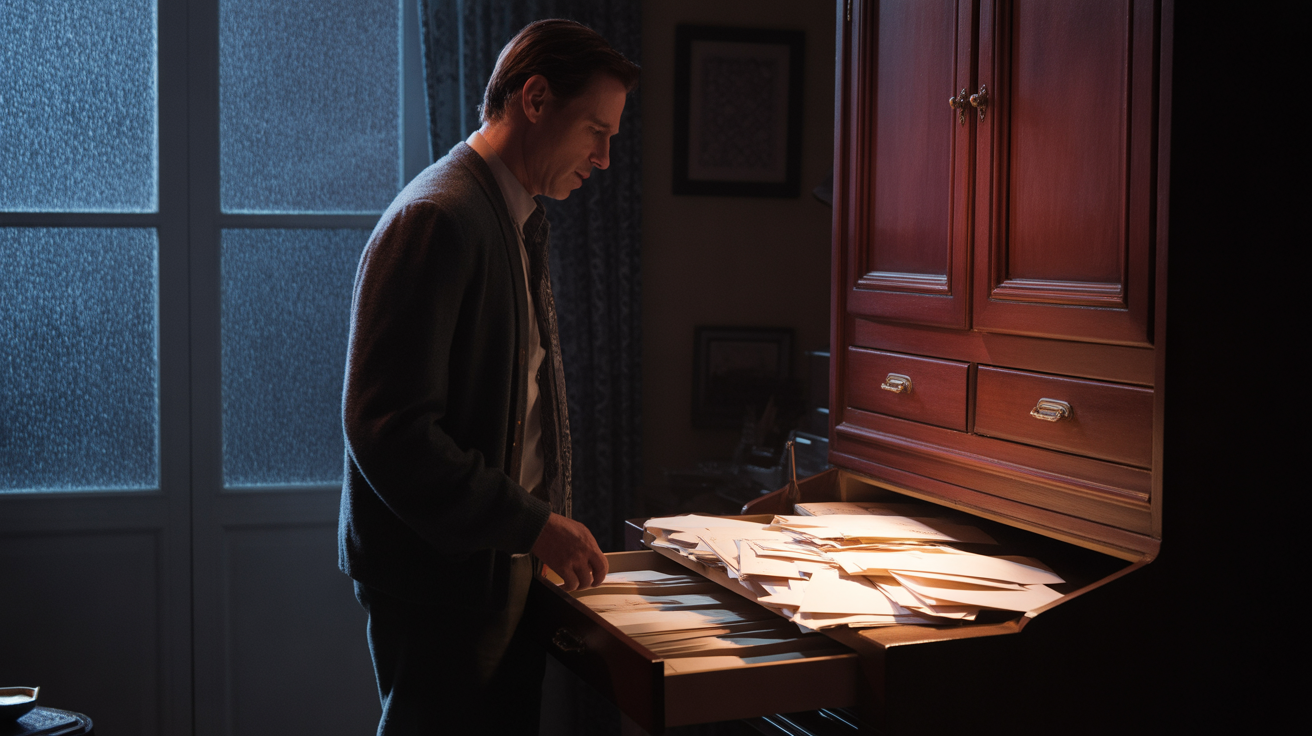
A handwritten clause, initialed by both parties, transferred the Ashbourne Lane property entirely into her father’s family trust if Marianne entered the marriage. There was no matching copy in any file Elara had ever seen. More troubling still, attached behind it was a typed note from a solicitor.
Client appears reluctant. Family pressure evident. Groom insists terms are necessary for reputation and swift resolution.
Elara read the line twice.
Reluctant.
Family pressure.
Resolution.
None of those words belonged in the story she had been told about her parents’ marriage.
The Solicitor at the Gate
The next morning, she drove into town before her mother woke.
The rain had cleared, leaving the streets silver and cold. At half past nine, Gabriel Marrow’s office still wore the hush of expensive discretion. Dark wood. Frosted glass. A receptionist who looked as though she had never once raised her voice in her life.
“I’m sorry,” the receptionist said, “Mr. Marrow is fully booked.”
“Tell him Elara Vale brought a concert program from 1999,” she replied.
The woman blinked. Then, without another question, she disappeared into the back hall.
Three minutes later, Gabriel Marrow opened the inner office door himself.
He seemed older than Elara remembered, though not weaker. His hair was mostly silver now. His expression, however, remained composed in that dangerous way men in careful professions often preferred.
Until he saw the program in her hand.
Then, for the briefest instant, his control broke.
“Come in,” he said.
The Story Beneath the Story
His office overlooked the river. Shelves of leather files lined the walls. On the desk sat a photograph turned partly away, as if it had once been displayed more openly and then reconsidered.
Elara remained standing. “Who was Lucien Marrow?”
Gabriel did not answer immediately. Instead, he closed the door and moved behind the desk with a slowness that felt like respect for old damage.
“My older brother,” he said at last.
There it was.
Real. Specific. Impossible to take back.
“He knew my mother.”
“Yes.”
“More than knew her?”
Gabriel looked out at the river before replying. “He loved her. And unless I have misunderstood thirty years of consequences, she loved him too.”
Elara sat down without meaning to.
The room did not spin. It narrowed.
“Then why did she marry my father?”
Gabriel folded his hands. “Because your grandfather considered Lucien unsuitable. Because your father’s family offered security at the exact moment your mother’s own family needed rescue. Because reputations were treated as emergency medicine in those days. Choose any version you like. They are all true.”
“Did my father know?”
“Enough.”
That answer chilled her more than certainty might have.
Enough to what? Punish? Control? Secure? Endure?
Gabriel seemed to read some part of her thoughts. “Your father was not a simple villain, Miss Vale. However, he understood advantage, and he came from people who believed emotion should be negotiated like property.”
“And Lucien?”
A shadow moved through the solicitor’s face. “He left the city after the wedding. He played for a few years abroad. Later, he died in Vienna.”
Something in Elara’s chest tightened unexpectedly. She had never met the man. Still, grief arrived anyway, perhaps because lost futures were often easier to mourn than real people.
The House Began to Change
When Elara returned home, the house looked different.
Not physically. The same cream stone held the same narrow windows. The same roses bent over the back path. Yet the whole place now seemed built from edited choices.
Her mother was in the dining room, wrapping crystal in newspaper.
Marianne did not look up right away. “You were out early.”
“I went to see Gabriel Marrow.”
The glass in her mother’s hand slipped and struck the table with a bright, frightened sound.
“You had no right.”
“Then you should have given me the truth first.”
For several seconds, neither of them moved. The room around them remained beautifully arranged, full of polished furniture and inherited discipline. Nevertheless, the calm had gone thin.
“How long?” Elara asked.
Her mother sat down slowly. “Long enough.”
“Did you love him?”
Marianne closed her eyes.
“Yes.”
The answer came so quietly that it might have been mistaken for relief.
Elara felt anger rise first. Then sorrow. Then something far more difficult.
Understanding.
“And you married Dad anyway.”
“I married what was arranged.”
“That is not the same thing.”
“No,” her mother said. “It is worse.”
The Document He Kept Hidden
Marianne rose and crossed to the sideboard. From the lowest drawer, she removed a flat folder bound in ribbon. Apparently, the violin case had not been her only burial place.
She set the folder in front of Elara.
Inside was the original marriage amendment, signed in fresh black ink. Beneath it lay one more document Elara had never seen: a private letter from her father, written the night before the wedding.
I know what is absent, and I accept the terms of it. What matters is that this marriage resolves what must be resolved. Affection can be built later, or at least imitated well enough for public life.
Elara stared at the page.
Imitated well enough.
The phrase was so cold it almost felt elegant.
“He wrote that to you?” she asked.
“Yes.”
“And you still married him.”
Marianne’s expression changed then, and for the first time in years Elara saw not her mother, not the keeper of the house, not the woman who corrected flowers at dinner, but the frightened young bride who had once stood where choice and pressure became indistinguishable.
“I thought survival was the same thing as strength,” Marianne said. “Later, I told myself duty would become a kind of peace. Eventually, I was no longer sure there was a difference.”
The confession settled between them heavily.
That was what readers of Dark Romance, Thriller, and Secrets & Suspense understood better than most: some tragedies were not loud. Some simply dressed themselves in respectability and stayed for dinner.
The Decision Waiting in the Hallway
By evening, the rain had returned.
Boxes lined the corridor. Half-wrapped paintings leaned against the staircase. The whole house looked suspended between one life and another.
Elara stood outside her father’s old study with the violin case in her hands.
Inside that room were ledgers, deeds, estate letters, and the architecture of the version she had grown up believing. In her arms, meanwhile, rested the proof that another life had once existed beside it, hidden but not erased.
Her mother appeared at the far end of the hall. She had changed into a dark wool dress and looked, suddenly, much older than the day before.
“What will you do?” Marianne asked.
Elara considered the question seriously.
She could take copies of everything. Just as easily, she could challenge the trust records. More dangerously, she could force surviving relatives to explain why pressure had been called duty for so long. At the very least, she could refuse to let the house be sold as though it held only tasteful memories and simple loss.
“I don’t know yet,” she said.
Then she looked down at the case.
“But nothing in this family gets to be called innocent just because it was quiet.”
Marianne’s face tightened, not in anger, but in recognition.
What Survived the Years
Elara carried the violin case into the study and set it on the desk beside her father’s papers.
For the first time, the room felt balanced.
Not healed. Not forgiven. Balanced.
One history had finally been forced to sit beside the other.
Outside, night settled over Ashbourne Lane. Rain darkened the windows. Somewhere in the distance, a car passed and faded. Inside the study, the old house seemed to listen.
Elara opened the concert program one last time and traced the printed name with her thumb.
Lucien Marrow.
A man she had never known. A love her mother had never buried as completely as she had pretended. A ghost not of horror, but of withheld tenderness. No wonder the house had always felt careful instead of warm. It had been built around an absence and taught to call that elegance.
She did not cry.
Instead, she began sorting documents into two piles: what the family had displayed and what it had hidden.
By morning, there would be questions. Later, there would be anger. Eventually, there might even be freedom.
For now, there was only the storm, the desk lamp, and the quiet certainty that truth did not always arrive to destroy a home.
Sometimes it arrived to explain why it had never truly been one.
Explore more emotionally layered fiction in Stories, and follow related themes through marriage secret, hidden document, old love, family lies, secret letter, violin case, and buried truth.