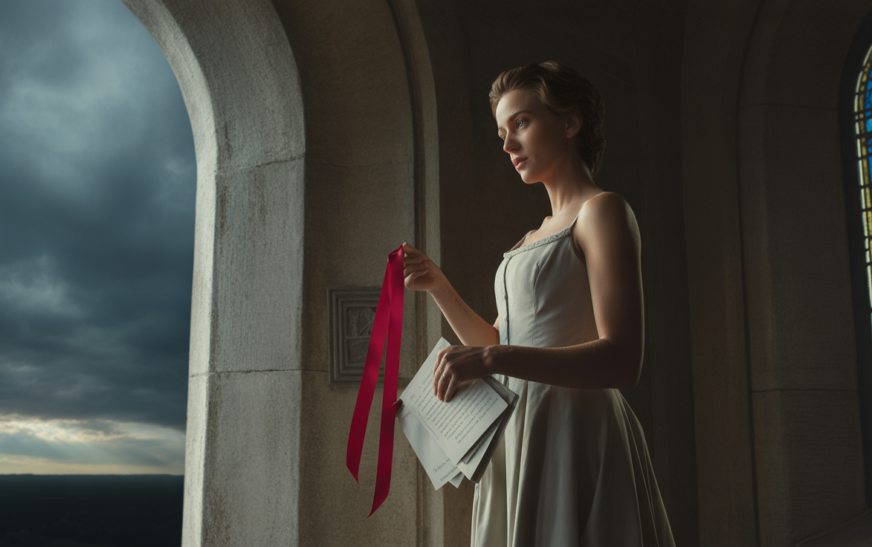
Saint Vale Court in Rain
Rain followed Celia all the way up the winding drive to Saint Vale Court.
The estate appeared through the weather in fragments first: the iron gates, the black yews, and the pale chapel spire lifting behind the main house like a warning no one had translated correctly. By the time her car stopped beneath the porte cochere, the stone facade had darkened with rain, and every window reflected a sky the color of bruised silver.
She had not returned in five years.
Staff came down the steps with umbrellas and practiced sympathy, each one speaking in the softened tone people used when a family was preparing for a wedding after a season of scandal. Her cousin Isabelle was set to marry on Saturday. Therefore, everyone at Saint Vale Court had agreed to behave as though happiness were simply a matter of discipline.
Celia stepped out with a faint smile that convinced no one, especially herself.
“You’re late,” Isabelle said from the doorway.
She looked beautiful already, even in a loose silk blouse and unpinned hair. However, beauty had sharpened in her over the last year. It no longer made her seem warm. Instead, it made her seem expensive.
“The road flooded near the lower bridge,” Celia said.
Isabelle kissed her cheek. “At least you made it before dinner. Mother would have called it an omen.”
“And what would you call it?”
Isabelle glanced past her toward the chapel tower. “Bad timing.”
The answer was light, yet it stayed with Celia as servants carried in her case. Readers drawn to Dark Romance recognized that mood well. So did those who preferred the quieter danger of Forbidden Love, where the loveliest places often kept the least innocent histories.
Dinner and the Doorway
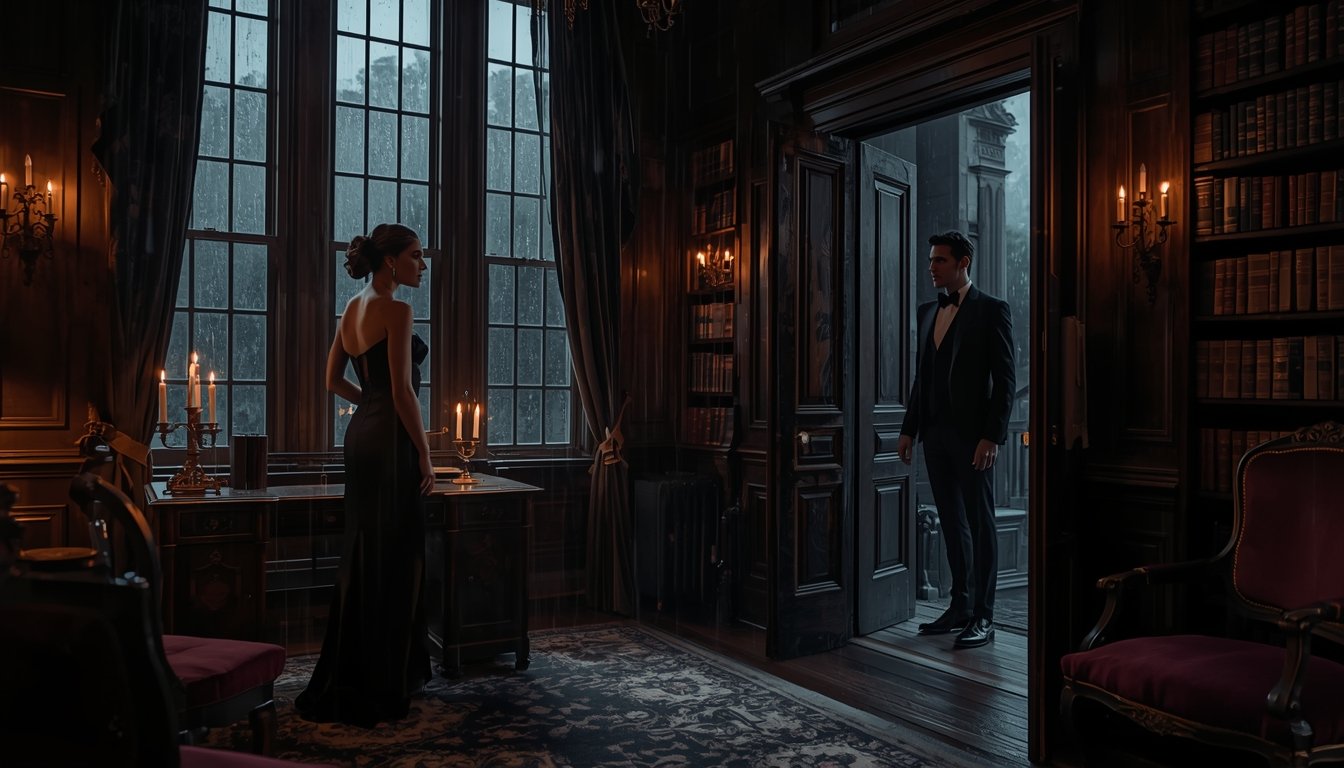
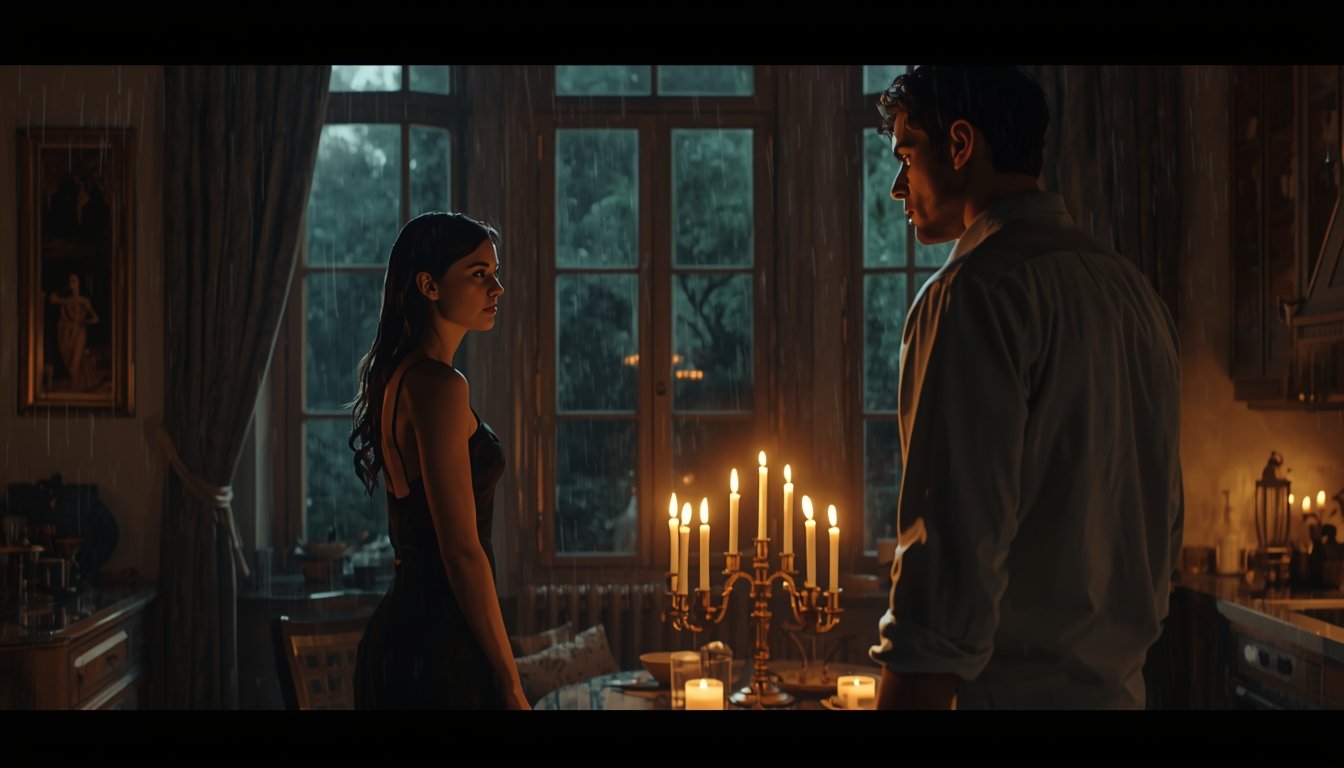
Dinner was all candlelight, polished silver, and careful laughter. Celia sat halfway down the long table between an uncle she disliked and a florist who had too many opinions about white roses. She might have passed through the evening untouched if she had not looked up during the soup and seen him standing in the doorway.
Lucian Vale.
He had removed his coat, though not the weather from himself. Rain still darkened his hair at the temples. One hand rested lightly against the carved frame as he spoke to Celia’s aunt in a voice too low to hear. Years ago, he had been the estate archivist’s son, then Saint Vale Court’s least welcome presence, then the reason Celia learned how quickly a family could turn affection into surveillance.
Age should have made him safer.
Instead, it made him harder to dismiss.
Isabelle leaned closer. “I forgot to tell you. He’s handling the chapel restoration before the ceremony.”
Celia kept her gaze on her plate. “That seems unwise.”
“For whom?”
She did not answer.
Lucian had once kissed her in the chapel orchard during a July storm while the bells shook above them. She had been twenty-three. He had been twenty-nine and already spoken of as unsuitable in at least six different ways, which in families like hers meant he lacked both money and obedience.
Her aunt ended it in forty-eight hours.
Not the feeling. Only the visible part.
Across the table, Lucian finally looked at her. The distance between them was crowded with crystal, conversation, and years. Still, something tightened low in her chest with humiliating speed. Later, she would call it memory. In the moment, it felt far less innocent.
The Stair Toward the Bell Tower
She found the ribbon the next morning.
The chapel smelled of old stone, wax, and lilies delivered too early. Workers had left ladders near the side aisle, and the organ stood open as if expecting someone to confess into it. Celia came only to escape the bridal fittings in the main house. Yet the place had its own gravity, and she wandered farther than she intended.
A narrow stair at the rear led toward the bell tower.
Halfway up, she noticed something caught on a nail beside the rail. It was a strip of crimson ribbon, faded at the edges but still vivid at the center, tied in a deliberate knot. When Celia touched it, a chill passed through her.
Lucian’s voice rose from below. “You always did climb where you were told not to.”
She turned too quickly. He stood at the foot of the stairs in shirtsleeves, one hand resting on the banister, watching her with an expression that was not surprise.
“Were you following me?” she asked.
“No. I was looking for cracked leadwork near the tower window.”
“And instead you found me.”
“You say that like it’s a minor inconvenience.”
Celia glanced back at the ribbon. “What is this?”
Lucian climbed two steps, then stopped. “I wondered whether it was still there.”
“You knew about it.”
“I tied it there.”
Her hand went still on the rail.
Below them, morning light filtered through stained glass and cast jewel tones across the stone floor. The chapel felt both holy and theatrical, which suited Saint Vale Court perfectly. Meanwhile, the air between them grew more strained with every second. Stories rich in Thriller tension often began with a sign that only mattered to two people. This one belonged equally to memory and provocation.
What Waited Behind the Panel
Lucian moved higher until he stood one step beneath her.
“There’s a loose panel near the top landing,” he said. “I hid something behind it years ago. I thought the workmen might find it before the wedding.”
Celia gave a soft laugh. “And telling me improves matters?”
“Not improves them. Changes them.”
She should have walked away. Instead, she continued upward.
The bell tower chamber was small and colder than the nave below. Pigeons had once nested in the corners, though now only dust and old feathers remained. Rain tapped against the louvers. Lucian crossed to the wall beneath the bell rope and pressed on a warped section of oak paneling. After a second, the wood shifted.
Inside was a shallow recess.
Within it lay a narrow tin box wrapped in oilcloth and bound with another piece of the same crimson ribbon.
Celia stared at it. “What did you do?”
“Saved what your family wanted destroyed.”
He handed her the box. It felt heavier than its size should allow. When she untied the ribbon, the knot came loose with infuriating ease, as if it had been waiting for her hand alone.
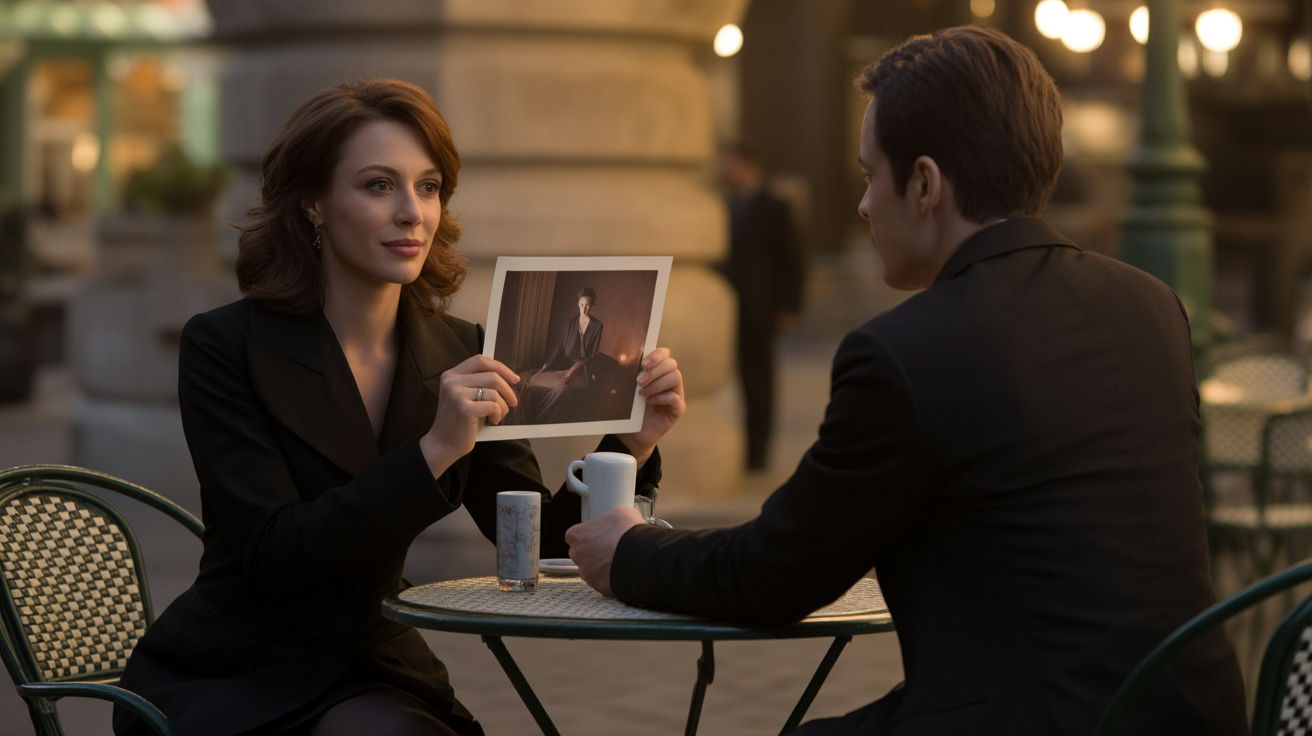
Inside were six letters, a dried white camellia, and a small photograph of the chapel taken from the choir loft many years earlier. In the image, Celia stood in the side aisle while Lucian turned toward her. They were not touching. They did not need to be. Anyone with eyes would have understood enough.
Her stomach tightened.
“Who took this?”
“Your cousin.”
Isabelle’s Hand in It
Celia looked up sharply. “Isabelle?”
Lucian nodded once. “She knew before your aunt did.”
“No.”
“She found one of your notes in the orchard wall and brought it to me with that photograph. Then she said you were frightened, that you wanted everything back, and that I was making your life impossible.”
Celia’s fingers tightened around the tin box. “She told me you had chosen ambition over me. She said you wanted money from the family and thought I was the easiest path toward it.”
“I know.”
Silence filled the bell tower. Wind pressed against the louvers with a low, restless moan.
“Why keep this?” Celia asked at last.
Lucian glanced at the letters. “Because once I understood we were being handled from both sides, I became less interested in dignity.”
One envelope carried Celia’s handwriting. Another did not. That one was addressed to Lucian in Isabelle’s script. Celia opened it first, although she already felt the answer moving toward her.
Leave before she ruins everything.
You know how she is when she wants something she cannot defend. If Aunt Sabine discovers the truth, she will cast Celia out and punish us all with it. Go now, and I’ll make sure your father keeps his position at the estate archives.
This is mercy, whether you recognize it or not.
Celia read the final line twice. Then she set the page back down with such care it resembled tenderness.
It was not tenderness. It was control.
The strongest stories in Secrets & Suspense and Psychological fiction rarely needed monsters. Families could do enough damage with language, timing, and the right arrangement of fear.
The Wedding House in Daylight
By noon, Saint Vale Court had turned bright with guests, flower deliveries, and the expensive anxiety of final preparations. Celia moved through it as though behind glass.
Every room offered a polished version of anticipation. In the morning room, seamstresses pinned Isabelle into ivory silk while her mother corrected everyone’s breathing. On the terrace, men in dark coats discussed wine with solemn urgency. Meanwhile, the bell tower kept its tin box and its faded ribbon above them all like a threat the house had not yet announced.
Isabelle found Celia alone in the gallery just before tea.
“You disappeared,” she said. “Don’t do that this weekend. I need at least one person here who still knows how to act normally.”
Celia looked at her cousin’s face, so composed and lovely under the chandelier light, and understood suddenly why some betrayals lasted. They did not arrive in ugly clothing. Instead, they arrived charming, plausible, and even affectionate.
“Did you ever go into the bell tower?” Celia asked.
Isabelle’s smile shifted by only a fraction. “Why?”
“Because I found something there.”
For the first time, a real silence opened between them.
Then Isabelle sighed. “If this is about Lucian, I saved you from a great deal of embarrassment.”
“You lied to both of us.”
“I managed both of you.”
The difference in wording was almost elegant.
“Why?” Celia asked.
Isabelle’s eyes stayed calm. “Because you were foolish, and because he was never meant to stay in your life. Aunt Sabine would have destroyed him. I merely made the outcome cleaner.”
“Cleaner for whom?”
“For the family.”
Celia let out a low breath. “Of course.”
What She Could Not Forgive
Isabelle moved closer. “You should thank me, honestly. You always confused intensity with destiny.”
Celia had expected denial, perhaps even shame. This cold confidence was worse. It suggested her cousin had rehearsed righteousness until it felt indistinguishable from love.
“You wrote to him,” Celia said. “You threatened his father’s position.”
“I protected the house.”
“From what?”
“From you making one spectacular mistake and calling it romance.”
The gallery windows trembled under a rush of wind. Somewhere downstairs, someone laughed too loudly. Still, the wedding house kept breathing around them, ignorant or indifferent.
Celia might have tolerated cruelty. She had grown up among polished varieties of it. What she could not forgive was theft. Isabelle had taken choice and then renamed the theft as care.
That was the wound.
That was also the reason Celia knew the wedding could not proceed untouched.
She thought of the quiet devastation that powered Drama and the intimate distortions found in Mind Games. This family had practiced both for generations, dressing coercion in silk and calling it refinement.
The Orchard After Rain
Rain returned before evening. Celia walked out to the chapel orchard without telling anyone where she was going. The old trees leaned under the weather, their leaves dark as lacquer. At the far wall, Lucian stood where he had once waited for her with mud on his shoes and impatience in his smile.
Now the impatience had become something harder.
“Did you confront her?” he asked.
“Yes.”
“And?”
Celia gave a brief, humorless laugh. “She called manipulation mercy. Very convincing, if one has no soul.”
Lucian watched her for a long moment. “I should have come back sooner.”
“Why didn’t you?”
Rain ticked softly through the orchard leaves.
“Because after my father died, I found the rest of your notes folded inside one of his account books,” he said. “I realized then how many people had chosen the shape of our ending for us. Later, I thought returning would only reopen a ruin you might have learned to live inside.”
Celia held the crimson ribbon in one hand. Although the silk had faded, it still looked indecently alive against her skin.
“And now?” she asked.
“Now I think ruin is sometimes the honest option.”
The answer passed through her like cold wine. It was not a promise. Instead, it was the sort of truth that made promises look decorative.
Between them stretched all the years no one had allowed to be real. Yet the air felt dangerously unchanged. Readers who loved Romance for tenderness alone might have turned away. Those who stayed for pressure, longing, and forbidden longing would have understood the silence perfectly.
The Ceremony Splits Open
Saturday arrived clear and cold.
The chapel filled before noon with perfume, black coats, satin sleeves, and the hush that always precedes a public lie. Celia took her place near the front as Isabelle came down the aisle with a veil like poured light. Lucian stood near the side transept, supposedly there to monitor a repaired leaded pane. His face revealed nothing.
The priest began.
Celia lasted through the first reading, the first prayer, and half the vows. Then Isabelle lifted her chin toward the altar with that serene certainty Celia now recognized as conquest, and something in Celia hardened beyond recovery.
So she rose.
The chapel turned toward her in ripples.
“Before this continues,” Celia said, her voice carrying farther than she expected, “the bride should explain why she once forged kindness out of threats and ended a life that was not hers to arrange.”
Gasps were vulgar things in ordinary rooms. In a chapel, however, they sounded almost ceremonial.
Isabelle went white, then cold. “Sit down.”
“No.”
Celia took the letters from her bag. The crimson ribbon was wrapped around them like a wound dressed for display. “You told me Lucian abandoned me. You told him I withdrew. You threatened his father’s work. You called it mercy.”
Shock in the Chapel
The priest stepped back. Guests began to whisper. Aunt Sabine looked less shocked than furious that the scandal lacked her permission. Meanwhile, Isabelle’s groom stared as though he had just discovered the floor beneath him was decorative.
“You are hysterical,” Isabelle said.
Celia smiled then, because the insult was lazy and therefore weak. “No. I am simply finished being managed.”
After the Wedding Fails
The ceremony dissolved quickly after that.
Some guests left at once in a rush of velvet, outrage, and delighted future gossip. Others remained to watch the family fracture with the patient appetite only old money could refine into etiquette. Isabelle denied everything for eight minutes, then made the mistake of calling Lucian opportunistic in front of the groom, who asked very quietly whether she had lied about other things as well.
That question did the rest.
By late afternoon, Saint Vale Court had become a masterpiece of damage control. Doors closed. Staff moved faster. Sabine issued instructions in a voice that suggested human feeling was merely an administrative inconvenience. Meanwhile, Celia packed her case with a steadiness that surprised her.
Lucian found her in the west hall as servants carried away untouched wedding flowers.
“Where will you go?” he asked.
“Away from the family performance,” she said. “That seems a promising start.”
He nodded, though something restless crossed his expression. “And after that?”
Celia looked toward the chapel windows at the end of the corridor. Sunlight struck the glass there and turned the floor red and gold, almost the exact color of the old ribbon in her pocket.
“After that,” she said, “I decide without witnesses.”
His mouth nearly softened into a smile. “That sounds dangerous.”
“It probably is.”
What the Ribbon Became
She left before dusk.
At the gate, Celia asked the driver to stop for one final minute. The chapel spire rose above the trees behind her, pale against the darkening sky. Somewhere inside it, the bell tower still held the space where the tin box had waited all those years, protected by dust, height, and the arrogance of people who assumed hidden things remained theirs forever.
From her coat pocket, Celia drew the ribbon.
It had once marked a place of concealment. Now it marked survival.
Rather than tie it back to the tower, she wrapped it around the bundle of letters and set them beside her on the seat, not as relics of innocence, but as proof that innocence had never been the point. Love had not failed because it was weak. Instead, it had been interrupted because other people found control more useful than truth.
That knowledge did not make the feeling gentle. It made it sharper.
Beyond Saint Vale Court
Chapel shadows, orchard rain, and the long theft arranged in beautiful rooms stayed with her as the car waited at the gate. So did the image of Lucian, who had returned without asking for rescue, and the memory of herself standing in the aisle at last with ruin on every side and relief beneath it.
Outside, evening gathered over Saint Vale Court. Inside the car, the crimson ribbon, the bell tower secret, the ache of hidden letters, and the old heat of romantic tension settled into a future that had not yet chosen its final shape. Some endings closed like doors. Others waited like storms beyond the estate gates.
As the car rolled forward, Saint Vale Court fell behind her: a broken wedding, a family forced to hear itself clearly, and a chapel that had finally surrendered its secret. Ahead waited uncertainty, scandal, and the dangerous freedom of wanting something again. For a woman raised to call obedience peace, that was more than enough to begin.