By the fifth rehearsal, Clara had started measuring her engagement by the studio key.
At first, the key had seemed like nothing.
Bellgrave Academy owned too many rooms, too many mirrors, and too many old decisions polished into tradition. Therefore, doors were always being unlocked for someone important. Donors wanted tours. Instructors wanted storage opened. Costumers wanted access to rails of sleeping silk. So when Mara pressed a brass key into Clara’s palm before evening rehearsal and said, “You’ll need the west studio before Owen arrives,” the gesture should have remained practical.
However, practical things become dangerous when they begin to repeat.
Each evening after that, Clara found herself waiting for the moment the key changed hands. It happened quietly. No witness would have called it intimate. Even so, the brief contact carried a charge the rest of her life had begun to lack.
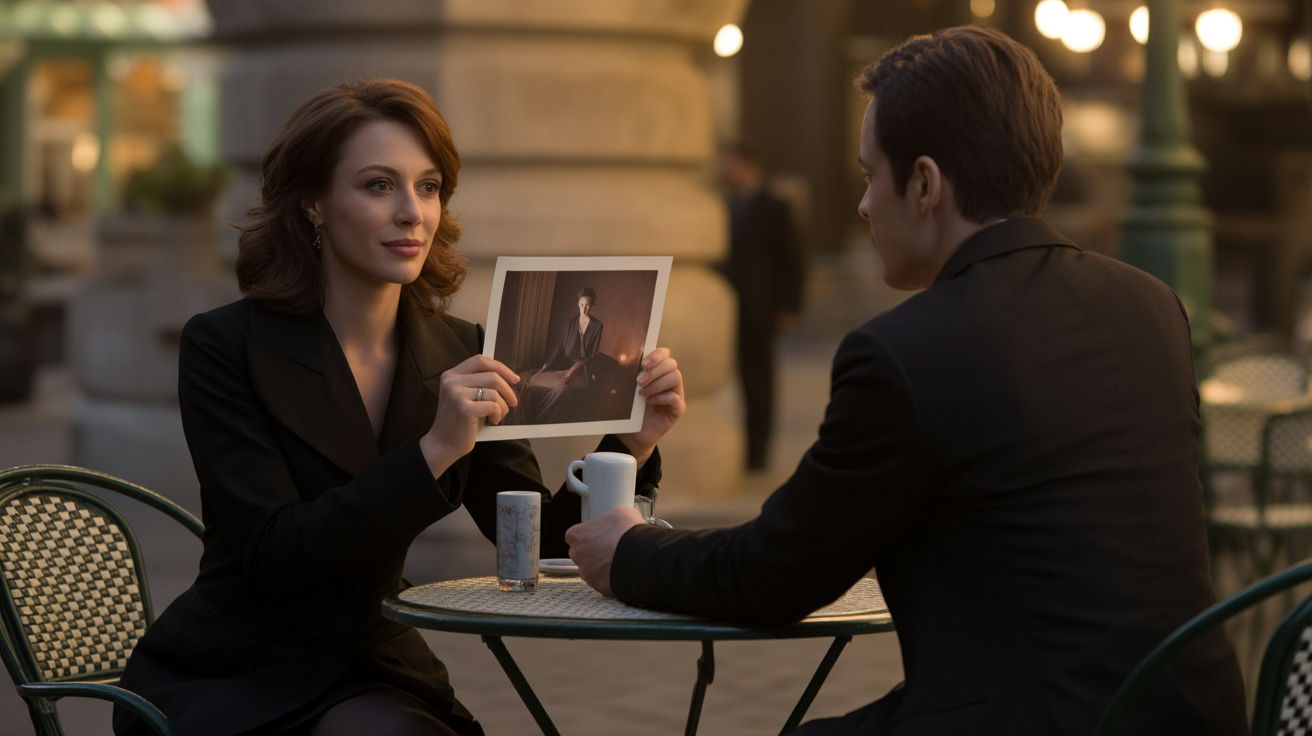
“You’re early again,” Mara said on the fifth night.
Clara closed her fingers around the metal. “That sounds suspiciously like disapproval.”
“No,” Mara replied. “Only observation.”
The answer should have been harmless. Instead, it unsettled the whole evening.
What Bellgrave Expected
Bellgrave Academy was one of those institutions that mistook survival for virtue.
The building stood on a hill above the river, all stone arches, narrow staircases, and framed photographs of impossible ankles from better-funded decades. By day, children crossed the front court in neat knitwear while parents discussed scholarships in softened voices. By contrast, evening belonged to adults, private rehearsals, and the patrons whose money preserved the illusion that art could remain untouched by commerce.
Clara had entered that world through Owen Mercier.
He was handsome in the curated way wealth often permits. He remembered names. He sent flowers after minor disappointments. He spoke about Clara’s future at Bellgrave as if inclusion were the same thing as love. Meanwhile, his mother chaired the restoration board, his father funded the summer program, and his surname moved through the academy like an extra source of lighting.
Their engagement had been announced three weeks earlier at a donor dinner attended by people who applauded restraint the way other crowds applauded talent.
At lunch one day, Clara found herself drifting through the Dark Romance and Forbidden Love archives on her phone, as though fiction might explain why approval could feel so similar to enclosure. It did not. Nevertheless, those pages gave shape to the trouble she had not yet named: sometimes a future becomes frightening because it arrives already furnished.
The Woman with the Rehearsal Rooms
Mara Sloan did not belong to the Mercier version of Bellgrave.
That was obvious even before Clara knew anything about her. She wore black knit dresses and practical boots. She carried sheet music instead of gossip. During rehearsals, she sat at the academy piano with the composure of a woman who trusted rhythm more than people. Everyone relied on her. Few spoke about her unless necessary.
Officially, Mara was the academy accompanist for the winter gala. Unofficially, she kept the building running after six. She knew which mirrors distorted posture, which radiators failed first, and which doors swelled in wet weather. Most importantly, she kept the brass ring of room keys clipped inside her tote bag with almost ceremonial indifference.
On the second evening Clara stayed late, Mara said, “Owen has never learned the west studio lock.”
“That sounds ungenerous.”
“It sounds proven.”
Clara laughed before she meant to.
That was the first real crack in the evening.
Why the Studio Key Mattered
The west studio sat above the river side of the building, far from the public halls and donor portraits. Its windows were tall enough to collect the last blue of daylight. Its floorboards held old rehearsal marks beneath fresh varnish. Because the academy used the room only for advanced coaching, it often stood empty until night.
Clara had been given the space to practice a solo for the winter benefit, a private honor arranged by Owen’s mother and presented as confidence in her talent.
That should have pleased her. Instead, the room felt loaned rather than earned.
Meanwhile, Mara alone seemed able to open it without performance. She crossed the corridor, turned the lock, and pushed the door inward as if the studio answered to no one but use.
“There,” she said on the third night. “It behaves better when respected.”
Clara glanced at the old brass key in Mara’s hand. “Is that how you describe all difficult things?”
A faint smile moved at the corner of Mara’s mouth. “Only the ones that still work.”
After that, the studio key acquired a second meaning Clara disliked too much to ignore.
The Rehearsal Before the Dinner
One Thursday, the academy hosted a planning supper for the gala committee.
Clara was expected downstairs in a dark blue dress at eight-thirty. Until then, she had an hour to rehearse in the west studio while Mara prepared the accompaniment for the benefit variation. Owen promised to join them after his meeting with the event sponsors. Consequently, the evening began in a shape that should have been ordinary.
Yet nothing in the room felt ordinary once Mara sat at the piano.
Music altered her. Not theatrically. If anything, it made her more exact. Notes entered the air without pleading for admiration. Rhythm became authority. Clara danced badly at first because she was too aware of being watched. However, Mara never corrected her with softness. She corrected her with honesty, which proved far more intimate.
“Again,” Mara said.
“That sounded severe.”
“You’re reaching the turn before you trust it.”
Clara stood breathing hard in the fading light. “That was annoyingly perceptive.”
Mara’s hands rested motionless on the keys. “I’m paid for timing, not comfort.”
The line should have ended there. Instead, Clara said, “And outside music?”
For the first time all evening, Mara looked away. “Outside music, I try not to interfere.”
The answer stayed in the room long after the last note had gone.
What Owen Noticed Too Late
Owen arrived twelve minutes before supper carrying charm and apology in equal measure.
“I’m late,” he said, kissing Clara’s cheek with practiced warmth. “Sponsors behave like royalty when they have enough money to resent being thanked.”
From the piano, Mara closed the score. “That sounds exhausting.”
“Not as exhausting as art,” Owen replied lightly.
The joke passed, but Clara felt the room cool around it. Owen admired Bellgrave most when it made him appear generous. Mara, by contrast, seemed loyal only to the work itself. That difference had once felt academic. Now it felt like fault.
During supper downstairs, donors discussed lighting budgets and floral restraint. Owen’s mother praised Clara’s poise in front of three women who evaluated poise professionally. Meanwhile, Mara sat farther down the table beside the costume supervisor and said almost nothing.
Across the long white cloth, Clara caught herself searching for her anyway.
That was the first unforgivable thing.
The Night of the Blackout
The following week, a storm crossed the river just before rehearsal.
At seven-twelve, the academy lights dimmed. At seven-thirteen, the east corridor went dark completely. Staff moved through the building with torches and muttered expertise. Because the backup system covered only the public halls and offices, the upper studios fell into shadow fast enough to feel intentional.
Clara was standing by the west studio door when the power failed.
From the stairwell, Mara’s voice reached her first. “Don’t move.”
Then the beam of a small emergency lamp cut across the corridor. Mara appeared carrying the light in one hand and the brass keys in the other. Rain sounded against the tall windows like handfuls of thrown gravel.
“Are you afraid of the dark?” Mara asked.
“Only when buildings enjoy it.”
That answer earned the briefest smile.
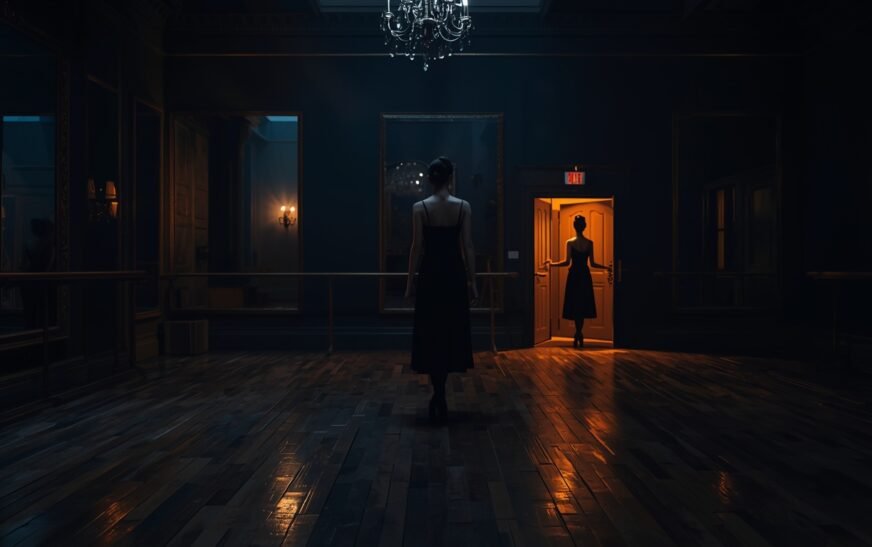
Instead of sending her downstairs, Mara unlocked the studio and set the lamp on the piano lid. Soft amber light spread across the room, finding the mirrors in broken reflections.
For several seconds neither of them spoke.
Then Clara said, “You always look as if you already know the end of an evening.”
Mara’s fingers tightened around the keys. “That has never improved one.”
Outside, thunder moved over the river.
What Mara Refused to Say
The storm trapped them in the west studio for nearly twenty minutes.
No music followed. No confession either. That restraint made everything worse.
Clara sat on the rehearsal bench with her hands folded too carefully in her lap. Mara remained by the windows, half turned toward the dark glass, as if the weather deserved more trust than conversation. Nevertheless, the silence between them was not empty. It was crowded with discipline.
Finally, Clara said, “Do you dislike him?”
“Owen?”
“You made that sound clinical.”
Mara looked down at the brass ring of keys. “He is not cruel.”
“That was not my question.”
A pause followed. Then Mara answered, “No. He isn’t the problem.”
Clara felt the room contract around that sentence. “What is?”
Very quietly, Mara replied, “Timing.”
By the time the corridor lights returned, the truth had already taken shape between them without the courtesy of language.
The Studio Key After Midnight
Later that same night, Clara could not sleep.
Rain still touched the windows of Owen’s apartment in thin, persistent lines. Beside her, he slept with the confidence of a man who believed tomorrow would continue in the same obedient direction. Clara lay awake thinking about the west studio, the emergency lamp, and the way Mara had said the word timing as if it were an old injury rather than an excuse.
At 12:17, her phone lit with a message.
You left your scarf in the piano room.
No greeting. No softness. Mara’s restraint remained intact even in text.
Clara stared at the screen before replying.
You could have left it with reception.
Three dots appeared, vanished, then returned.
I could have.
That was all.
Nothing in the exchange was overt. Even so, it felt more intimate than lines better people might have condemned more easily.
The Benefit Rehearsal
Saturday brought the final gala run-through.
Bellgrave looked polished enough to deny every private discomfort inside it. Staff adjusted candles in the lower hall. Donors arrived early to inspect progress. Owen moved through the building as if he already belonged to its future. Meanwhile, Clara waited backstage in the west studio while Mara checked the score one last time.
“You can still leave,” Mara said without looking up.
Clara went still. “That is a dangerous thing to offer five minutes before a donor rehearsal.”
“Dangerous is not the same as false.”
From downstairs came the dull rise of voices, the social hum of people who had never doubted their right to organize other lives.
Clara stepped closer to the piano. “Would you come with me?”
At last Mara looked up.
The answer took long enough to hurt. “Not tonight.”
The refusal landed with strange precision. It was not rejection. It was ethics, which often feels colder at first touch.
Then Mara added, “Leave because you mean it. Not because I’m standing here.”
That was the cruelest honest thing anyone had done for her in years.
What the Public Room Could Not Hold
Clara danced the rehearsal well enough to earn applause.
That made everything worse.
After the final turn, Owen met her offstage with flowers and a kiss to her temple. His mother called her luminous. Two donors discussed future programming as if Clara had already been permanently framed inside the academy. Across the room, Mara stood by the piano with Clara’s forgotten scarf folded over one arm like a private verdict.
At that moment, the shape of the future became unbearable in its neatness.
“Owen,” Clara said, before caution could arrange better phrasing, “we cannot do this.”
The room went still in ripples.
He frowned first, not wounded yet, only inconvenienced by public difficulty. “Do what?”
“All of it.”
Her own voice sounded calm, which surprised her. Then again, truth often arrives flatter than panic.
His mother took one step forward. A donor looked away too late. Somewhere near the back, a stage manager pretended to become fascinated by cable placement.
“Clara,” Owen said quietly, “this is not the place.”
“No,” she answered. “That’s why it has lasted so long.”
After the West Studio Closed
There was no beautiful ending that night.
Owen’s anger remained contained, which made it more humiliating in public and less useful in memory. His mother spoke of pressure, confusion, and postponement in the language of women who believe shame can be negotiated into discretion. Clara listened, handed back the ring with steadier fingers than she expected, and left before anyone could improve the story into something survivable.
Outside, the academy steps were wet from earlier rain.
Mara came after her only once the building had fully absorbed the scandal. She held out the brass key and Clara’s scarf together.
“You forgot both,” she said.
Clara looked at the key in her hand. “I think one of them was never mine.”
Mara did not smile. Instead, she stepped close enough for the space between them to feel deliberate and adult and difficult.
“The west studio reopens on Monday,” she said. “There’s a slot at seven no one has claimed.”
“Is that an invitation?”
“No,” Mara replied. “It’s a door.”
For the first time in weeks, Clara laughed without caution.
Nothing was resolved. Owen would remain furious. Bellgrave would continue polishing the evening into a version suitable for donors. Even so, one fact stood clear beneath all the ruin: the studio key had never merely opened a rehearsal room. It had opened the one choice Clara had been postponing long enough to mistake for fate.