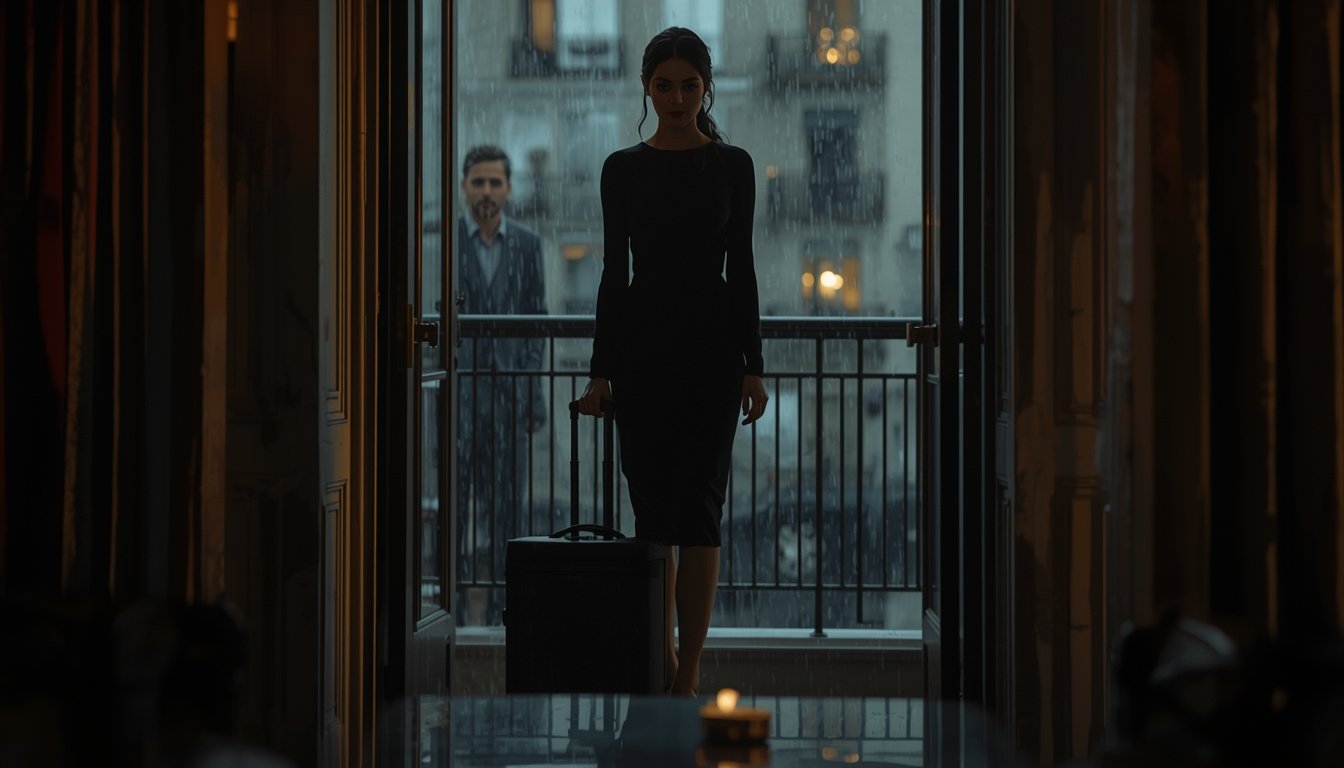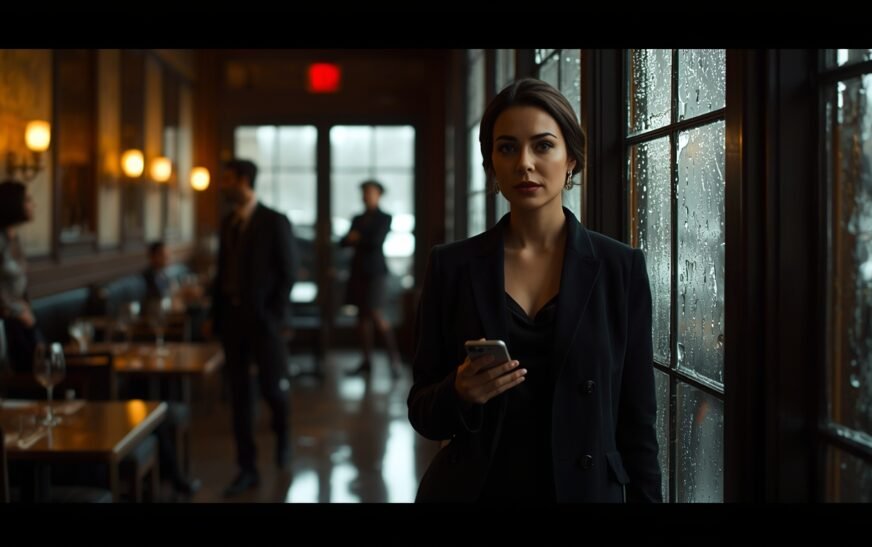
Elena received the courtesy call while standing beneath the awning outside Bellmere House, with rain stippling the pavement and her father’s birthday gift cooling inside its silver paper. Daniel’s name lit her screen just as a waiter opened the restaurant door for a passing couple. She smiled at first, because she assumed he was calling to say he had found parking. Instead, his voice arrived low and careful, already dressed for retreat.
“I’m running behind,” he said. “Go in without me.”
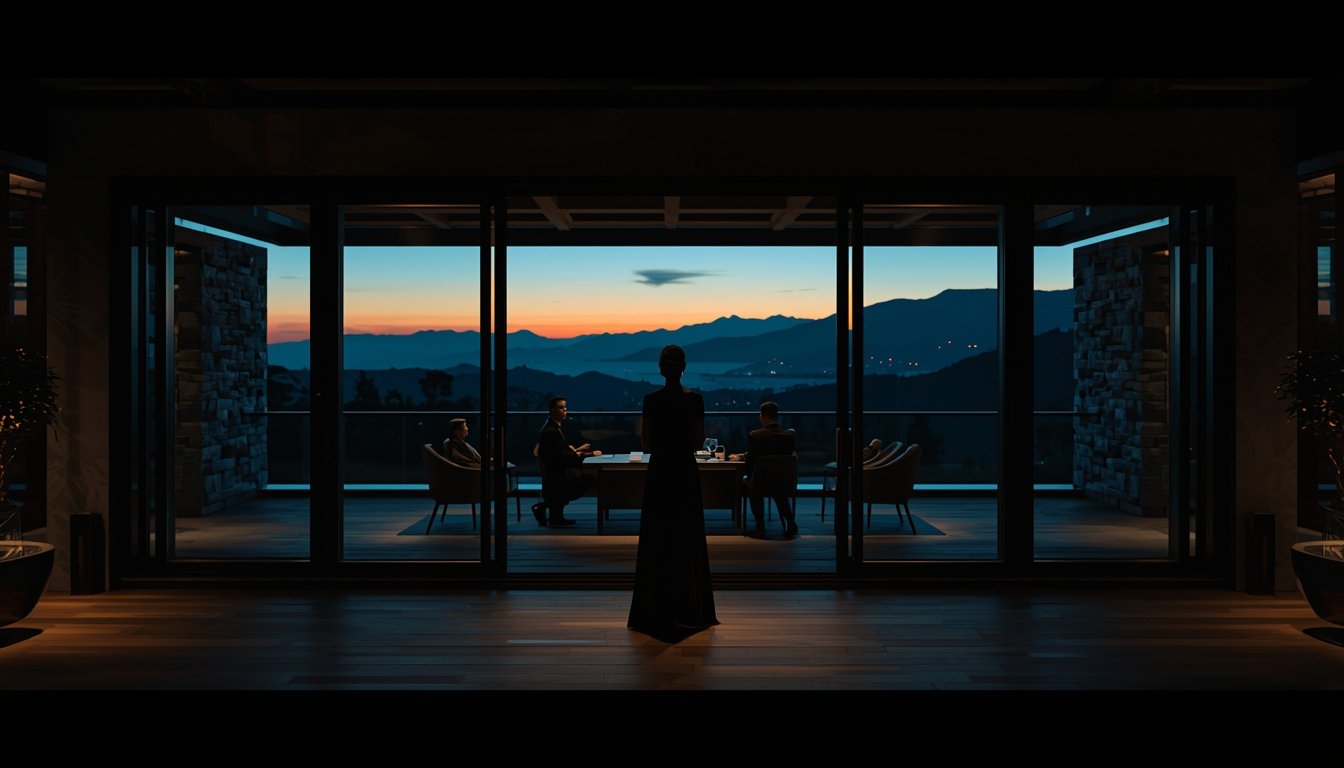
Bellmere House stood at the corner of two expensive streets, all dark windows and pale stone, the kind of restaurant that made family occasions feel more intact than they were. Elena adjusted her grip on the gift bag and looked through the glass. Her mother was already at the table near the back, one hand folded over the menu. Nearby, her younger brother leaned toward the bread basket with the hunger of a man who disliked ceremony. No one had seen her yet.
“How far behind?” she asked.
Rain gathered on the awning seam, then fell in slow drops beside her shoulder. Meanwhile, Daniel exhaled with a softness she had started to distrust in recent weeks.
“I’m not sure,” he said. “I didn’t want you standing outside waiting. I thought a courtesy call was better.”
Better than what, she almost asked. Better than arriving? Better than telling the truth?
Before she went inside
At first, Elena told herself not to build meaning where there might only be delay. City traffic stalled everything. Meetings ran late. Adults with jobs and obligations became inconvenient by accident all the time. Nevertheless, something in Daniel’s tone felt arranged rather than rushed.
“Are you coming?” she asked.
He paused for half a beat. “I’ll try.”
Not yes. Not even of course.
Elena watched a taxi move through the rain with its roof light glowing pale amber. For a moment, she imagined turning away from the restaurant altogether, walking past the florist, across the square, into some other version of the afternoon. Instead, she said, “They’re expecting you.”
“I know.”
“Then don’t make me explain your absence before dessert.”
Daniel was quiet long enough for her to hear dishware clink through the restaurant door. “I’m not asking you to explain anything,” he said.
That sentence should have comforted her. However, it felt like a line spoken by someone who had already stopped imagining himself beside her at the table.
“Fine,” Elena said. “Come when you can.”
“Thank you.”
She ended the call before his politeness could make her feel unreasonable.
The family table
Inside, warmth wrapped around her damp sleeves and carried the scent of browned butter and rosemary. A server took her coat. The piano in the side room moved through something light and forgettable. By contrast, her chest felt too tight for elegant places.
Her father stood when he saw her. “There she is.”
Elena smiled and crossed to him, kissing his cheek before passing over the gift. More carefully, her mother rose and adjusted the silk scarf at her neck. Tomas, already on his second piece of bread, lifted a hand in greeting.
“Where’s Daniel?” her mother asked at once.
There it was. The first required answer of the afternoon.
“Running behind,” Elena said, taking her seat. “He called from the car.”
Her father waved one hand. “Good. Then he’s alive. That puts him ahead of most men in this weather.”
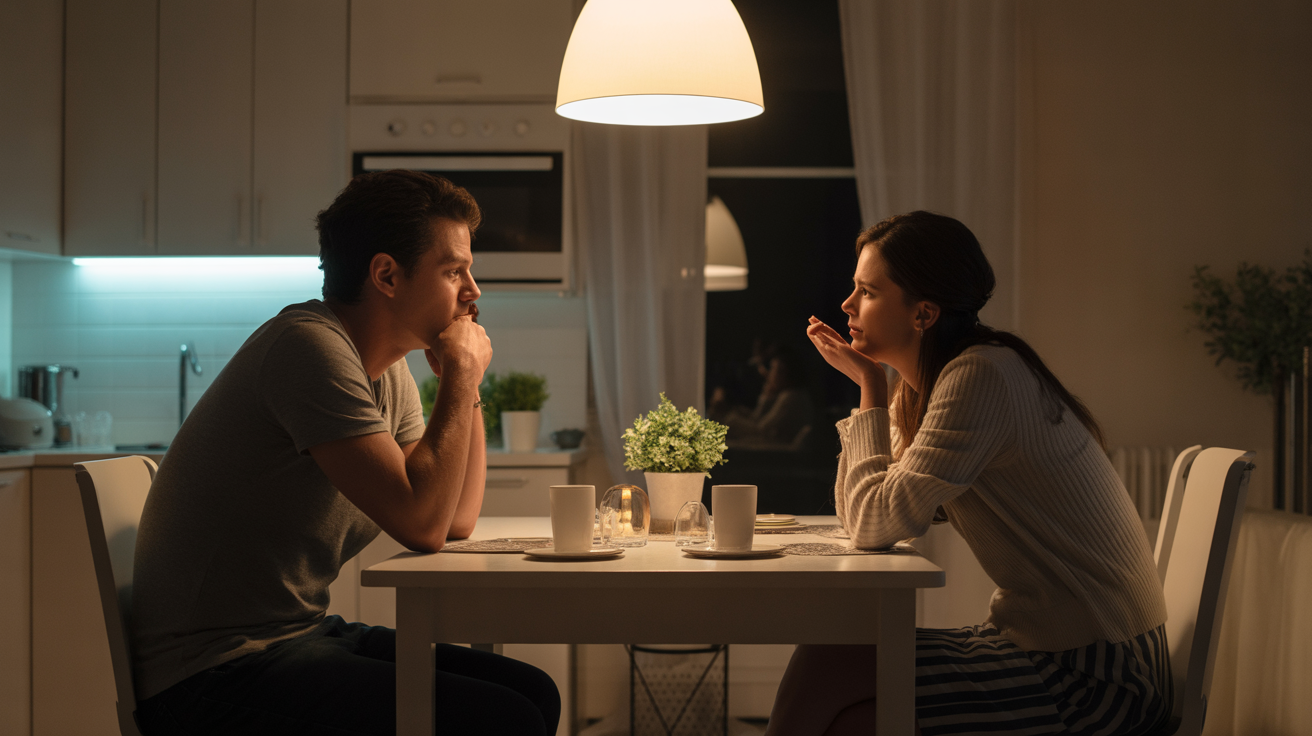
Tomas laughed. Meanwhile, Elena unfolded her napkin and placed it in her lap with more care than necessary. The chair beside her remained empty, a detail no one mentioned again for nearly eight minutes.
Then the drinks arrived.
“Still delayed?” her mother asked.
Elena reached for the water glass before answering. “Still delayed.”
“Hm.” Her mother’s expression sharpened almost invisibly. “Interesting day to misjudge time.”
Her father asked about work, and Tomas launched into a complaint about an impossible client. Therefore, conversation moved on. Still, the empty chair kept its own presence at the table, like a guest made entirely of omission.
What her mother noticed
By the time the starters arrived, Elena had checked her phone three times without new messages. She began replying to emails she did not care about, purely for the comfort of moving her hands.
Her mother watched this in silence until the waiter set down the soup.
“You can tell me now,” she said quietly.
Elena looked up. “Tell you what?”
“Whether you are angry with him or embarrassed by him.”
Tomas groaned. “Please don’t do this before the fish course.”
Their father gave a mild warning glance, but their mother had already fixed on Elena with the merciless tenderness only mothers and surgeons seemed to possess.
“I’m neither,” Elena said.
“Then you are disappointed,” her mother replied. “That one is worse because women defend it as patience.”
Elena almost laughed. Instead, she lifted her spoon. “He’s late. That’s all.”
“All right,” her mother said, though her tone suggested she did not believe in small things arriving alone.
Outside the long windows, rain streaked the square in slanted silver. A couple hurried past beneath a black umbrella. Somewhere deeper in the restaurant, someone applauded softly for an unseen birthday cake. Meanwhile, Elena became aware of how long Daniel had been “on his way.”
The second call
The courtesy call should have been the only one. Instead, Daniel called again just as the main course was served.
Her phone vibrated against the tablecloth. Tomas glanced at the screen and looked away with conspicuous effort. Elena excused herself before anyone could comment, then crossed the dining room toward the corridor beside the coat check.
“Where are you?” she asked the moment she answered.
“Still downtown.”
“Daniel, lunch started forty minutes ago.”
His voice remained calm, too calm. “I know. That’s why I’m calling.”
Cold moved across her despite the heated corridor.
“You already called.”
“Elena…”
A server passed carrying wine glasses on a tray. She stepped closer to the wallpapered wall and lowered her voice. “Do not use my name like that unless you are about to say something simple.”
For a moment, all she heard was traffic hissing through rain on his end of the line.
“I don’t think I should come,” he said.
The corridor seemed to narrow.
“To lunch?”
“Today.”
“That is the same thing.”
“No,” Daniel said, and suddenly she understood this was not about lateness at all. “It isn’t.”
In the corridor by the coats
At first, Elena felt nothing but irritation refined to a sharp, useful point. Anger was easier to hold than fear. Later, other emotions would enter. For the moment, however, she leaned against the wall and forced each word out cleanly.
“You picked my father’s birthday lunch for this?”
Daniel answered too quickly. “I didn’t pick today.”
“You called twice. That suggests planning.”
“I was trying to handle it with respect.”
Respect. The kind word always arrived first with him now, smooth as pressed linen.
Elena watched a child in patent shoes skip past the corridor entrance with her grandmother. Their laughter felt obscene in the polished air.
“Handle what?” Elena asked.
He exhaled. “Us. The fact that we haven’t been right for months.”
“Then you should have spoken to me months ago.”
“I was trying to understand it.”
“No,” she said quietly. “You were trying to arrange it.”
He did not deny that. Instead, he said, “I didn’t want a scene.”
“So you gave me a hallway.”
The silence that followed carried its own confession.
The part she learned too late
“Has anyone else known before me?” Elena asked.
Daniel hesitated.
That hesitation answered first. His words came after.
“I talked to Leo,” he said. “And to Mara.”
Leo was his brother. Mara was the friend who had introduced them six years earlier, the one who still sent anniversary messages with too many exclamation marks.
Elena closed her eyes for a moment. “You told other people we were ending before you told me?”
“I told them I was struggling.”
“Do not thin the sentence down now.”
Her voice remained level, which frightened her more than if she had shouted. Meanwhile, the corridor lights glowed softly over framed sketches of old city streets, all calm lines and tasteful nostalgia. She had never hated tasteful rooms more.
“I needed perspective,” Daniel said.
“You needed witness,” Elena replied. “There’s a difference.”
Someone laughed at the far end of the corridor. A coat hanger clicked against a rail. Life continued with unbearable smoothness.
“Does my mother know too?” she asked.
“No.”
“How generous.”
He said her name again, but she cut across it.
“You made me walk into a family lunch carrying your absence like a tray.”
“I thought calling first was kinder.”
“It was a courtesy call,” Elena said. “Courtesy is what you offer strangers before passing them on the street. It is not what you build a six-year ending on.”
Back at the table
When she returned, the sea bass had arrived. Her mother looked up immediately. Her father pretended not to. Tomas stopped cutting his food.
Elena sat down and lifted her napkin again, though she no longer remembered where she had placed it.
“Well?” her mother asked.
No one else in the dining room seemed aware that one table had tilted out of balance. Forks rose and fell. Wine shone in glasses. The pianist had moved into something slower.
“He isn’t coming,” Elena said.
Her father frowned. “Car trouble?”
“No.”
Tomas set down his knife. “Then what?”
There was a mercy in plain language once the performance had become impossible.
“He chose today to tell me he doesn’t think we should continue,” she said.
Her mother’s face went still first. Then it hardened.
Her father looked as if someone had struck the table with an unseen hand. “On the phone?”
Elena nodded once.
Tomas swore under his breath.
For a moment, no one moved. Then her mother folded her hands beside the untouched bread plate and said, with terrifying softness, “Your soup is getting cold.”
Elena stared at her.
“Eat something,” her mother said. “Men do not get to take appetite with them.”
What her father said outside
Later, between the main course and dessert, her father asked Elena to step into the front vestibule with him. Rain still marked the windows in thin wandering lines. Guests arrived with wet collars and expensive umbrellas. The host smiled through all of it.
Her father stood beside the potted olive tree near the entrance and adjusted his cuffs twice before speaking.
“I liked him,” he said.
“I know.”
“That makes this more annoying, not less.”
Despite everything, she almost smiled.
He looked toward the street, where taxis drifted past the curb. “When your mother and I were younger, we fought badly but honestly. I always thought dishonesty looked louder than this.”
Elena crossed her arms against herself. “Apparently it can look very well mannered.”
“Yes,” her father said. “That’s the insult.”
His voice changed then, becoming gentler. “Did he tell others before telling you?”
She nodded.
The old anger that rarely reached his face appeared anyway. “Then he did not merely leave badly. He left you carrying the public version last.”
That sentence landed with painful precision because it named what had been hurting beneath the shock. Daniel had not only withdrawn. He had edited the order of dignity.
The dessert she almost refused
Back at the table, candles had been placed near the cake stand. Her mother had resumed talking to Tomas about an upcoming trip as if composure itself were an inheritance she intended to force into the next generation. Nevertheless, every few minutes her hand reached toward Elena’s wrist or glass or plate in some small unannounced act of repair.
When dessert arrived, Elena almost pushed it away.
“No,” her mother said at once. “Absolutely not.”
“I’m not hungry.”
“That is irrelevant.”
Tomas slid the plate closer to her. “Eat the chocolate and hate him efficiently.”
The laugh escaped before Elena could stop it. It hurt, but it also helped.
Then her phone lit again.
Daniel: I’m sorry for the timing.
No grand paragraph followed. No explanation opened underneath it. Just that thin sentence, standing alone as if apology could survive without architecture.
Elena turned the phone facedown.
“Was that him?” Tomas asked.
“Yes.”
“Block him,” he said.
Her father drank the last of his wine. “Not yet. People say truer things when they think time remains.”
After the courtesy call
The courtesy call had not been an act of kindness. Ultimately, it had been a method of control. Daniel had called ahead so he could begin the ending from a safe distance, while Elena entered the room alone and absorbed the social cost on schedule.
By the time coffee was poured, she understood that with startling clarity.
Her mother asked whether she wanted to come home for the night. Her father offered his car. Tomas offered to “accidentally” send Daniel into the river. Each proposal carried love in a different dialect. Elena refused them all with gratitude she could not fully voice.
“I want my own apartment,” she said. “I want my own clothes. I want one room where no one is trying to soften this.”
Her mother nodded first. “Good.”
Outside, the rain had gentled into mist. Bellmere House glowed behind her as Elena stepped onto the pavement alone, her father’s silver wrapping now tucked under one arm. The city sounded cleaner after weather, though not kinder.
Daniel called once more before she reached the corner.
She let it ring out.
The walk home
The square beyond the restaurant was lined with wet stone benches and plane trees stripped nearly bare by the season. Elena took the longer route home because she could not bear enclosed transit or immediate walls. Meanwhile, traffic lights changed over slick streets with indifferent precision.
At the florist, a bucket of white tulips waited just inside the door. Near the pharmacy, two women argued softly beneath one umbrella and then dissolved into laughter. Ordinary life kept placing small intact scenes in her path, which felt cruel at first. Then again, perhaps it was only reminding her that collapse was local, not universal.
She thought of all the stories hidden inside emotional drama, the ones where people imagined betrayal would arrive as spectacle. Instead, hers had worn a reasonable voice and excellent timing for everyone except her.
By contrast, the deepest wound was not that Daniel wanted to leave. Love failed every day in every district of the city. The wound was sequence. He had spoken outward before speaking inward. He had made room for sympathy elsewhere while letting her arrive unprepared at her own humiliation.
At the crossing, Elena waited beneath the red light and thought of quiet betrayals that break relationships, of careful secrets in long partnerships, of psychological strain that hides in manners, and of suspense built from what is delayed. The city seemed full of those stories now.
The message she did not answer
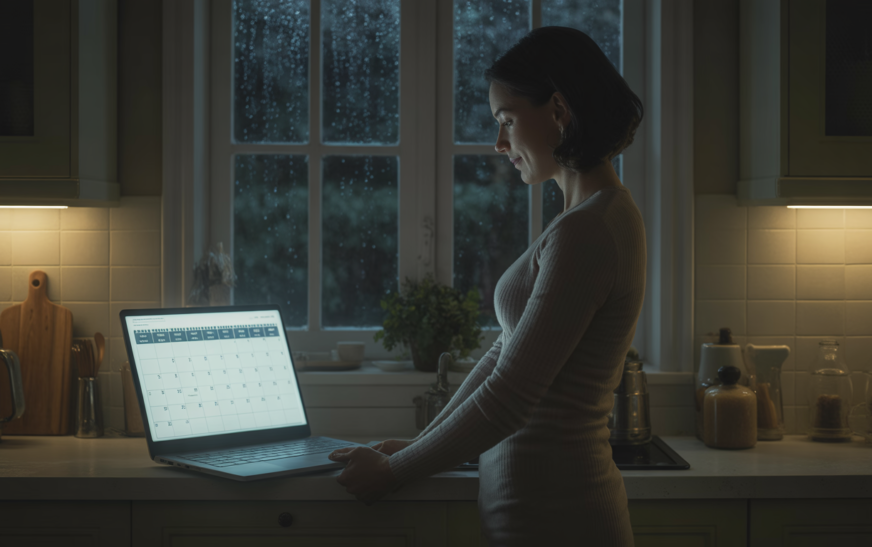
At home, the apartment smelled faintly of cedar and the coffee she had made that morning. Daniel’s keys were not on the dish by the door. She noticed that at once. Later, she would decide whether that absence was mercy or preparation.
Her phone buzzed on the console table.
I never wanted to hurt you like this.
Elena stared at the message until the words lost shape.
Perhaps he believed it. Perhaps people always mistook reluctance for innocence. However, injury did not become smaller simply because someone preferred not to witness it directly.
She set down her bag, removed her earrings, and stood in the dim living room without switching on the lamp. The windows reflected her back as a dark outline against darker glass. For a moment, grief pressed hard enough to make her bend forward.
Then she straightened.
Not because she was strong. Not because the day had taught her anything noble. Simply because standing was the first task available.
The sentence she sent back
Elena typed one sentence.
You should have told me before you told the world around me.
She sent it, muted the thread, and placed the phone face down.
Later, there would be logistics, divided shelves, returned books, and the ugly arithmetic of a shared future withdrawn. For now, there was only the apartment, the weather easing against the glass, and the clean cold knowledge that the relationship had ended before the lunch ever began.
And that, finally, was why the courtesy call hurt most. It had not warned her. It had merely informed her that everyone else’s comfort had already been considered.
In the quiet that followed, Elena turned on the lamp beside the sofa and let the room become fully, undeniably hers.
Readers drawn to social humiliation, emotional absence, quiet cruelty, family pressure, late truth, relationship collapse, and public-private betrayal will recognize the shape of what was taken from her long before the call ended.