By the fifth Tuesday, Lena had started measuring her marriage by the night ward.
At first, the change looked temporary.
Daniel blamed quarter-end pressure at the firm, which sounded plausible enough to survive two dinners and a third apology. Therefore, Lena reheated soup, answered his late texts, and told herself that marriage often meant tolerating one week’s distortion in order to preserve the shape of the next. However, Tuesday did not return to normal. Instead, it hardened into its own private evening.
By six-thirty, his messages grew careful. By eight, his voice changed. Then, just before nine, he came home carrying the kind of exhaustion that looked arranged rather than accidental.
“You’re quiet again,” Lena said on the fourth week.
Daniel set down his keys with too much precision. “I’m only tired.”
Tired had become the door he closed whenever she reached for anything more exact.
When Tuesday Began to Tilt
For eleven years, Lena and Daniel had lived by habits quiet enough to feel trustworthy. Morning coffee. Shared calendars. Grocery lists on Sundays. A glass of wine after the dishes if the day had been poor enough to deserve one. Even their disagreements remained orderly, as if both of them respected walls too much to wound them unnecessarily.
Then Tuesday changed first, and the rest of the week began leaning around it.
On Monday, Daniel was almost his usual self. Wednesday brought overcompensation, with pastries from the bakery or questions about her students delivered with suspicious tenderness. Meanwhile, Tuesday hollowed out the center of his attention. By late afternoon, he stopped finishing thoughts. By early evening, he seemed to be listening to a second conversation no one else could hear.
At lunch one day, Lena drifted through the Drama archive on her phone and hated how quickly her imagination dressed secrecy in the clothes of infidelity. After all, fiction makes betrayal look elegant. Real marriages usually break in duller tones.
Even so, she began watching the clock.
The Voice He Used at Eight
On the sixth Tuesday, Lena called him at 8:07.
He answered on the third ring, voice low and flattened, as though the room around him required obedience.
“Are you still at work?” she asked.
A pause came first. “Yes.”
She heard something in the background then. Not office noise. Not traffic. More like a rolling cart or a door pushed softly shut.
“You don’t sound like work.”
“Lena.” His tone shifted gently, which she disliked more than irritation. “I told you this month is difficult.”
“And I told you difficult is not a location.”
For a moment, she thought he might say something honest. Instead, he exhaled and replied, “I’ll be home soon.”
That line ended the call more efficiently than goodbye.
Later, while he showered, Lena found herself scrolling through Marriage & Secrets and then Secrets & Suspense, as though taxonomy might reduce dread to something sortable. It did not. Nevertheless, it gave her a sharper name for what had settled into the flat: not panic, but erosion.
The Tuesday She Followed
The following week, Lena left campus early and parked two streets from Daniel’s office.
Rain had just finished. Pavement lights were coming on. Across the city, commuters moved in restless bands beneath umbrellas and station awnings. At 6:12, Daniel emerged from his building, not with the distracted speed of a man running late for more work, but with the focused haste of someone trying to arrive where he had already decided to belong.
He did not turn toward the station.
Instead, he crossed the square, hailed a taxi, and got in without checking his phone once.
Lena followed in her own car with the nauseating calm of someone behaving badly for reasons that felt righteous.
The taxi stopped twenty minutes later beneath the pale frontage of St. Catherine’s Hospital.
For several seconds, she sat motionless with both hands on the wheel.
Daniel paid the driver, walked through the sliding doors, and disappeared into white light.
The hospital was old enough to have elegance and new enough to have lost it. Long windows. Clean signage. A foyer full of controlled grief. Lena entered three minutes behind him, passing reception with her pulse loud in her throat.
The board near the lifts listed departments in blue letters. One word caught and held her immediately:
Night Ward — Special Care Unit B.
The Night Ward Corridor
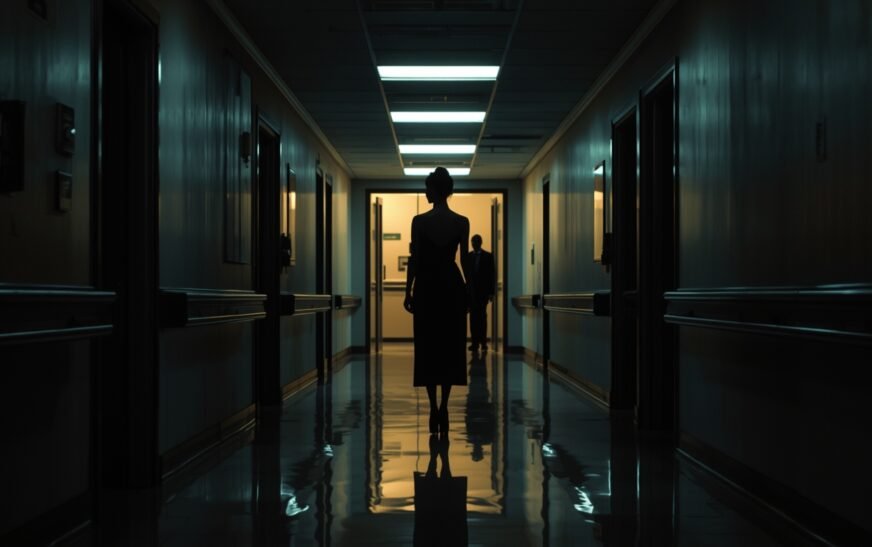
She found him on the third floor.
Not in another woman’s arms. Not whispering anything shameful. Nothing so simple waited at the end of the corridor.
Daniel was standing beside a bed with both hands in his coat pockets, listening to an elderly man speak in a voice too weak to travel far. The room door remained partly open. From where Lena stood, she could see only a profile at first: a hollowed cheek, a thinning line of silver hair, one hand lying motionless against the blanket.
Then the patient turned slightly, and recognition reached her like cold water.
Her father.
Lena stepped back before either man saw her.
The corridor swam briefly out of proportion. Fluorescent light sharpened. The smell of disinfectant became intrusive, intimate, almost violent. Twelve years had passed since she had spoken to Anton Vale in any deliberate way. Twelve years since his last message, which had arrived half-apologetic and entirely too late. She had buried him in language long before illness touched him.
And Daniel had been visiting him.
What the Nurses Already Knew
Lena did not enter the room.
Instead, she walked to the far end of the corridor and stood beside a vending machine full of carefully joyless snacks until a nurse approached with a clipboard.
“Are you here for Mr. Vale?” the nurse asked.
Lena looked up too quickly. “Why would you ask that?”
The woman offered a professional half-smile. “Because his son-in-law usually stands in exactly that expression before going back in.”
The phrase landed harder than it should have: his son-in-law.
“Daniel has been coming often?” Lena asked.
“Every Tuesday and most Fridays,” the nurse said. “Sometimes longer if your father is confused. He settles for him better than for us, oddly enough.”
Oddly enough.
Lena thanked her with a voice she did not recognize and left before the corridor could ask anything else of her. Downstairs, the hospital café had already closed. Chairs were stacked on tables. The vending machines hummed with indecent normality. Somewhere behind a pair of swing doors, a porter laughed once at something kind or tired or ordinary.
Ordinary sounds. Safe sounds. Yet none of them made sense in the life she had entered an hour earlier.
The Man She Had Buried Alive
Her father had once possessed the dangerous charm of men who mistake selfishness for appetite. As a child, Lena adored him because children often adore brightness before they understand cost. Later came the missed birthdays, the swallowed debts, the woman in Turin he claimed was not relevant, and the year her mother spent learning that humiliation can keep a straight back in public.
By twenty-four, Lena had done the difficult thing cleanly. She left his calls unanswered. She ignored Christmas cards with expensive handwriting. When news of his second collapse reached her through an aunt, she sent flowers without a note and felt only relief at the distance.
Daniel knew all of this.
More importantly, Daniel knew the things beneath it: the nights Lena woke furious without context, the way hospitals made her jaw lock, and the private shame of still wanting some apology capable of rearranging the past.
So why had he gone there alone?
Back in her car, she sat in the dark and opened old tags she had saved from insomnia reading: old family wounds, emotional absence, and trust erosion. The words felt thin beside the real thing.
When He Came Home
Daniel arrived at 8:54 carrying supermarket tulips and caution.
Lena was waiting at the kitchen table with the overhead light off.
He stopped in the doorway. “Why are you sitting in the dark?”
“Why are you standing in the night ward?”
Recognition struck him with frightening speed. All the practiced calm left his face at once.
“You followed me.”
“I followed you because you lied to me.”
Without looking at them, he set the flowers on the counter. “Lena—”
“Do not use my name as a softener.”
Rain began again against the windows, a fine, indecisive tapping.
For a long moment, he said nothing. Then he pulled out the chair opposite hers and sat down carefully, as if sudden movement might make the truth less manageable.
“He wrote to me in March,” Daniel said.
“Of course he did.”
“According to him, he was ill. He did not think he deserved your forgiveness. Before he lost the ability to say things properly, he wanted someone to know where he was.”
Lena stared at him. “And you answered.”
“At first, no.”
“But eventually, yes.”
He nodded.
What Daniel Had Decided Alone
The story emerged in sections rather than grace.
Her father had written twice. Daniel ignored the first letter. He opened the second because it arrived marked urgent from a hospital social worker. By then, Anton had been admitted after a fall, his memory fraying in cautious places. He had asked for Lena once, then retracted the request and given Daniel’s name instead.
“Why yours?” she asked.
Daniel looked down at his hands. “Because he thought you would come if the request was mine.”
“He was wrong.”
“I know.”
Then, very quietly, he added, “But I wasn’t sure.”
Lena stood and crossed to the sink because sitting still had become impossible. “So you decided to test that uncertainty for me.”
“No. I decided to keep you out of it until I knew whether there was anything to tell.”
“That is the same arrogance in a better coat.”
Daniel accepted that without protest.
He told her about the first Tuesday visit: the old man disoriented, charming in flashes, pathetic in longer stretches. Next came the second visit, when Anton remembered Lena’s age incorrectly but her favorite childhood story exactly. By contrast, the third visit had been worse. Anton cried when a nurse closed the curtains because he thought evening meant abandonment. After that, Daniel kept going.
What He Thought He Was Protecting
“I was trying to spare you,” Daniel said.
“From him?”
“From choice.”
Lena turned back toward him. “That is not an answer anyone should say out loud.”
His composure thinned. “I know.”
For the first time that night, anger gave way to something more difficult. Not forgiveness. Certainly not that. More like the bruised comprehension that Daniel’s failure had been built from love badly managed rather than indifference.
“Why didn’t you tell me after the first visit?” she asked.
He looked exhausted suddenly, not theatrically, but with the plain fatigue of a man who had been carrying the wrong loyalty too long. “Because the second would have followed. Then the third. After that, each Tuesday I told myself I would come home and say it plainly. Instead, I saw you making lecture notes, choosing paint samples for the hallway, speaking as though the past had finally stopped charging rent. I could not bear to reopen him inside you unless I absolutely had to.”
Lena pressed both hands flat against the counter.
“You don’t get to decide whether he exists in me,” she said.
“I know.”
“And yet you did.”
He closed his eyes once. “Yes.”
After the First Truth
They spoke until the kitchen lost its evening outline.
Not gracefully. Not kindly. Truth delayed too long rarely enters with manners.
Lena learned that her father’s condition was worsening in uneven ways. Some evenings he was lucid enough to ask after books she had loved at fifteen. On other nights, he mistook Daniel for a younger version of himself and asked whether Lena still believed in summer storms. A social worker had begun discussing residential arrangements no one wanted to call final.
Meanwhile, Daniel admitted the ugliest part freely: not all of his secrecy had been protective. Some of it had been easier. In the hospital, pity simplified things. At home, Lena’s rightful anger would have demanded a cleaner courage than he possessed.
“That sounds more accurate,” she said.
“Yes.”
“And less flattering.”
“Also yes.”
For one brief second, they nearly smiled. Then the moment passed.
What Pity Made Easier
Later, while putting the untouched tulips in water, Lena glanced at the open tabs she had abandoned earlier: Romance, Psychological, and Drama again. All those categories offered versions of betrayal, obsession, tenderness, and fear. Yet the thing in her kitchen felt both simpler and far more invasive: a husband who had pitied her father and mistrusted her with the knowledge.
Neither of them tried to repair the evening with softness. That, at least, felt honest.
The Choice He Could Not Keep
On Friday, Daniel asked whether she wanted to come with him.
Lena did not answer immediately.
The question had lived in the flat all week, moving from room to room with them while they discussed groceries, emails, and everything except the obvious center. By then, silence itself had become a third person in the marriage.
“No,” she said at last. “Not yet.”
He nodded. “All right.”
“But you don’t go there as my representative anymore.”
“I understand.”
“Do you?”
Daniel met her gaze. “Enough to know I should have understood sooner.”
That was not redemption. It was only competence arriving late. Still, it mattered.
Saturday came down bright and cold after rain. Lena walked alone through the market, bought pears she did not need, and let memory arrive in fragments she had spent years disciplining. Her father teaching her to skip stones. Her father forgetting her school play. Her father whistling in hotel lobbies as if consequence were always elsewhere.
By contrast, the present offered no theatrical answer. Only a decision postponed, then waiting.
What the Night Ward Held
The next Tuesday, Lena went to St. Catherine’s alone.
The lift smelled faintly of disinfectant and old metal. On the third floor, the night ward corridor looked exactly as she remembered: too bright, too patient, full of lives reduced to essential sounds. A television murmured somewhere behind a half-closed door. Rubber soles moved lightly across polished floor. At the desk, the same nurse recognized her and said nothing unkind.
Anton Vale looked smaller than memory had permitted.
His eyes opened when Lena entered, and for one terrible second she thought he would not know her at all. Then something cleared.
“You came,” he said.
The sentence contained no triumph. That helped.
Lena stood by the bed with her coat still on. “Apparently.”
He gave the ghost of a smile. “Daniel said you’d be angry.”
“Daniel has become overqualified in that area.”
A dry, broken laugh escaped him. Then his expression changed into something older and less survivable. “I didn’t want the first call to be mine,” he said. “I’ve ruined enough beginnings.”
It was not a sufficient apology. It was not even a good one. Nevertheless, it was the first sentence he had ever said to her that did not sound like self-defense.
For now, that was all the room could hold.
After the Visit
When Lena left forty minutes later, Daniel was waiting by the lift without stepping too close. She did not lean into him. He did not ask how it went. Instead, they stood beside each other while the doors opened on their shared reflection, altered and not yet repaired.
Some secrets break a marriage by revealing betrayal. Others do it by revealing the private mercy one person thought they had the right to manage alone. The night ward had given Lena neither reconciliation nor ruin. It had given her something narrower and harder: the return of choice.