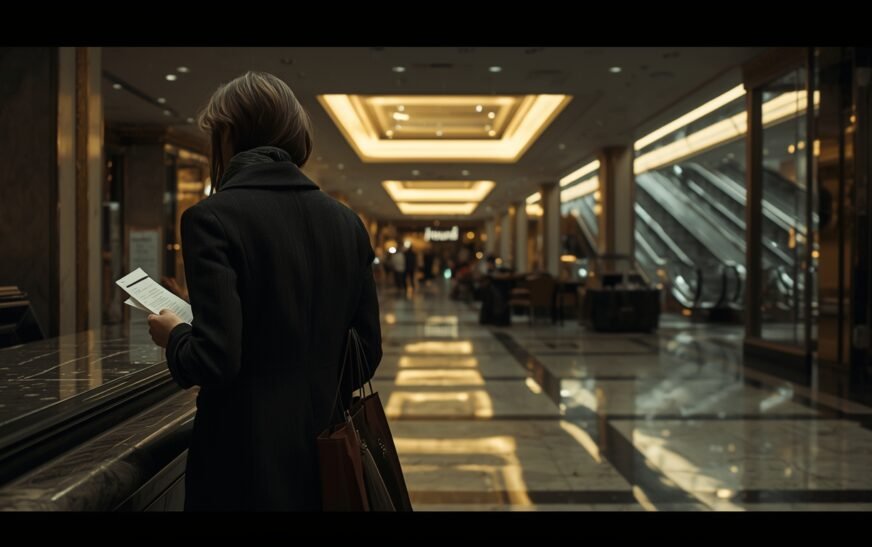
Eva learned the phrase return window under warm department-store lighting while rain streaked the high front windows and a pianist somewhere near the cosmetics hall played something too graceful for errands. She had come to Bell & Wren on a Saturday afternoon with Oliver’s unworn coat folded inside a garment bag and the receipt tucked into her wallet behind two family photos she kept meaning to replace. At first, the trip felt harmless. The coat was the wrong cut. The color drained him. Their anniversary dinner was that night, and she thought exchanging it before six might make the evening feel orderly again.
Instead, the clerk behind the returns desk scanned the barcode, paused, and said, “I’m sorry, the return window closed on Thursday.”
Eva looked up. “That can’t be right. I bought it last week.”
The clerk turned the screen slightly. “It was purchased on the ninth. The exchange period ended after ten days because it was part of the early event sale.”
Thursday. Two days ago.
Oliver had stood in their kitchen that morning, kissed her cheek, and reminded her not to forget the return.
The coat he never wore
At first, Eva assumed she had heard the clerk wrong. People made mistakes in bright places where everything gleamed too hard. Sale rules blurred. Dates slipped. Nevertheless, the sentence settled badly because Oliver tracked deadlines the way other people tracked weather.
“Could you check again?” she asked.
The clerk, a woman in a black silk neck scarf with a name tag reading Marin, gave a sympathetic nod. “Of course.”
The scanner chirped once more. Behind Eva, shoppers moved through perfume and polished glass with the serene urgency of people buying small luxuries to justify the rain. Meanwhile, an escalator hummed toward the upper floors where bridal gowns and luggage sat beneath the same flattering light.
Marin studied the screen. “The system notes an account reminder went out three days before closing.”
Eva frowned. “An email?”
“Yes. To the primary customer profile.”
That was Oliver’s account.
He had not forgotten the date. He had let it pass.
The message he sent at noon
Her phone buzzed before she could answer.
Running late at the studio, Oliver wrote. May need to push dinner to eight. Hope the return goes smoothly.
The words sat on her screen with unbearable neatness.
Eva read them twice, then locked her phone without replying. By contrast, her pulse had become unruly. Not because of the coat itself. Not even because of the money. The real disturbance lived in timing. He had known the return window was closed when he sent her out into the rain.
Marin lowered her voice. “I can ask the floor manager for an exception.”
“No.” Eva adjusted the garment bag on her arm. “Thank you. I just needed a second.”
“Take all the time you want.”
That kindness almost undid her. Instead, she stepped away from the desk and moved toward a seating area beneath the central atrium, where velvet chairs faced a display of winter coats on silver stands. Across from her, a couple argued softly over gift boxes while pretending not to be arguing at all.
Eva sat down and opened Oliver’s message again.
Hope the return goes smoothly.
Hope required uncertainty. This had not been uncertainty.
The pattern she had been missing
Later, Eva would understand that the coat was never the story. The story was arrangement.
Over the previous month, Oliver had become unusually helpful. He made their coffee before she woke. He booked restaurant tables she had not asked for. He restocked the olive oil, remembered her mother’s dental appointment, and texted when meetings ran late with a tenderness polished enough to look thoughtful from the outside. However, his attention had changed texture. It no longer arrived with appetite or impatience or spontaneous warmth. It arrived managed.
At home, he had started speaking in soft logistical phrases.
I didn’t want to burden you.
I thought this would be easier.
I was trying to make the week smoother.
Those sentences had seemed generous at first. Then again, generosity often became suspect when it appeared exactly where honesty should have been.
Eva looked around the atrium. Bell & Wren was the kind of place that sold order as a mood. Women drifted past in camel wool and patent boots. Men stood near the watch counter examining things they did not need. Somewhere below, dishes touched softly in the café. The whole building suggested that life could be improved through tasteful corrections.
Yet nothing in her chest felt correctable now.
At the café balcony
Instead of leaving, Eva carried the garment bag upstairs to the mezzanine café and ordered tea she did not want. Rain softened the glass wall facing the avenue. Below her, the returns desk looked almost theatrical from that height, one bright rectangle where other people brought back misjudged purchases and hoped for cleaner choices.
Oliver called at 12:27.
She let it ring once before answering. “Hi.”
“You sound far away,” he said.
“I’m in the café.”
“Finished already?”
The ease in his voice chilled her.
“No,” Eva said. “The return window closed on Thursday.”
Silence answered first.
Then Oliver exhaled. “Right.”
Not surprise. Not confusion. Right.
Eva watched a taxi blur past beneath the rain. “You knew.”
“I meant to tell you.”
“When?”
He took too long. “I don’t know.”
That sentence landed with the heavy, familiar shape of a truth delayed until it became cruel by default.
“You reminded me this morning,” she said. “You sent me here anyway.”
“Eva—”
“Why?”
What he called kindness
For a moment, all she heard was the muted studio noise behind him—voices, a door, the scrape of a chair. Finally, he said, “Because I thought having a small errand would make tonight easier.”
“Tonight.”
He did not correct himself.
Below the balcony, a child laughed near the escalator. The sound rose into the café and vanished under quiet music. Meanwhile, Eva understood with slow, exact horror that Oliver had not been preparing for dinner. He had been preparing for an ending.
“You picked tonight,” she said.
“I picked an evening when we’d both be home.”
“That’s not the same thing.”
“I wasn’t trying to humiliate you.”
“No,” she replied. “You were trying to stage-manage me.”
His voice lowered. “I wanted the day to stay calm.”
There it was again. Calm. As if emotional damage became acceptable when delivered without raised volume.
Eva set her cup down before her hand shook visibly. “Did you think sending me out to fail at a return would keep me occupied?”
“I thought it might keep the afternoon from becoming one long wait.”
“So you gave me a shorter humiliation instead.”
He said her name then, softly enough to sound injured by her accuracy.
The anniversary reservation
“What were you going to tell me tonight?” Eva asked.
Oliver hesitated. “That I don’t think we should keep pretending the relationship is still working the way it used to.”
The phrasing was so curated she almost laughed.
“You’ve been rehearsing that,” she said.
“I’ve been trying to find the least damaging way to say it.”
“Damage still counts when the tone is nice.”
Across the mezzanine, two women in dark lipstick leaned over a dessert menu, speaking in conspiratorial murmurs. A waiter polished glasses that were already shining. By contrast, Eva felt as if the whole store had become too sharply lit.
“Is there someone else?” she asked.
Oliver was quiet.
That pause mattered more than any polished denial could have.
“I haven’t done anything,” he said carefully.
“That is not an answer.”
“There’s someone at the studio I’ve been talking to.”
Eva looked at the rain again because the alternative was closing her eyes. “Talking.”
“It’s not physical.”
“You say that as if the border makes you noble.”
The woman in the studio
Oliver worked in architectural visualization, all elegant renderings and carefully lit futures. He had always liked revised versions of things—the better angle, the improved layout, the line that led a viewer exactly where intended. Eva understood, suddenly, that he had begun applying that instinct to her life without permission.
“Does she know about me?” Eva asked.
“Yes.”
“What version?”
The question sharpened the silence.
Finally, he said, “She knows we’ve been struggling.”
Eva smiled once, without warmth. “Interesting. I hadn’t realized the struggle had been jointly published.”
“That’s unfair.”
“No,” she said. “Unfair was sending me to a returns desk with a dead deadline while you waited for evening to become convenient.”
He breathed in slowly. “I knew you’d turn this into a symbol.”
“Because you made it one.”
That ended the softer part of him. She heard it in the shift of his tone.
“I’m trying to do this carefully,” he said.
“Carefully for whom?”
He had no answer that would survive the question.
What Marin noticed
After the call ended, Eva remained at the café table until her tea went cold and the pianist downstairs moved into a brighter song that made the whole afternoon feel falsely recoverable. Eventually, she stood, straightened the coat bag, and went back to the returns counter because movement felt safer than thought.
Marin looked up at once. “Did you want me to try for the exception?”
Eva almost said no again. Instead, she heard herself answer, “Yes. Please.”
The clerk nodded and disappeared through a side door. While Eva waited, she studied the polished counter edge, the stacked tissue paper, the gold-embossed shopping bags folded with impossible neatness. All around her, other people were exchanging sizes, correcting colors, fixing small wrong choices before they settled into permanence.
Marin returned with a man in a navy suit who introduced himself as Daniel, floor manager.
“Ordinarily we’d have to refuse,” he said, glancing at the receipt. “However, because the account reminder was sent and the item is unworn, I can offer store credit.”
Eva should have felt relieved. Instead, the mercy struck her as nearly unbearable.
“That’s fine,” she said.
Daniel processed the exception with elegant efficiency. Meanwhile, Marin folded the coat away as if it had never belonged to anyone at all.
When the gift card slid across the counter, Eva stared at it for a moment before taking it. A clean rectangle. A value reassigned. Something returned, but not restored.
Outside in the rain
Rain met her in a silver sheet the moment she stepped beyond the revolving doors. Bell & Wren’s awning offered partial shelter, though not enough to make staying sensible. Cars hissed along the avenue. Across the street, the florist was closing early, its window full of white lilies and dark greenery that looked expensive enough to apologize for anything.
Oliver called again.
She declined it.
Then she began walking without deciding where, the garment bag now empty and folded over one arm, the store-credit card pressed between her fingers like a thin accusation. People passed with umbrellas lowered against the weather, each enclosed in private errands and private irritations. By contrast, Eva felt suddenly visible in the worst way: as someone who had just learned that the day she thought she was having had already been revised elsewhere.
She thought of the stories buried in breakup and betrayal, the ones where love collapsed through evidence dramatic enough to name at once. Her life had given her something quieter. Meanwhile, that quiet made the wound more exact.
At the next corner, she stopped under a pharmacy awning and opened her phone. Three missed calls. Two messages.
I’m sorry.
Please come home before we talk.
Home before we talk. As if the location, once properly chosen, might soften the design of the day.
The message she sent instead
Eva typed carefully because anger made her hands too quick.
You did talk. You just used my afternoon to do it in advance.
She sent the message, muted the thread, and slipped the phone back into her coat pocket.
Later, there would be practical ugliness: books divided by shelf, rent notices, key returns, toothbrushes standing beside each other for one final morning. However, the central fact had already arrived with enough clarity to survive logistics. Oliver had been leaving in installments. He had simply hoped to make the final version look orderly.
Eva crossed toward the river road rather than the bus stop. The rain eased to mist. Buildings along the embankment appeared softened at their edges, elegant and slightly unreal. Somewhere ahead, church bells counted the half hour.
There were stories of emotional drama, of secrets inside long commitments, of psychological strain hidden by manners, and of quiet suspense built from delay. This day belonged to all of them a little. Still, its cruelty remained simple. He had mistaken careful timing for care.
After the return window
By the time Eva reached the river, the city had gone silver and blue with early evening. Lights came on behind restaurant glass. Couples stepped around puddles and leaned toward one another beneath shared umbrellas. The whole world seemed arranged for continuation.
She stood at the railing and looked down at the dark water moving under the bridge arches.
The return window was never about the coat. Ultimately, it was about sequence. Oliver had known something was ending and had let her keep performing the ordinary shape of their Saturday anyway. He had sent her into public light carrying a task already designed to fail, then planned to meet her later with measured sorrow and a practiced voice.
That was the betrayal.
Not the studio woman. Not even the delayed confession. The betrayal was curation—the decision to manage her experience instead of respecting her reality.
Eva breathed in the wet cold air and felt, beneath the ache, a cleaner emotion beginning to take shape. It was not relief. It was not triumph. Rather, it was the first hard edge of refusal.
Readers drawn to delayed honesty, quiet cruelty, partner withdrawal, polished deception, emotional absence, weekend collapse, and private ending will recognize the colder kind of heartbreak that arrives through arrangement rather than chaos.
She turned away from the river before Oliver could call again. Tonight, there would be no anniversary dinner, no soft lighting, no gracious conclusion staged at a well-set table. He had already used the day he wanted. What remained belonged to her.
And for the first time since Marin had spoken the phrase across the counter, Eva understood the true shape of the return window: some things could still be taken back after the deadline, but they never came home in the same form.