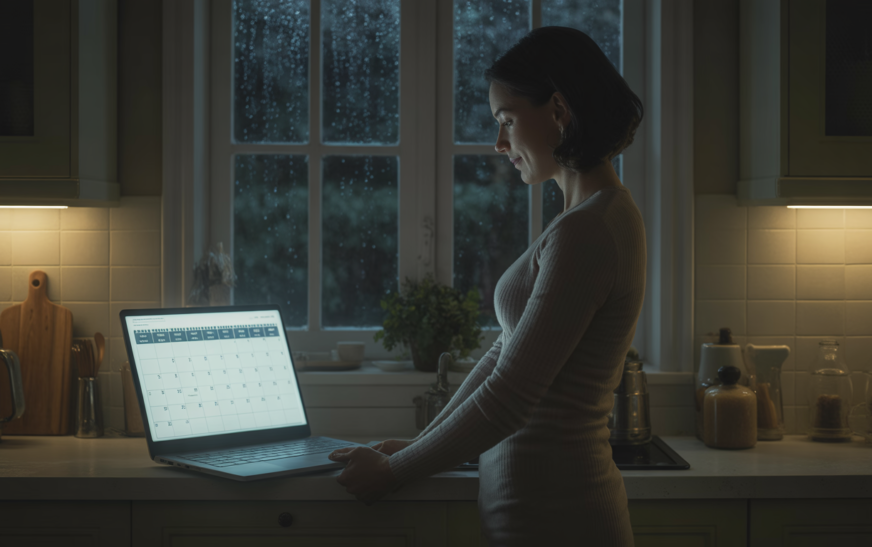
Priya opened the shared calendar at 7:12 on a Tuesday because the roast was already resting and Arun still was not home. At first, she only wanted the dinner time from the school fundraiser he had promised to attend with her on Friday. The laptop glowed on the kitchen counter beside a bowl of cooling green beans, and rain pressed softly at the window over the sink. Nothing in the room looked broken. Even so, the evening had begun to lean at an angle she could feel in her shoulders.
Usually, Arun texted when he ran late. He believed in notifications, backups, color-coded reminders, and the soft authority of neat planning. Their marriage had survived three moves, one miscarriage, two promotions, and the long slow exhaustion of caring for Priya’s mother after surgery, partly because Arun kept life from sliding off its rails. Therefore, when he forgot something, she noticed. When he omitted something, she noticed even more.
The shared calendar opened to the current week: dentist appointments, a parent-teacher meeting, utility renewal, Mira’s violin lesson, Priya’s editorial deadline. Friday still showed the fundraiser at St. Aldwyn’s under both their names. However, Thursday contained an empty white block from six until eleven, strange only because Arun hated empty blocks. He filled even leisure with labels.
Priya looked at it for a second longer than necessary.
The missing block
At first, she told herself the blank space meant nothing. People forgot to update calendars. Syncing failed. Work plans shifted and then settled again. Nevertheless, the omission felt deliberate because every other hour of Arun’s week had been accounted for with his usual precision.
Mira padded into the kitchen in sock feet. “Is Baba late?”
“A little,” Priya said.
Her daughter reached for a carrot from the salad board. “You said we were eating together.”
“That was the plan.”
Mira nodded with the solemn disappointment of ten-year-olds, then wandered back toward the living room where her math workbook lay open beside the lamp. Priya watched her go and turned back to the screen.
Under Thursday’s blank space sat a line for “client review” at noon. Below that came “drop dry cleaning” at four. Then nothing. No commute. No meeting. No dinner. No note. By contrast, Tuesday had “fuel car” written at 8:10 a.m., which was so characteristically Arun that Priya suddenly felt cold.
She checked the following week.
There it was again. Thursday, six to eleven, left white and empty inside a calendar that otherwise looked curated to the minute.
The way routine had changed
Over the past month, Arun had become better rather than worse. That was what unsettled her. He made coffee before she woke. He folded laundry without being asked. He remembered Mira’s library book, her mother’s blood pressure refill, Priya’s preference for the jasmine rice rather than the long-grain bag he always bought by mistake.
Kindness should have comforted her. Instead, it had gained a polished quality she did not trust.
Earlier in their marriage, stress made Arun sharper, distracted, absent in ordinary ways. Lately, however, his absences arrived wrapped in courtesy. He no longer snapped when tired. He simply removed himself with elegant timing. While Priya spoke about the school auction, he nodded at the right moments. Meanwhile, something behind his eyes kept drifting elsewhere, not dramatically, but enough.
She closed the laptop halfway, then opened it again.
The rain deepened. In the next room, Mira recited fractions under her breath with theatrical misery. A spoon settled in the sink. The whole house carried that fragile domestic calm which often dissolved the second one person asked the right question.
When he came home
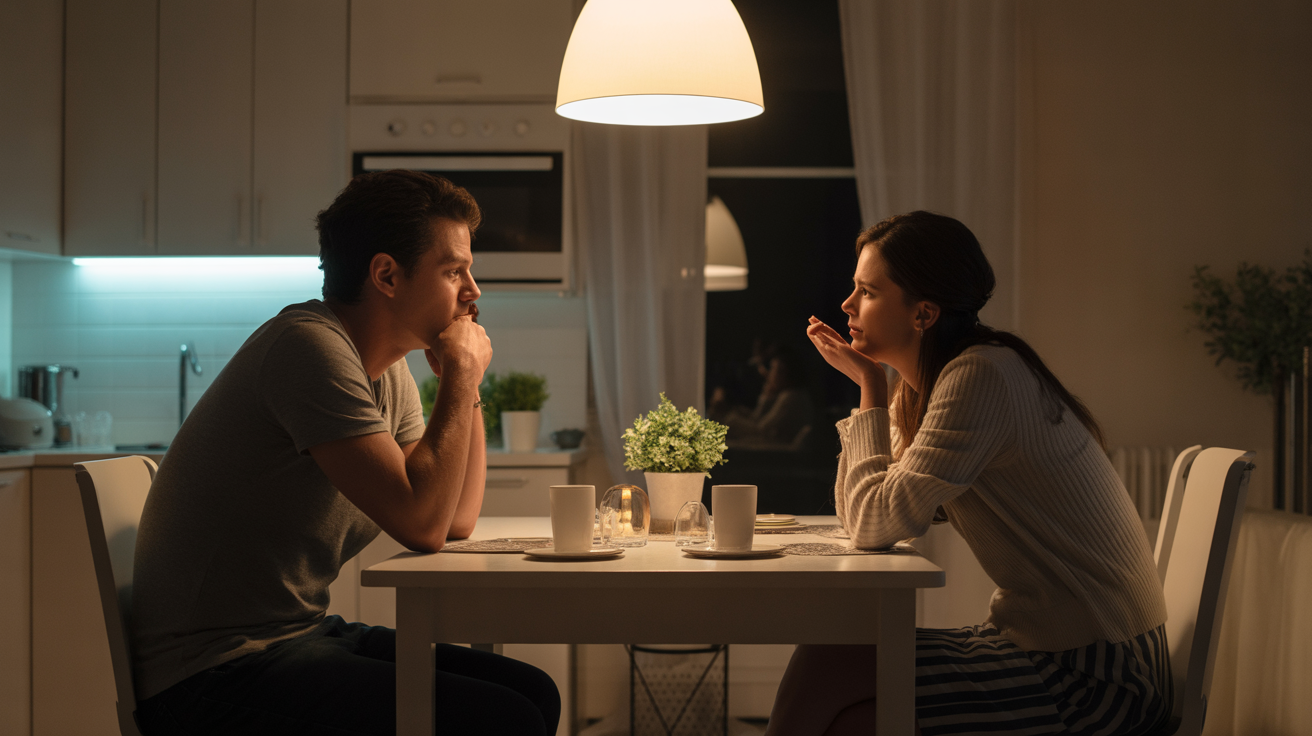
Arun arrived at 7:39 with wet shoulders and an apology already prepared.
“Traffic at the bridge,” he said, setting down his briefcase. “Then Vikram called just as I left, and it became a twenty-minute conversation.”
Priya looked up from the plates she was laying out. “That sounds crowded.”
He crossed to kiss her temple. The gesture landed accurately, almost tender. Still, it felt placed rather than spontaneous.
“I should have messaged,” he said.
“Yes.”
Mira appeared in the doorway. “You missed the crispy potatoes.”
Arun widened his eyes in mock horror. “Then I’ve had a catastrophic evening.”
She laughed and ran to the table, and for a few minutes the room returned to itself. Dinner moved forward with the clink of cutlery and the familiar inventory of family talk: a spelling test, a difficult client, an aunt who had sent four voice notes instead of one concise answer. Arun told a funny story about the office espresso machine flooding the kitchenette. Priya even laughed in the right place. Yet beneath the conversation, the shared calendar remained open in her mind like a second room.
After Mira went upstairs
Later, once homework was signed and lights were dimmed in Mira’s room, Priya found Arun in the study sorting receipts into labeled envelopes.
“You’re doing quarterlies in April?” she asked.
“Trying to get ahead.”
Rain ticked at the window beside his desk. The lamp turned one half of his face warm and the other unreadable.
Priya leaned against the doorframe. “I checked the shared calendar tonight.”
His hands paused only briefly. “For Friday?”
“Yes. And then for Thursday.”
Silence altered the room in an instant.
Arun set down the envelope he was holding. “What about Thursday?”
“You tell me.”
He gave a small shrug that would have looked natural to anyone less married to him. “Probably an incomplete update.”
“Two Thursdays in a row?”
“Maybe three,” he said. “I’ve been careless.”
That answer might have worked if carelessness had belonged to him. It did not.
The explanation that sat too neatly
“You have never once been careless with scheduling,” Priya said.
Arun leaned back in his chair. “People do evolve.”
“Not this selectively.”
A car moved through the wet street outside, headlights sliding across the study wall. For a moment, both of them watched the shadow pass as though it offered an escape route from the conversation.
“It’s work,” he said finally. “There’s a prospective client I haven’t wanted to discuss until I knew whether it was real.”
“Then why leave it blank instead of private?”
He looked at her. “Because if I marked it private, you would ask.”
Priya almost smiled at the honesty buried inside the evasion. “And leaving it empty was meant to stop me?”
“I thought it might pass unnoticed.”
That sentence hurt more than she expected. Not because it proved anything grand, but because it revealed the size of the gamble. He had counted on her being busy enough, tired enough, trusting enough to overlook the space where his real life had been happening.
The question she changed
At first, Priya wanted to ask whether there was another woman. The shape of the scene invited it. A hidden evening, an omission, a husband too polished to trust. However, the question felt secondhand the moment it reached her mouth. Something else mattered more.
“Why didn’t you want me to know where you were?” she asked instead.
Arun’s expression altered then, not toward guilt exactly, but toward fatigue.
“Because I didn’t know what it meant yet.”
“That is a vague answer.”
“It is the accurate one.”
Priya crossed the room and sat in the chair opposite the desk. Between them lay receipts, tax papers, sharpened pencils, and the ordinary machinery of a life built jointly over twelve years. Nothing in that room could be called dramatic. Nevertheless, the air felt charged with the kind of quiet that changed structure.
“Try accuracy with more nouns,” she said.
The woman from his office
Arun looked down at his hands before speaking. “Her name is Leena.”
Priya did not react outwardly.
“She joined the consultancy in January,” he continued. “She’s smart, difficult, impatient with weak thinking, and very good with clients who usually ignore everyone. We started staying late on Thursdays because that’s when the Singapore team signs on.”
“And?”
He breathed in slowly. “And somewhere inside those late hours, I started looking forward to them for reasons that were not entirely professional.”
The honesty should have felt clean. Instead, it seemed arranged, as if he had polished even the confession before offering it to her.
“Have you touched her?” Priya asked.
“No.”
“Has she touched you?”
“No.”
“Does she know?”
His answer came after a pause. “I think so.”
For a moment, Priya heard only the rain, the low hum of the heater, and the soft click of Mira turning in bed upstairs. The house remained intact around them. By contrast, her understanding of the marriage shifted with almost mathematical precision.
What counted as betrayal
“You think this is safer because it isn’t physical,” Priya said.
Arun rubbed one thumb against the edge of a receipt. “I think it is less ugly than it could be.”
“That is not the same thing.”
He nodded once. “No.”
“You built secrecy into routine,” she said. “You made omission look like administration.”
The words landed. She could see that. Still, he did not deny them.
“I kept telling myself I needed time to understand whether it was just relief,” he said. “Work has been lighter with her. Conversation has been easier. Around home, everything feels like logistics and medication schedules and school forms and—”
He stopped.
“And what?” Priya asked quietly.
Arun met her eyes. “And I have not known how to say that I am tired without sounding ungrateful for our life.”
There it was: not romance, not even seduction, but emotional migration dressed in competent language. Priya had feared something flamboyant once, years ago. Instead, she had received something colder—an attraction born inside shared spreadsheets, fluorescent light, and the comfort of being less necessary somewhere else.
Downstairs in the kitchen
Later, Priya stood at the sink rinsing plates that did not need rinsing. Arun remained in the study because she had not asked him to follow. The kitchen light cast a pale shine across the counter where the laptop still waited.
She opened the shared calendar again.
Thursday, six to eleven. Thursday, six to eleven. Thursday, six to eleven.
The repetition disturbed her more than any single lie would have. Each blank block represented intention renewed. Each week he had looked at the space, preserved it, and moved on with dinner, bedtime, and weekend grocery lists.
Priya thought of the stories buried in marriage and secrecy, the ones where betrayal announced itself through lipstick, receipts, or a forgotten message preview. Her life had offered something tidier. Meanwhile, that tidiness made the wound feel more intimate.
On the windowsill sat Mira’s painted clay bird from last spring, one wing uneven, the glaze imperfect and bright. Priya stared at it until her vision steadied.
What she asked him downstairs
When Arun finally entered the kitchen, he did so quietly, as though volume might decide the night.
“I’m sorry,” he said.
Priya kept her hands flat on the counter. “That sentence is too small.”
He nodded. “I know.”
“Do you want to leave?”
The question landed harder than anything else she had said. For the first time that evening, fear crossed his face without polish.
“I don’t know,” he admitted.
She looked at him for a long moment. “That is the first useful thing you’ve said.”
Outside, the rain began easing into a fine mist. The refrigerator hummed. Somewhere beyond the back fence, a neighbor’s gate clicked shut.
“Have you told her you might leave your wife?” Priya asked.
“No.”
“Have you told her your marriage is unhappy?”
He hesitated, which answered enough.
“Arun.”
“I told her things were strained,” he said.
Priya let out one slow breath. “So she has been allowed to know the edited version of me.”
The sentence that changed the room
That thought seemed to settle over everything at once. Not simply that there was another person in the edges of her marriage, but that this stranger had been given narrative access. Leena knew the softened draft. Leena had likely heard about tiredness, responsibility, distance, the burdens of a well-run house. However, she had not seen Priya changing dressings on her mother’s shoulder after surgery or staying up to finish invoices when Arun’s father was in the hospital or rebuilding cheer for Mira after the miscarriage had turned the home silent for months.
“You made me background texture in my own life,” Priya said.
Arun flinched.
“I did not mean to.”
“No,” she said. “You meant to make things easier for yourself.”
He did not argue.
For a moment, she expected tears. None arrived. Instead, a colder clarity moved in, practical and stern. It told her what mattered immediately and what could wait until morning.
“You will go to the fundraiser Friday,” she said. “You will smile for Mira. You will not create confusion in front of her because you are uncertain how to manage your emotional life elegantly.”
He stared at her. “Priya—”
“And tomorrow,” she continued, “you will tell Leena nothing further about me, our marriage, or this house. Whatever happens next will happen with fewer borrowed intimacies.”
After midnight
Later, after the dishwasher finished and the rooms had gone still, Priya lay awake listening to Arun move carefully in the guest room across the hall. They had not had a dramatic fight. No plate had shattered. No one had stormed into the rain. Yet the restraint made the night harsher rather than softer.
The shared calendar sat closed on the kitchen counter, but she could still see it in her mind: those white gaps inside a structure meant to hold mutual life. Omission had its own architecture. Once noticed, it was impossible to unsee.
At 12:26, she rose and walked to Mira’s room. Her daughter slept with one arm above her head, all fierce trust and careless breathing. Priya tucked the blanket back over her shoulder. Then, for a moment, she stood in the dark and let herself feel the scale of what had shifted.
This was not the end of the marriage yet. Then again, it was not the marriage she had woken inside that morning.
The morning without guessing
Dawn came silver and thin. Priya made tea before anyone else woke, then sat alone at the kitchen table with the laptop open once more. The shared calendar remained unchanged, still displaying Thursday’s blank white space as if innocence could be designed.
She clicked into the block and typed four words: Discuss truth. No omissions.
Then she marked it visible.
The act was small, almost absurd. Nevertheless, it gave the morning shape. She was no longer the woman staring at absence and wondering whether she had earned the right to name it. By contrast, she now understood exactly what had been taken from her: not certainty, not even loyalty in the old romantic sense, but the dignity of accurate information inside her own home.
Readers drawn to emotional relationship drama, psychological tension, quiet suspense, and betrayal without spectacle will recognize the slow dread of a routine that has been edited from within.
Meanwhile, the deeper fracture lived in quiet omission, hidden routine, emotional migration, domestic tension, polished deception, marriage strain, and careful lies that never needed an obvious affair to become devastating.