By the seventh Thursday, Elin had started measuring her marriage by the side entrance.
At first, the change had seemed too small to matter.
Jonas still came home at six-thirty. He still kissed her cheek in the kitchen. He still asked about her students with the same careful interest he used on difficult weeks. However, after dinner, something in him shifted. By eight-fifteen, his attention thinned. By eight-thirty, he rose from the table with an apology that never changed much in tone. Then, instead of leaving through the front hall, he crossed the pantry and stepped out by the side entrance into the narrow strip of dark between their house and the hedge.
“You’ll be back soon?” she asked on the third Thursday.
Jonas paused with one hand on the latch. “I won’t be long.”
That was not an answer. Even so, it was the only one she got.
For four more weeks, the same routine returned, neat enough to look intentional and strange enough to alter the whole house around it.
When Thursday Changed Shape
For twelve years, Elin and Jonas had been ordinary in the ways that once pleased her. Shared shopping lists. Laundry on Sundays. Midweek leftovers with too much black pepper because he never measured anything honestly. Even their silences had been companionable, arranged by repetition rather than fear.
Then Thursday turned selective.
On Monday, Jonas was attentive. Tuesday he joked while drying dishes. Wednesday often brought flowers from the station kiosk, as if tenderness could be purchased in stems and good timing. Meanwhile, Thursday hollowed him out by degrees. The warmth never vanished at once. Instead, it withdrew carefully, like furniture being taken from a room one piece at a time.
At lunch one day, Elin found herself scrolling through the Drama archive and hating how quickly her imagination supplied a lover. After all, affairs are easy to picture because they flatter suspicion. Real secrecy is usually less glamorous and more humiliating.
Nevertheless, she began noticing details.
His shoes changed on Thursdays. Messages arrived and were dismissed too quickly. Once, at 8:22, she saw him standing at the sink doing nothing at all, one hand braced against the counter as if preparing for weather.
The Door Beside the Pantry
The side entrance had never mattered before.
It was a narrow door off the pantry, used for bins, muddy boots, and summer herbs when the garden still looked disciplined. Guests came through the front. Family used the kitchen. The side door belonged to chores and private movement, the sort of exit a person chooses only when they do not want departure to gather ceremony.
That was exactly why Elin hated it.
“Why do you keep going out that way?” she asked on the fifth week.
Jonas looked up from buttoning his coat. “It’s closer.”
“Closer to what?”
A pause followed, brief and tidy. Then he said, “Don’t make this stranger than it is.”
The reply irritated her because it assumed the right to define reality before she spoke. Later, while tidying the pantry shelves with unnecessary violence, she realized the smaller betrayal was not where he went. It was that he had started managing her perception before he had offered her truth.
What Mira Noticed First
On Saturday morning, Elin met her friend Mira for coffee near the school.
The café smelled of cinnamon and wet coats. Around them, people discussed mortgage rates and train delays with the exhaustion of adults committed to surviving their own routines. Mira listened without interrupting while Elin described the Thursdays, the timing, and the careful use of the side door.
“That is either an affair,” Mira said at last, “or something he thinks is more embarrassing than one.”
Elin gave a brittle smile. “Comforting range.”
“You said he doesn’t look pleased when he leaves.”
“No.”
“Men sneaking toward pleasure usually brighten on the way to it.”
The line stayed with Elin all afternoon.
By contrast, Jonas spent the day being almost offensively kind. He cleaned the bathroom without being asked. He touched the back of her neck while passing behind her in the hall. At dinner, he suggested a weekend away in November with a tone so reasonable it felt rehearsed.
She nearly hated him for choosing charm on the wrong day.
The Thursday She Followed
The next week, rain began just after dusk and held steady through dinner.
At 8:28, Jonas stood from the table and took his coat from the chair. Elin remained seated with her hands around an empty wineglass.
“You’re doing it again,” she said.
He did not pretend not to understand. “I’ll be back before ten.”
“That is still not an explanation.”
“No.” He met her eyes briefly. “It isn’t.”
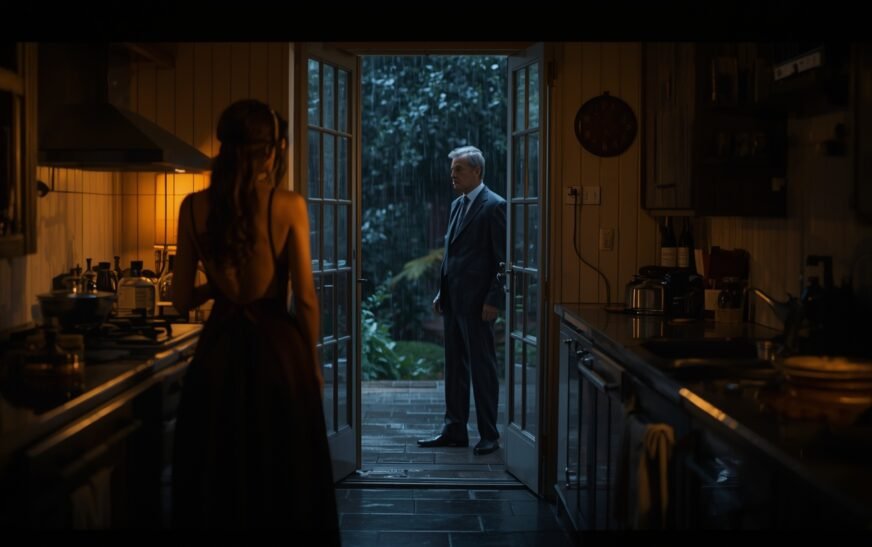
Then he left through the side entrance with rain moving silver against the dark beyond him.
Elin waited six minutes before following.
The hedge along the side path hid her well enough to feel shameful. From there, she watched Jonas cut through the back lane rather than the main street. He did not hurry. More unsettlingly, he moved with the confidence of someone repeating a practiced route.
He crossed the lane behind the chemist, passed the closed bakery, and turned toward St. Jude’s parish hall, a building Elin had passed for years without ever thinking about. No lights showed in the main windows. Only the side annex glowed faintly through frosted glass.
Jonas did not approach the front steps.
He entered through another side door.
For a moment, Elin stood under rain with her coat darkening at the shoulders and felt something colder than jealousy begin to move.
The Hall with Plastic Chairs
She should have gone home.
Instead, suspicion led her forward with the ugly steadiness of duty. Elin crossed the pavement, slipped under the low awning, and looked through the annex window before her conscience could improve.
Nothing illicit waited there.
No woman sat too close. No intimate scene justified her dread. Instead, a circle of plastic chairs filled the small hall beneath fluorescent lights. A kettle stood on a folding table beside stale biscuits and leaflets. Around the circle sat eight men of varying ages, all carrying the same expression in different versions: practiced fatigue.
Jonas was one of them.
A printed sheet on the wall, taped slightly crooked, read:
Thursday Group — Spouses with Gambling Debt.
Elin stared at the words until the rain on the glass blurred them.
Then one of the men inside began to speak, voice low enough that she caught only fragments. Missed payments. borrowed money. wife doesn’t know. not again. shame.
For several seconds, the world narrowed to the fluorescent room and the man she had married sitting under it with both hands clasped too tightly between his knees.
What the Sign Explained
She did not wait for him to finish.
Instead, she walked home through the rain with wet hair at the nape of her neck and a pressure behind her eyes that felt almost architectural. The kitchen still smelled faintly of pepper and red wine. Two plates remained in the sink. The side door stood shut, polite and unremarkable, as if it had not just rearranged twelve years of trust.
Gambling debt.
The phrase explained too much at once.
There had been small gaps over recent months she had not wanted to name. Savings discussed vaguely. A delayed transfer Jonas blamed on banking errors. One cancelled lunch with a contractor because “the numbers needed sorting.” Each incident had looked survivable by itself. Together, they now formed a shape so obvious she felt insulted by her own loyalty.
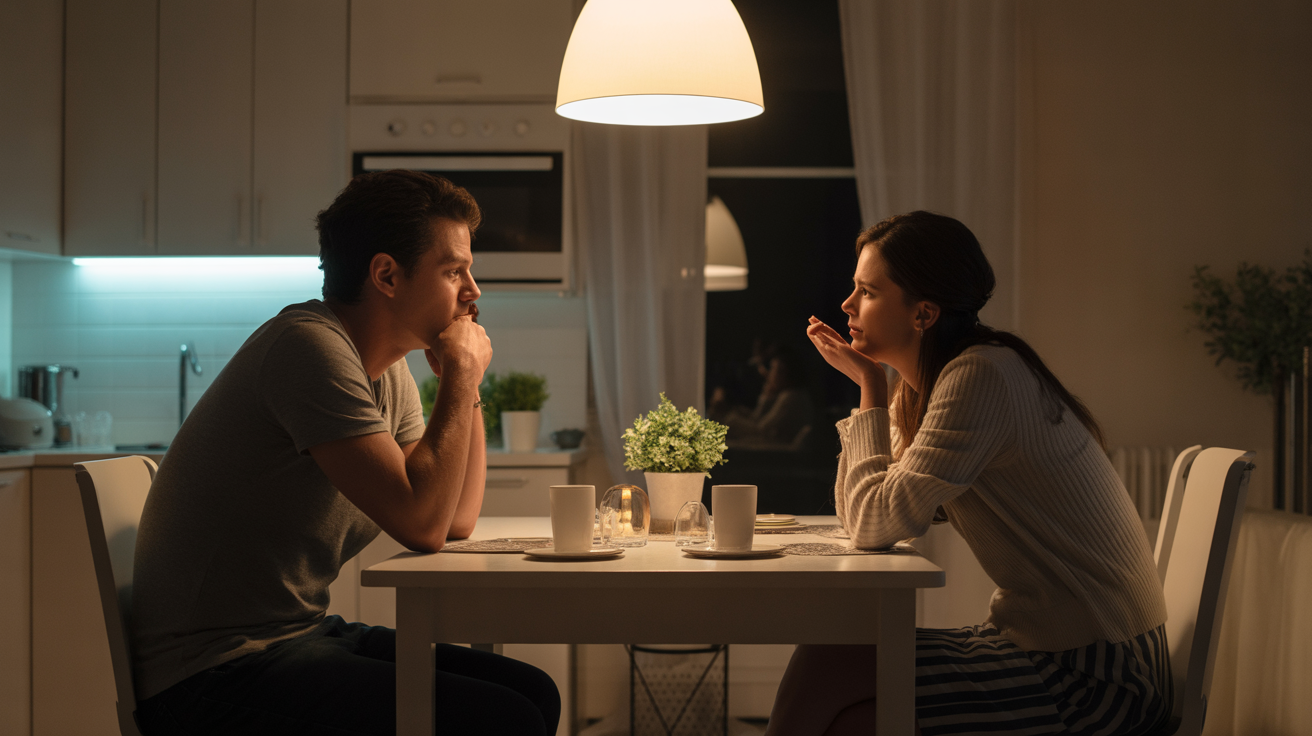
When Jonas came home at 9:42, she was waiting at the kitchen table with the overhead light still off.
He stopped just inside the room. “Why are you in the dark?”
“Because you prefer truths that arrive sideways,” she said. “It seemed respectful.”
His face changed before the meaning fully reached him.
“Elin—”
“St. Jude’s,” she said. “Plastic chairs. Bad lighting. A sign on the wall.”
All color left him then.
What He Owed the Table
For one long moment, Jonas said nothing at all.
Rain moved softly against the window above the sink. Somewhere in the lane, a car door slammed and the sound faded. Inside the kitchen, shame arrived so visibly on his face that Elin nearly pitied him and despised herself for the reflex.
“You followed me,” he said at last.
“You lied to me for months.”
He set his keys down with a hand that was no longer steady. “I was trying to fix it before it became real.”
“That is the sort of sentence people say when reality has already eaten the walls.”
He sat down opposite her without being asked. For once, he looked older than she remembered him. Not dramatically. Just enough to suggest too many private calculations had been done in bad light.
“It started small,” he said. “Football bets with the men from the office. Then online cards. Then a few losses I thought I could recover if I just stopped being stupid for one week.”
“And?”
A laugh escaped him, joyless and brief. “Apparently stupidity is not frightened by schedules.”
The line might once have made her smile. Tonight it only made the room feel poorer.
The Debt Beneath the Marriage
The story came in pieces.
First there had been hidden transfers from his discretionary account. After that, he used credit he never mentioned. Later came the borrowed money from a colleague who believed himself discreet. Each stage had been justified to himself as temporary. Each lie had been built not around greed, but around delay.
“How much?” Elin asked.
Jonas looked down at the table between them. “Enough.”
“No. Numbers.”
He swallowed once. “Thirty-eight thousand.”
The kitchen remained exactly the same size. Even so, everything in it seemed to shift by a degree.
“Thirty-eight thousand?” she repeated.
“Some of that is already arranged.”
“Arranged by whom?”
He did not answer quickly enough.
Recognition reached her before the explanation did. “Your mother knows.”
His silence confirmed it.
That knowledge struck harder than the amount itself. Debt was devastating. Being managed around it was worse.
“She helped you?” Elin asked.
“Only with one payment.”
“And both of you decided I was the sort of wife who should be edited for clarity?”
“No,” he said. “I decided that. She told me to tell you.”
What Shame Sounds Like
He finally looked at her then, and the sight of his face made the anger more difficult, not less.
Not because he deserved softness. He did not. Rather, he looked stripped of the ordinary vanity with which people usually defend themselves. What sat across from her now was not innocence or even remorse in its most useful form. It was collapse held upright by effort.
“I kept thinking one more week would let me come to you with a cleaner version,” he said. “A paid-off balance. A plan. Something that sounded less ugly than what it was becoming.”
Elin folded her arms because her hands wanted to shake. “And instead?”
“Instead, I learned that secrecy breeds faster than debt.”
That sentence, infuriatingly, was the first honest one he had given her all night.
She thought of the parish hall then. The men in plastic chairs. The fluorescent exhaustion. Not glamour. Not seduction. Only humiliation repeated until it became routine.
“Why the side door?” she asked.
He blinked. “What?”
“Why leave that way?”
His answer came so quietly she almost missed it. “Because walking out through the front felt like admitting it belonged to the whole house.”
What the House Already Knew
After that, they stopped pretending the argument could stay elegant.
Elin learned there had been no second life in the romantic sense, but there had absolutely been one in the practical sense: hidden accounts, controlled timings, cash withdrawals folded into lunch breaks, and one mortifying conversation with Jonas’s mother in a bank car park. Meanwhile, Jonas learned what his secrecy had actually stolen. Not only money. Not only sleep. It had stolen her right to stand inside her own marriage with accurate information.
“You made me stupid in my own kitchen,” she said.
He flinched then, more than he had at the amount.
“I know.”
“No,” she replied. “You know the sentence. Understanding it would hurt differently.”
For a while, neither of them spoke.
Later, unable to bear the stillness, Elin opened the tabs she had searched during the previous weeks: Marriage & Secrets, Secrets & Suspense, and, for reasons she immediately resented, Romance. None of them knew what to do with this kitchen, these debts, this man who had mistaken concealment for repair.
The Morning After the Side Entrance
By morning, the rain had cleared and the house looked offensively ordinary.
Sunlight reached the pantry tiles. The side entrance appeared harmless again, merely a narrow door near the herb shelf and the umbrella stand. Yet some ordinary things never recover once they have been assigned a secret use.
Jonas made coffee and did not ask whether she had slept. Elin appreciated that restraint. Elsewhere, gentleness might have been welcome. Here, it would only have sounded like editing.
“I am going to the bank with you,” she said.
He nodded.
“I am seeing every account.”
Again, he nodded.
“And if I hear one more sentence that begins with ‘I was going to tell you’,” she added, “I will leave before you finish it.”
At that, his face tightened with something like the first real understanding of risk.
Not of exposure. Not of shame. Of losing the only witness who had once made his life feel less temporary.
What Remained at the Door
That evening, Thursday returned again.
At eight-thirty, Jonas stood in the pantry with his coat on and his hand near the latch. Elin watched from the kitchen threshold. The side entrance remained between them, narrow and plain and full of everything it had held in silence.
“I still have to go,” he said. “The group.”
“I know.”
“Do you want me to stay?”
The question was careful now. Not strategic. Careful.
Elin considered it longer than he liked.
Once, she would have heard abandonment inside the offer. Now she heard something uglier and more honest: the first uncertain attempt to stop choosing for them both.
“No,” she said. “Go.”
He looked relieved and wounded in equal measure. Then, with visible effort, he reached for the front hall instead of the pantry door.
“Not that way,” Elin said.
He stopped.
“If you leave,” she continued, “you leave through the proper part of the house.”
The words landed harder than she expected. Even so, she did not soften them.
Jonas stood still for a moment, then turned, crossed the kitchen, and walked out through the front hall under the ordinary light that had witnessed their whole marriage without once asking for payment.
After the door closed, Elin remained alone beside the pantry with one hand resting on the frame of the old side entrance. It would never be only a door again. Some objects are too ordinary to look dangerous until they become the route by which truth keeps escaping.