The Building With Good Manners
Mara took the apartment because it looked like the kind of place where people kept their disasters quiet.
The breakup had ended three weeks earlier with enough politeness to feel insulting. There were no thrown glasses and no slammed doors. Instead, there had only been the slow, careful language of a man who had already left in private and now wanted the public version to sound mature. Therefore, when the lease for her old place ended, she chose distance over memory and moved into Bellgrave House with two suitcases, a box of books, and a plant she did not expect to keep alive.
The building stood on a narrow street above a shuttered antique shop and a florist that closed too early. Its brass railings were polished. The lobby smelled faintly of wax and old roses. Even the elevator doors closed with a muted discretion that suggested wealth once lived there and preferred not to be discussed.
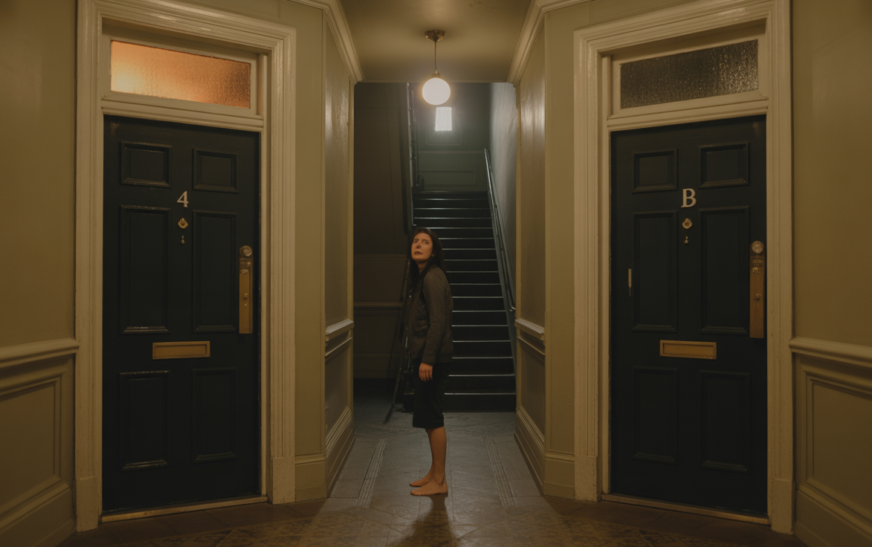
Mara’s apartment was 4A.
Across the corridor stood 4B, its black door glossy under the weak landing lamp. The brass number had darkened at the edges. A small stack of unopened circulars rested on the mat the day she arrived.
“Vacant?” Mara asked the porter while signing for her keys.
He glanced up only briefly. “At the moment.”
That answer stayed with her longer than it should have.
The First Quiet Night
The first evening passed in the usual disarray of new rooms.
Mara unpacked cups before plates, sheets before towels, and the kettle before anything sensible. Rain tapped at the windows after ten. Somewhere below, a taxi idled, then moved on. Meanwhile, the apartment settled around her with the small, dignified sounds of pipes, floorboards, and age.
She liked the silence immediately.
Her last place had carried too much recent history. This one, by contrast, felt impersonal in the best way. Pale walls. Tall windows. A narrow kitchen with black tile and silver handles. The bedroom shared one wall with 4B, though the porter had assured her the neighboring flat had been empty for months.
Just before bed, she stood in the hall and listened out of habit.
Nothing.
No television behind the walls. No steps in the corridor. No distant music filtering through the floorboards. Bellgrave House seemed determined to prove itself well bred.
Mara slept heavily for the first time in weeks.
The Sound at Two Fourteen
The second night changed that.
At exactly two fourteen, she woke with the sharp, dislocated certainty that someone else was in the room.
Darkness held steady around the bed. Rain had stopped. The digital clock on the bedside table glowed in thin red numbers. For several seconds, she heard nothing at all.
Then the sound came again.
Three slow claps.
Pause.
Three more.
Not loud. Not celebratory. Instead, the rhythm was measured, patient, and horribly deliberate, as if applause had been stripped of joy and left with only form.
Mara sat upright.
The noise came through the wall shared with 4B.
She held her breath and counted unconsciously with the next sequence. Three claps. Pause. Three claps. The pattern continued for nearly a minute. Then, without variation or visible cause, it stopped.
The silence afterward felt arranged.
Mara got out of bed and crossed to the wall in bare feet. The plaster was cool. The room beyond it remained wordless.
“No,” she whispered to no one.
Yet the midnight applause had already happened, and the hour made it feel less like a sound than a decision.
The Porter in the Morning
Morning made the fear look theatrical.
Sunlight entered through thin cloud and laid a harmless square over the kitchen floor. Mara showered, dressed, and even laughed once at herself while searching for coffee filters in the wrong cupboard. However, the confidence did not last long enough to reach the lobby.
The porter on day duty was different from the one who had checked her in. He was younger, in a sharper suit, with a name badge that read Colin.
“Excuse me,” Mara said. “Is anyone staying in 4B now?”
Colin frowned politely. “No, miss.”
“No one at all?”
“Not this month.”
She hesitated. “I heard someone in there last night.”
Colin’s face stayed courteous, though something in it withdrew. “Old buildings carry sound strangely.”
“This did not carry strangely. It sounded like clapping.”
“From 4B?”
“Yes.”
He adjusted the register on the desk. “I can ask maintenance to inspect the radiator lines if you’d like.”
That answer was too smooth to be useful. Even so, she said yes because useful people rarely arrive with the truth first.
The Woman With the Keys
When Mara returned that evening, a woman in a navy coat was unlocking the service cupboard on the fourth-floor landing.
She looked to be in her late fifties, with silver hair pinned neatly back and a ring of keys at her waist that suggested deeper authority than the porters enjoyed.
“You must be in 4A,” she said. “I’m Edith. House manager.”
Mara nodded. “I was told maintenance might check the pipes.”
“Tomorrow.” Edith’s expression remained neutral. “You heard something from next door.”
It was not a question.
“Yes,” Mara said. “At two fourteen.”
For the first time, Edith looked directly at 4B before answering. “Bellgrave has old walls. They don’t always keep to themselves.”
“That sounds like a sentence meant to end conversation.”
“Often, those are the kindest ones.”
Mara folded her arms. “Has someone died in there?”
Edith’s keys stilled briefly. “People have died in many apartments. It’s a city.”
“That is not what I asked.”
Edith closed the cupboard. “If the noise returns, don’t answer it.”
Then she walked to the stairs without once looking back.
The Routine Behind the Wall
That night, Mara stayed awake on purpose.
She made tea at one thirty. She read three pages of a novel without absorbing a sentence. Then she checked the clock too often and hated herself each time. Meanwhile, the building settled into its nocturnal composure around her. Pipes clicked distantly. An elevator hummed once, then slept again.
At two thirteen, the bedroom felt colder.
At two fourteen, the applause began.
Three claps. Pause. Three claps.
This time it lasted longer. The rhythm remained exact. However, a new detail arrived with it: between the pauses, a faint drag across the floor, as if a chair were being moved into place and then returned carefully after each sequence.
Mara stood in the middle of the bedroom, pulse climbing despite the stillness of the room.
Three claps. Pause. Drag. Three claps.
The sound was so unmistakably human that fear became irritation for one useful second. Therefore, she crossed to the door, opened it, and stepped into the corridor.
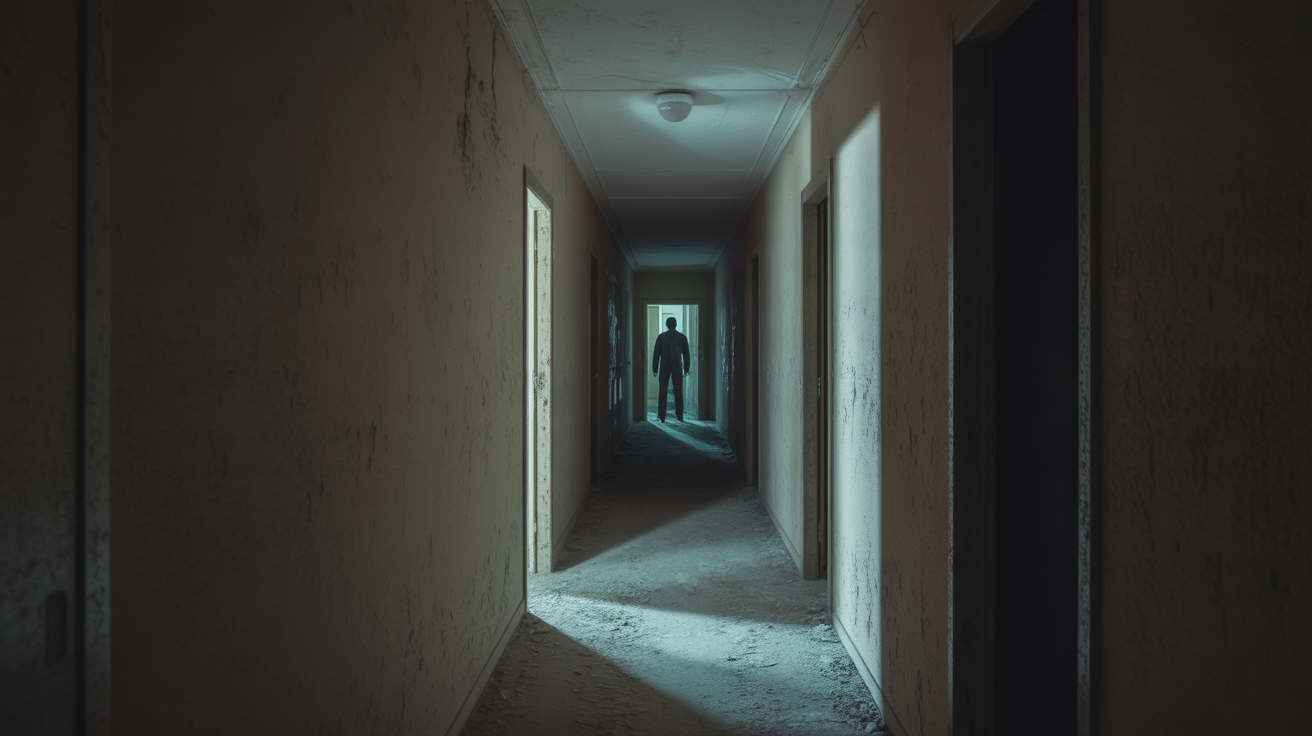
4B stood opposite under the weak lamp, black and immaculate. No light showed beneath it.
The applause continued.
Not behind the door now.
Behind her.
Mara turned too quickly. The sound had shifted back through her own bedroom wall, as though the apartment next door had moved while she was looking away.
The Door to 4B
Some instincts are older than reason. One of them told her to go downstairs immediately and never spend another night in Bellgrave House.
Another, more dangerous instinct kept her on the landing.
She crossed to 4B and touched the brass knob.
Cold.
The applause stopped at once.
Not faded. Not ended naturally. Instead, it stopped as though the silence on the other side had been listening for her hand.
Mara stepped back.
Then she noticed the mat.
The circulars were gone. In their place lay a folded cream card no bigger than a postcard. She was certain it had not been there when she entered the hall.
Her name was written on the front in narrow, dark ink.
Mara.
She did not pick it up. Instead, she stared until the letters seemed to sharpen and flatten by turns in the yellow light.
Finally, she crouched and lifted the card by one corner.
Inside was a single sentence.
You should clap back.
The Former Tenant
By morning, Mara wanted facts more than reassurance.
Edith refused to discuss 4B at the desk, so Mara waited outside the building office until the older woman appeared with a ledger under one arm and displeasure already prepared.
“Someone put a note outside my door,” Mara said.
Edith looked tired rather than surprised. “Show me.”
Mara handed it over. Edith read the sentence once and closed her eyes briefly.
“Who lived in 4B?” Mara asked.
Rain needled the lobby windows. Colin pretended to inventory parcels while listening too hard.
“A pianist,” Edith said at last. “Mr. Lucian Arkwell. He rented the flat for six years.”
“And?”
“He had a following. Students. Admirers. Women who confused melancholy with depth.”
The remark sounded old and therefore true.
“Two winters ago,” Edith continued, “he gave a final private recital upstairs. Only a few guests. After midnight, they heard applause from inside his flat. However, no one ever agreed whether the sound came before or after he collapsed.”
Mara said nothing.
“He died in hospital the next afternoon,” Edith added. “Since then, 4B has been difficult to let.”
“Because of clapping.”
Edith folded the note once more. “Because the sound does not always remain in 4B.”
The Test She Should Not Have Tried
Mara should have packed then. She knew this later with painful clarity.
Instead, the day passed, and evening returned with its usual false logic. Fear looked childish by daylight. Curiosity looked disciplined. Therefore, by eleven forty, she was seated on the bedroom floor beside the wall with the note in her lap and a cheap pair of foam earplugs she had not used.
At two fourteen, the applause began on time.
Three claps. Pause. Three claps.
Mara waited through three cycles, jaw tight.
Then, because the note had moved from threat to instruction in her mind, she raised her hands and answered.
Three claps.
The sound beyond the wall stopped.
For one second, the silence felt almost relieved.
Then every door in her apartment opened.
The bedroom door swung wide first. After that came the bathroom. Then the narrow hall closet opened. Finally, the kitchen cupboard she had left latched before bed shifted inward too. The openings happened in sequence, soft and measured, as though some invisible host were preparing rooms for guests.
Mara got to her feet so fast she kicked over the lamp beside the bed.
From the corridor outside came the drag of a chair across polished floorboards.
The Applause in Her Flat
It no longer came through the wall.
The midnight applause had crossed into 4A.
Three claps from the kitchen. Pause. Three more from the hall. The sound moved with impossible courtesy, never rushing and never striking too hard, as if it wanted to be welcomed as much as feared.
Mara backed toward the front door and fumbled with the lock.
The kitchen light flicked on by itself.
She saw only part of the room from the hallway: the white edge of the counter, the plant on the sill, the open cupboard door, and the dining chair she had left tucked neatly under the table.
Now it stood pulled out and angled toward the bedroom.
As though someone had been sitting there, waiting for a performance to improve.
Three claps. Pause.
“Stop,” Mara said, and hated how much it sounded like pleading.
The answer came not as a voice, but as another careful drag of the chair over tile.
She opened her front door at last and fled into the corridor barefoot, carrying nothing but her phone and keys. Behind her, 4A remained lit in sections. Meanwhile, 4B stood dark and immaculate opposite, its brass number dull under the lamp.
Then the clapping began from inside 4B as well.
One set from her flat. One from the vacant one. Call and response across the landing.
Mara ran for the stairs.
The Night Porter
She found the night porter asleep in a chair behind the lobby desk and woke him badly enough that his hand flew to his chest before he fully understood her face.
“Fourth floor,” Mara said. “Now.”
Whatever he saw in her expression kept him from offering the usual soft refusals. Instead, he took the service key ring and followed her upstairs with visible reluctance.
When they reached the landing, the corridor was silent.
4A stood open. 4B remained shut.
The porter, whose badge read Stephen, looked from one door to the other. “What exactly did you hear?”
Mara answered by stepping into her flat.
The kitchen light was off again. The chair stood neatly under the table. All cupboard doors were closed. The bedroom lamp lay on its side where she had kicked it. Everything else was arranged with such perfect order that panic suddenly felt embarrassing.
Then Stephen noticed the wall above the dining chair.
There, in dustless lines across the paint, was the mark of five fingertips.
Not pressed flat. Tapped.
Again and again in grouped patterns of three.
Stephen went pale enough that Mara stopped needing him to confirm anything.
After Bellgrave House
She left before dawn and never went back upstairs alone.
Edith arranged to end the lease within the week with a professionalism so efficient it felt rehearsed. No one asked her to explain further once Stephen described the marks on the wall and then refused to describe them a second time. Bellgrave House kept its manners. It kept its tenants’ silences too.
Later, when Mara found herself drawn to fiction shaped by Horror, the creeping intimacy of Dark Fear, and the quiet pressure inside Psychological stories, she understood why certain fears lasted. They did not crash into a room. Instead, they waited behind a wall, learned a person’s routine, and entered politely once invited. Some dark nights brushed the emotional ache of Drama or the measured cruelty of Mind Games, because dread was often most effective when it behaved beautifully.
In the end, the most lasting unease can begin with midnight applause, a supposedly vacant apartment, or the first note of creeping fear inside an elegant building. Sometimes it sharpens through an unsettling neighbor, the isolation of a sleepless night, and the ritual of a haunted wall that seems to listen back. Fear rarely announces itself rudely. More often, it waits for courtesy, then teaches the room how to clap.