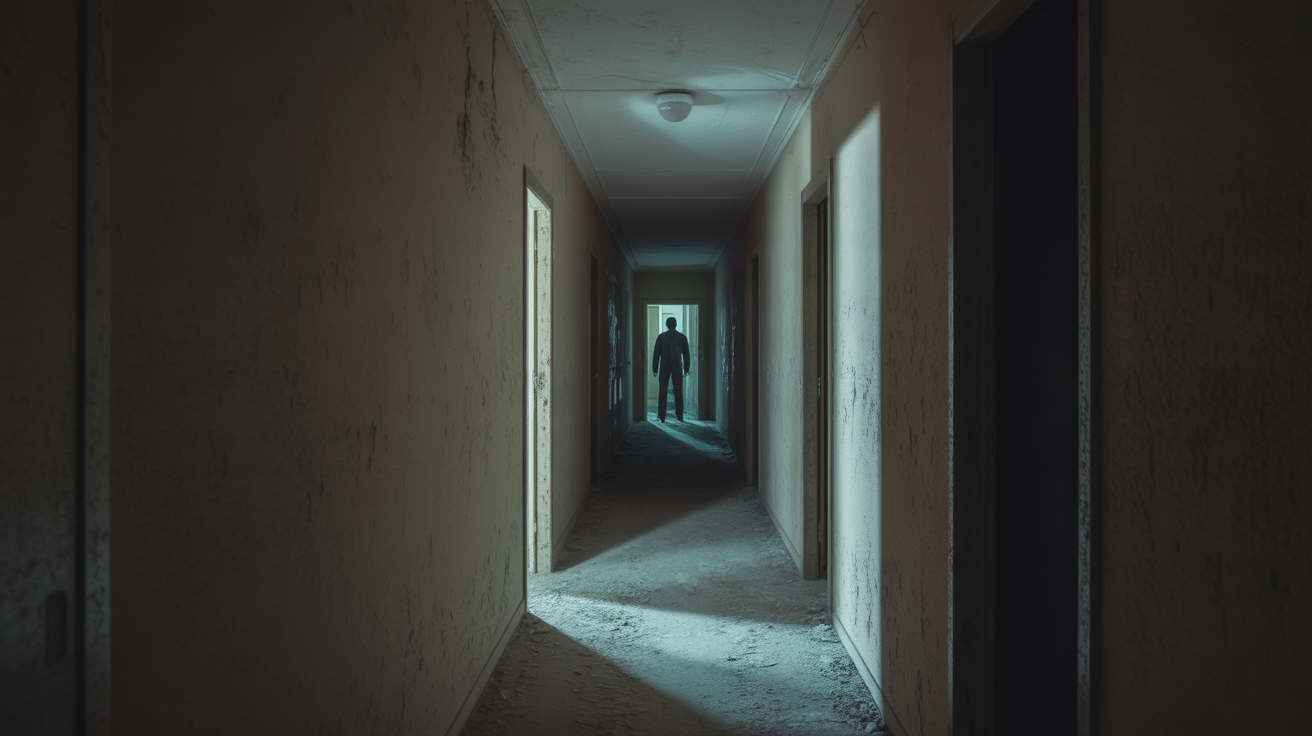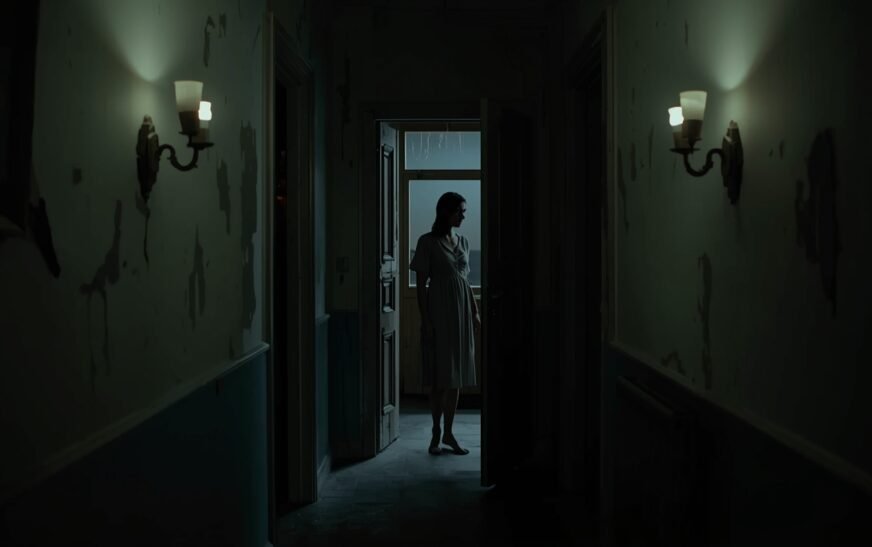
Imani first heard the night humming on her third evening in Flat 4C, just after the pipes settled and the sea wind began pressing its long cold hand against the building. At first, she mistook it for old wiring. Lornwick House stood too close to the shore and too far from repair, with salt in the window frames and damp rising under the wallpaper like a second skin. However, the sound did not come from the walls. Instead, it moved slowly down the corridor, low and human, as if someone outside each door was testing whether the people inside were still awake.
Her father had called the flat “practical” when he offered it to her for the month. He was in a rehabilitation clinic inland after a minor stroke, and the empty place needed checking, airing, and a few sensible repairs before he returned. Therefore, Imani agreed. She worked remotely, needed distance from the city, and told herself four quiet weeks by the sea might steady her after a winter full of endings.
By day, Lornwick House looked merely tired. The lobby smelled of old polish and wet umbrellas. Brass mail slots hung slightly crooked. Across the cracked tile, a stained-glass window by the stairs threw weak colored light. Meanwhile, the tenants behaved with the brittle courtesy of people who had lived too close to one another for too many years. They nodded. They never lingered. Above all, no one asked questions that might lead to real answers.
The night humming began at 2:14 a.m.
The first pass down the corridor
Imani sat up in bed before she fully woke. For a moment, she thought the sound belonged to a dream. Then it came again: not a tune, not words, only a long patient note that rose and fell with breath.
She looked toward the bedroom door.
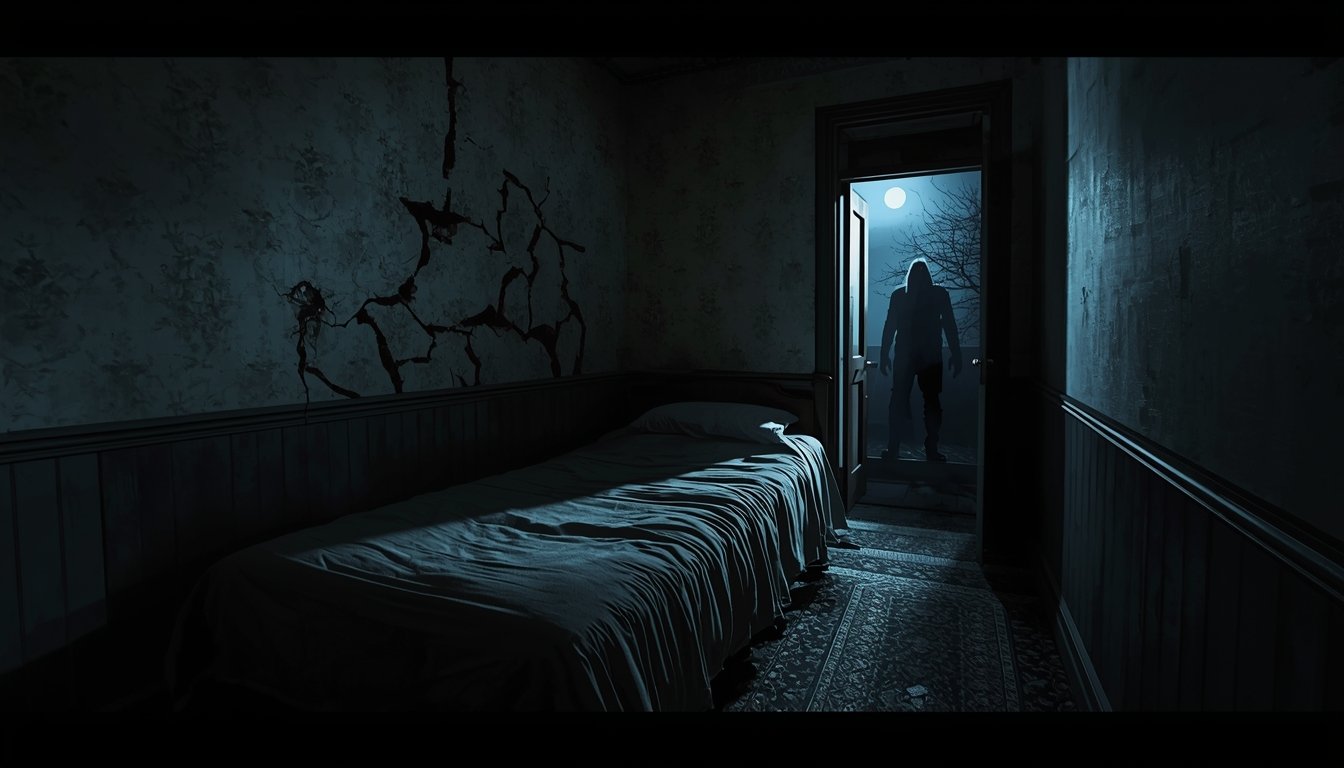
Moonlight from the narrow window in the hall reached only partway across the floorboards. Beyond it, the flat lay still. No television murmured in another room. No footsteps crossed overhead. Even so, the sound continued, soft and deliberate, pausing near her door before moving on.
Imani slid out of bed and crossed the room in bare feet. The boards felt cold enough to make her wince. When she reached the bedroom threshold, the humming had already drifted farther down the corridor outside the flat, as if the building itself had exhaled and was waiting for her reaction.
She checked the front door chain. Still locked.
Then she stood there listening until the silence thickened around her again.
By morning, the whole thing felt foolish. Old buildings made old sounds. Wind found strange routes. Lack of sleep enlarged everything. Nevertheless, when she opened her door to collect the milk bottle left on the mat, she noticed three things at once: the corridor smelled faintly of brine, the runner rug had been turned slightly sideways, and Mrs. Vale from 4A was already watching from the far end near the stairwell.
What the neighbors refused to say
Mrs. Vale was a thin woman with silver hair pinned so tightly it seemed painful. She wore dark dresses in every weather and carried a canvas shopping bag that looked older than Imani.
“Bad sleep?” the woman asked.
The question landed too quickly.
Imani straightened. “A little.”
Mrs. Vale’s gaze moved to the door chain, then back to Imani’s face. “Keep it that way.”
“Keep what?”
Instead of answering, the woman adjusted her bag on one wrist. “The wind gets louder after rain.”
Then she walked toward the lift without another word.
Imani nearly laughed. The building had the sort of residents who fed local folklore just by standing still. Still, the remark lingered. Later, while answering emails at the kitchen table, she found herself listening for movement in the corridor between every paragraph she wrote.
At noon, she went downstairs to ask the building manager about the heating. Mr. Seln kept office hours in a narrow room behind the lobby, where ledgers were stacked beside a humming electric kettle and a dying fern.
“Heating’s temperamental,” he said, making no note of her complaint. “Sea air gets into everything.”
Imani leaned one shoulder against the doorframe. “Do tenants ever walk the halls at night?”
His expression changed very slightly.
“Insomniacs live everywhere,” he replied.
“I heard someone outside the flats. Humming.”
For a moment, he looked past her into the lobby as though checking who else might be listening. “If you hear anything after two,” he said carefully, “leave your door closed.”
“That sounds less like maintenance advice.”
“Take it anyway.”
The rule on the noticeboard
That afternoon, rain came in hard from the sea, needling the windows and turning the front steps slick. Imani returned from the corner shop with bread, batteries, and the sharp feeling that the whole town had been arranged slightly wrong.
In the lobby, a new sheet of paper had been pinned to the noticeboard beside the fire-exit map.
Please avoid opening corridor doors between 2:00 a.m. and 3:00 a.m. during overnight maintenance.
No company name appeared beneath the sentence. No dates were listed. The page looked freshly typed yet somehow old-fashioned, as if dictated by someone who still trusted vague instructions to govern fear.
Imani stared at it until a voice behind her said, “They only put that up when someone asks directly.”
She turned to find a young man in a navy peacoat carrying takeaway cartons. He nodded toward the paper.
“I’m Theo,” he said. “5B.”
“Imani. 4C.”
His expression softened into something near sympathy. “Your father’s place, right?”
“You knew him?”
“Everyone knows everyone badly in this building.” Theo shifted the cartons to his other hand. “Listen, the notice is the kinder version.”
“Kinder than what?”
He hesitated, then lowered his voice. “Don’t answer anything you hear in the corridor after two. Not humming. Not knocking. Not your name.”
That should have sounded theatrical. Instead, it sounded exhausted.
The second night humming
Imani slept with the lamp on the next night, which irritated her enough to feel reassuring. Practical annoyance left less room for dread.
At 2:14, the lamp flickered once.
The night humming arrived from the far end of the corridor with the same low breath as before, except now she could hear a second texture beneath it. It was almost a scrape, as though fabric brushed wallpaper while something moved slowly past each flat.
She stayed in bed. She counted breaths. She told herself this was a building ritual, some local superstition fed by acoustics and poor sleep and tenants who preferred rules to repairs.
Then the humming stopped directly outside her door.
Silence followed, but not the easy kind. The pause felt attentive.
Imani held still under the blanket, every muscle braced. Somewhere below, water knocked once in the pipes. The sea wind sighed around the eaves. Nothing else moved.
A voice came next, so soft she almost mistook it for thought.
“Still here?”
The words were wrong in two ways at once. First, they were spoken in her father’s voice. Second, he would never have said them like that.
Her throat tightened. She did not answer.
After several seconds, the humming resumed and drifted farther along the corridor.
The flat across from hers
Morning brought hard sunlight and humiliation. Fear always looked excessive in daylight. Imani made coffee, opened every curtain, and nearly convinced herself she had hallucinated the voice.
Then she noticed the door opposite hers standing slightly ajar.
Flat 4D had appeared empty since she arrived. Dust lined the inside of the frosted glass panel. No post gathered on the mat. Even the brass number seemed dimmer than the others.
Now, however, the door was open by perhaps two inches.
Imani crossed the corridor before caution fully caught up. The air there felt colder. She knocked once on the frame.
No answer.
The gap revealed only darkness and the faint smell of damp carpet. Yet on the floor just inside the threshold lay a mug on its side, as if someone had set it down in a hurry or dropped it while listening.
“Don’t,” said Mrs. Vale sharply from behind her.
Imani stepped back at once.
The older woman stood by the lift with one hand gripping the rail of her shopping cart. “He opened the door last winter,” she said. “That flat hasn’t settled since.”
“Who?”
Mrs. Vale’s mouth tightened. “Mr. Fenn. 4D. He heard singing, apparently. Thought some girl was locked out.”
“What happened?”
The woman looked straight at the dark crack of the doorway. “In the morning, his flat was empty and his shoes were in the corridor facing inward.”
The call from her father
Later, Imani phoned her father from the promenade, where gulls dragged their cries across the gray afternoon and the sea looked like beaten metal.
He sounded stronger than he had the week before. That should have comforted her.
“How’s my glamorous estate?” he asked.
“Damp. Judgmental. Slightly haunted.”
He laughed, then stopped too quickly. “Has someone said something to you?”
Imani watched foam strike the black rocks below the rail. “Only that I shouldn’t open the door after two.”
Silence moved down the line.
“Baba?”
When he answered, his voice had changed. “I should have told you before you stayed there.”
“Told me what?”
He exhaled slowly. “Your mother used to hear it before we separated. The humming. She said it started after the winter storms, when the fourth floor flooded and they sealed the old service passage. I told her the place was affecting her nerves.”
Imani closed her eyes.
“Did you hear it too?” she asked.
“Once,” he said. “Then again months later. I never opened the door.”
“Why didn’t you tell me this before I moved in?”
“Because it sounds mad when the sun is out.”
That, she thought, was the building’s greatest talent. It made fear look embarrassing by noon.
What Theo admitted in the stairwell
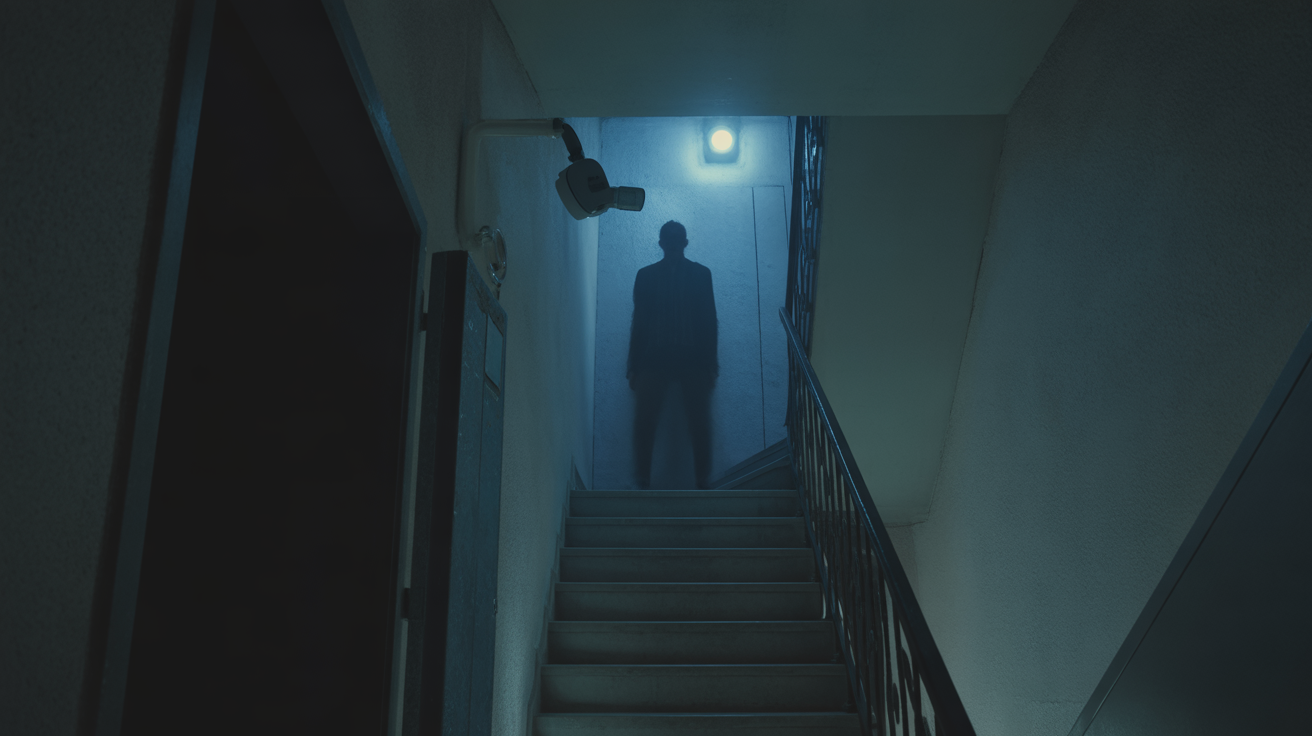
That evening, the lift stalled between floors, and Imani took the stairs with a torch from the kitchen drawer. On the landing between four and five, she found Theo smoking beside the cracked window, the cigarette cupped carefully against the draft.
“You look like you’ve started believing us,” he said.
“I’m considering it unwillingly.”
He nodded, as though that were the expected stage. “Best way to begin.”
Imani stopped one step below him. “What did you hear?”
Theo stared through the cracked pane toward the black sea. “My ex lived here with me for three months. Last autumn. She said the corridor called in voices it had borrowed.”
“Borrowed from where?”
“From whoever would make you open up.”
The stairwell smelled of wet brick and tobacco. Somewhere above them, a door clicked shut.
“Did she open it?” Imani asked.
He shook his head. “No. I did.”
That surprised her more than the answer itself.
“Then why are you still here?”
His face changed, becoming older in one quiet motion. “Because it wasn’t outside my own flat. It was hers. I heard my sister crying in the corridor and forgot every rule in the building.”
Imani waited.
“There was nobody there,” he said. “But after that, my ex never slept right again. She moved out two weeks later and said the hall had learned her breathing.”
Rain at 2:14
The third night brought rain so hard it erased the sea. Water struck the panes in relentless sheets. Wind crowded the chimney. Lornwick House groaned like something turning over in uneasy sleep.
Imani made tea she did not drink. She sat in the armchair facing the front door with all the lights on, her laptop open and unwatched on her knees. At 2:12, every ordinary object in the flat seemed overdefined: the chipped blue bowl on the sideboard, the framed photograph of her parents on a cliff path, the umbrella stand by the entrance, the thin line of brightness beneath the door.
At 2:14, the line of brightness darkened.
Something stood on the other side.
The night humming began so softly it might have been blood in her ears. Then it grew clearer, fuller, almost tender. The sound moved nowhere this time. It had arrived already at her door.
Imani did not breathe through her mouth because she feared whatever stood outside might hear the difference.
A knock followed. Not loud. Just three patient taps.
Then her mother’s voice said, “Open it, darling. He fell in the hall.”
Her fingers tightened around the mug. The tea burned her skin through the ceramic. Her mother had been dead for nine years.
Still, grief recognized itself faster than reason did.
The line under the door
For one terrible moment, Imani nearly moved.
Then Mrs. Vale screamed.
The sound ripped through the corridor from somewhere near the lift, raw and furious and alive in a way the voices at the doors never were. The humming broke at once. Not stopped—broke, as if the note had been cut across the middle.
What followed was worse than silence. It was retreat. Something passed down the corridor with immense slowness, brushing wallpaper, pausing once outside 4D, then continuing toward the old service end of the floor.
Imani stayed in the chair until dawn whitened the edge beneath her curtains.
When she finally opened the front door with the chain still on, the corridor appeared unchanged except for one detail. A damp line, thin as a dragged finger, ran from her threshold along the runner rug toward the bricked-up service passage at the far end.
Mrs. Vale stood in her doorway fully dressed, one hand still gripping a brass handbell.
“You screamed?” Imani asked.
“No,” the woman said. “I rang this.” She lifted the bell. “Sound breaks it sometimes.”
Imani stared at the metal. “Why didn’t anyone tell me that part?”
Mrs. Vale’s mouth twitched. “Because then people get brave.”
The sealed passage
By morning, Theo had found a crowbar. Mr. Seln objected weakly, then gave in when he saw the damp trail leading to the wall at the corridor’s dead end. The bricks there were newer than the rest of the floor, patched after the old flood her father had mentioned.
“This is absurd,” Mr. Seln muttered, though his hands shook.
“Yes,” Mrs. Vale replied. “Do keep going.”
Theo pried loose the first board covering the lower vent. Cold air spilled out carrying a smell like seawater trapped in cloth for too many years. Behind the grate lay a narrow maintenance passage just wide enough for pipes, cables, and a man willing to crawl.
No one volunteered.
Imani crouched and shone her torch inside.
The beam found salt bloom on brick, a rusted ladder, and dozens of old scratch marks low along the wall, as if something had moved there repeatedly without needing much space. Farther back, caught on a broken pipe joint, fluttered a strip of dark fabric.
Theo swore under his breath.
Mrs. Vale crossed herself with brisk irritation rather than piety.
Then the beam touched a shoe.
Only one. Brown leather. Dust-filmed and angled inward, exactly as if someone had stepped out of it while facing deeper into the dark.
After the night humming
No police report changed anything. The shoe was old. The passage was unsafe. Mr. Fenn had disappeared eighteen months earlier and the sea kept many explanations in circulation. By afternoon, officials had closed the vent again with cleaner boards and firmer language. Nevertheless, the building had shifted. Tenants spoke to one another in the lobby. The noticeboard gained specifics. Mr. Seln ordered brighter bulbs for the fourth floor.
Imani did not leave.
That surprised her most. After all, fear usually made departure look wise. Yet staying felt important in a way she could not fully defend. Lornwick House had lived for years on silence, embarrassment, and the polite management of dread. Now it had been named, if not understood.
The night humming did not return the next evening. Nor the one after that.
Even so, Imani kept the brass handbell Mrs. Vale lent her on the table by the door. She answered emails, called her father, cooked simple dinners, and began sleeping in longer stretches. Meanwhile, the corridor outside 4C remained an ordinary corridor by day and a place of careful listening after dark, which was perhaps the nearest any building came to honesty.
Readers drawn to atmospheric horror, dark fear stories, psychological unease, quiet thriller tension, and secrets and suspense will recognize the shape of terror that asks for nothing dramatic at first, only one small answer through a locked door.
Meanwhile, the deeper dread lived in apartment horror, eerie neighbors, midnight sound, old building dread, coastal horror, borrowed voice, and locked corridor that continue long after the sensible explanation has gone home.
The last note behind the wall
On her last night in Flat 4C, Imani woke just before two for no reason she could name. The building lay still around her. Rain tapped softly at the glass. Nothing moved in the corridor.
Then, very faintly from somewhere deep behind the sealed wall, a single note rose and fell like someone remembering how to begin.
This time, no one in Lornwick House opened a door.