The Hall She Did Not Revisit
Nora had avoided Bellthorne Hall for eleven years because some buildings become louder after loss.
The recital hall stood at the edge of the old arts district, hidden now behind shuttered cafés and a florist that only opened on weekends. Once, it had hosted youth concerts, winter recitals, and audiences disciplined enough to applaud on cue. Later, after renovations failed and funding thinned into excuses, the place was closed to the public and rented only for storage, private rehearsals, and the occasional charity event too underfunded to deserve better.
Nora knew all of this because her mother still called it “that hall” with the strained neutrality of women who wanted language to behave.
She had come because the city was finally selling the building. A final viewing had been offered to former families with connections to its history. That was the phrase used in the letter. Connections to its history. Elegant, bloodless, and almost offensive.
Her sister had disappeared there after a winter recital.
No body. No witness who mattered. No explanation worth repeating without sounding theatrical.
Therefore, on a damp Thursday evening in November, Nora climbed the worn stone steps with her invitation folded in one gloved hand and the old refusal still lodged somewhere under her ribs.
The Woman With the Keys
The front doors opened before she knocked.
A caretaker in a navy coat stood beneath the dim lobby chandelier, one hand still on the lock. She was in her sixties, perhaps, with silver hair pinned back and the patient face of someone who had spent years being left alone with old buildings and their moods.
“Nora Vale?” she asked.
“Yes.”
“I’m Mrs. Harrow. Thank you for coming before dark fully settled in.”
“That sounds less reassuring than you think.”
Mrs. Harrow gave the faintest smile. “Old halls prefer evening. They always have.”
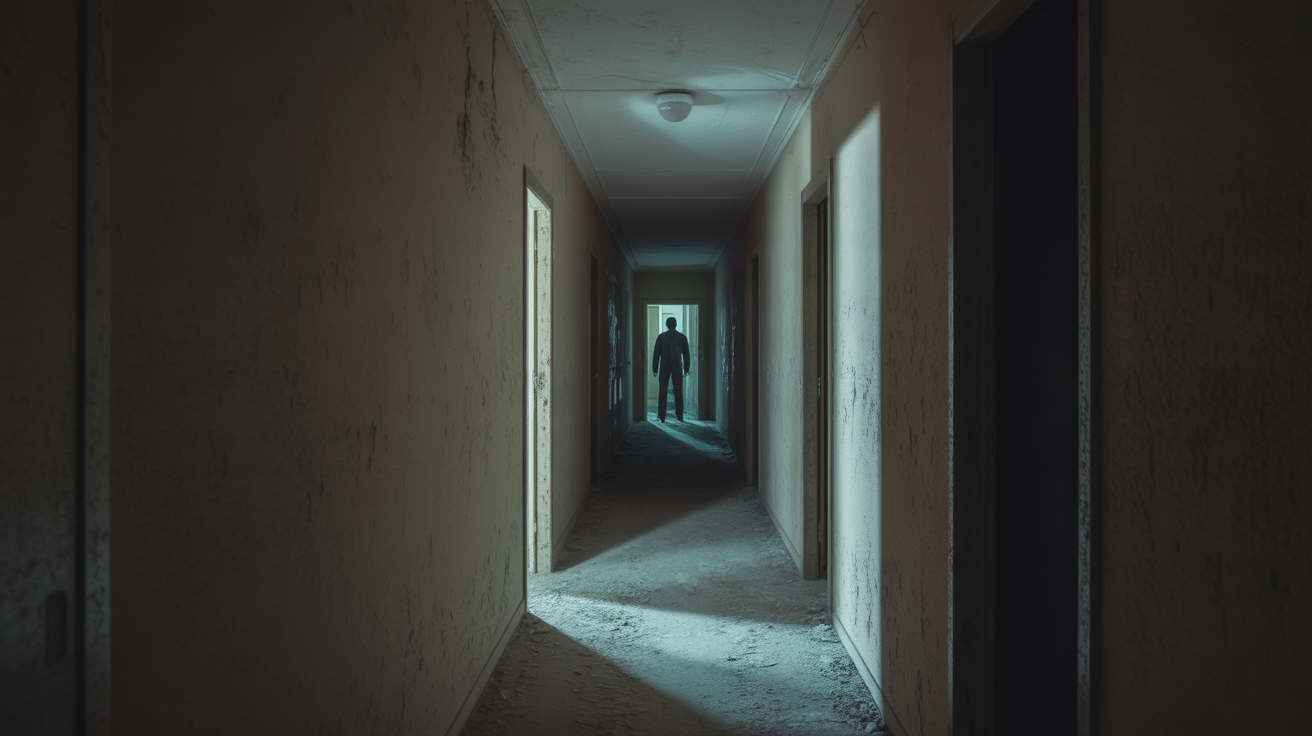
Inside, the air smelled of velvet dust, damp wood, and something faintly metallic beneath both. The lobby had once aimed for grandeur and now settled for endurance. Framed posters leaned crookedly along the walls. A brass rail curved toward the staircase. Above, shadow filled the upper gallery where the bulbs no longer worked.
“You’ll want the main auditorium,” Mrs. Harrow said. “Most people do.”
Nora followed her through a corridor lined with photographs of children holding violins, choirs in white gloves, and conductors smiling with the strain of men expected to look inspired for too long.
At the end of the passage, double doors stood half open.
Beyond them, the hall waited.
The Stage Without Music
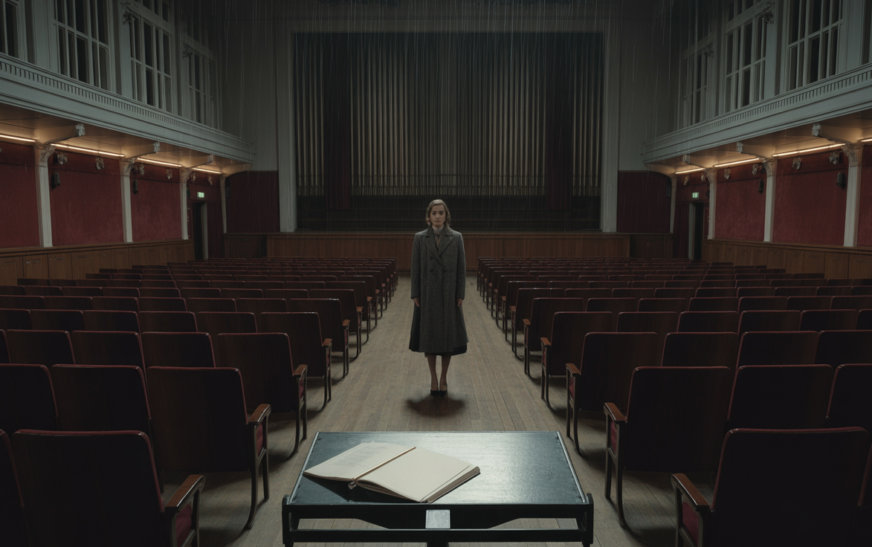
The auditorium was larger than memory had left it.
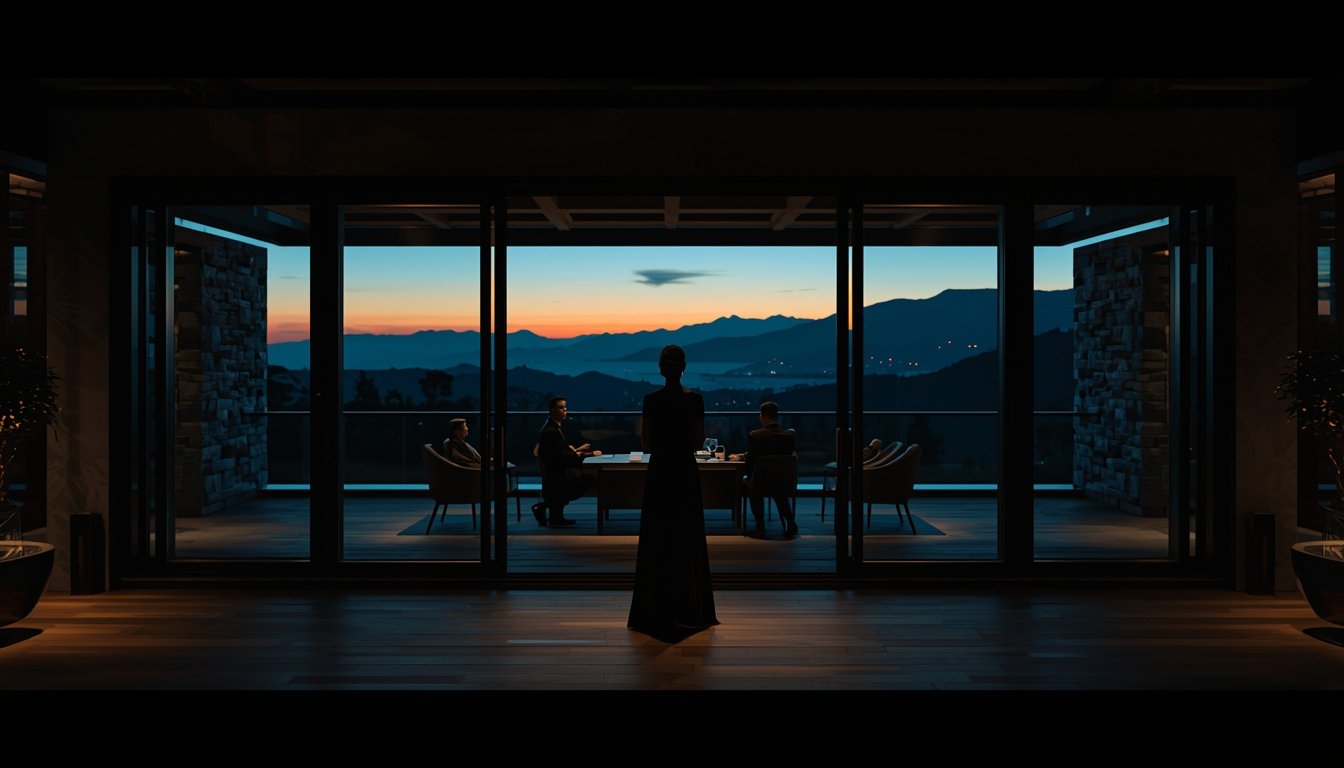
Rows of red seats descended toward a dark stage framed by heavy curtains and tarnished gilt. Overhead, the ceiling arched high enough to gather every whisper and return it altered. Meanwhile, rain touched the windows high above the side balconies, too distant to seem part of the same weather.
Nora stepped down the aisle slowly.
She had last stood there at seventeen, holding a coat her sister had forgotten in the dressing room and telling herself Celia had simply gone out the wrong exit. By midnight, that explanation had become impossible. By morning, it had become useless. The police had asked questions. Volunteers had searched the river path and the streets behind the hall. Her mother had sat in the lobby with both gloves still on, as if bare hands would have made the loss more official.
Nora stopped at row H.
That had been their mother’s seat. Celia had played a Debussy piece with too much feeling and not enough obedience. Afterward, she had smiled from the stage in a way that made rules seem briefly negotiable.
Mrs. Harrow remained at the back of the aisle with her keys gathered in one hand. “You may take your time,” she said.
“You remember that night?” Nora asked.
“I was an assistant then. Very young. Very underpaid.”
“Did you see anything?”
The caretaker’s expression did not change. “Only confusion. It came fast.”
That answer sounded practiced, but not false.
The Silver Program
Nora sat in row H because standing made the room feel too aware of her.
The seat creaked once beneath her weight. Dust moved faintly in the stage light left burning for the viewing. On the floor below the neighboring seat lay a folded recital program printed on silver-gray paper.
Her breath caught before reason could interfere.
It was the old design.
The winter recital eleven years ago had used metallic stock because some donor thought it looked elegant under chandeliers. Nora remembered making fun of it with Celia in the dressing room while safety pins held one sleeve of her sister’s black concert dress in place.
She picked it up carefully.
The paper was dry, not brittle. The cover read:
Bellthorne Winter Student Recital
Inside, the list of performers looked exactly as it had that night.
Celia Vale appeared fifth.
“Mrs. Harrow,” Nora said without turning. “Was this here when we came in?”
“No.”
The answer arrived too quickly.
Nora looked back. The caretaker had not moved.
“You’re certain?”
“Quite.”
Nora lowered her gaze to the silver program in her hands. It had no dust on it. No warping. No smell of age.
Only the faint metallic scent already living in the hall.
The Seat Beside Her
At first, she told herself it had been missed during clearing.
That was stupid, and she knew it. Eleven years did not spare paper from dust, damp, or human hands. Even so, ordinary explanations are a kind of shelter, and Nora stood inside one for as long as she could.
“Can I see the backstage rooms?” she asked.
Mrs. Harrow nodded once. “Of course.”
Nora set the program on the empty seat beside her and rose.
They crossed the front of the auditorium and stepped through the side curtain onto the stage. Up close, the boards showed scratches from chairs, music stands, and years of anxious shoes. The wings smelled of paint, rope, and stale velvet. Beyond a narrow passage waited the dressing corridor where mirrors had yellowed at the edges.
“Celia was in room three,” Nora said quietly.
“Yes.”
The certainty in Mrs. Harrow’s voice made Nora turn. “You do remember.”
“Some nights keep their shape,” the older woman replied.
Room three was exactly as useless as memory required. A counter. A mirror. Three bulbs still working. A stool with one leg slightly shorter than the others. Nora opened drawers she knew would contain nothing and found only bent hairpins, a cracked powder compact, and dust gathered in the corners like deliberate neglect.
When they returned to the auditorium, the seat in row H was empty.
The program was gone.
The Balcony Light
“No,” Nora said.
The word sounded small in the size of the room.
She walked quickly down the aisle and checked the floor, the neighboring seats, and the one behind them. Nothing. Only old fabric, dim light, and the heavy listening silence of buildings built for performance.
“Did you take it?” she asked.
Mrs. Harrow remained near the aisle, still and unoffended. “I didn’t touch it.”
“Then where is it?”
“That,” the woman said, “is the difficulty here.”
A light flickered in the upper balcony.
Both of them looked up at once.
It was not one of the dead bulbs waking briefly. Instead, it was a low, narrow glow moving behind the brass rail as if someone had just stepped past with a covered lamp or a phone turned downward in the dark.
Nora’s pulse climbed fast enough to feel embarrassing.
“Is someone else in the building?” she asked.
Mrs. Harrow did not answer immediately. “Not officially.”
“That is not an answer.”
“It’s the only one I trust.”
The glow vanished as quickly as it had appeared.
The Rule of the Hall
They did not go to the balcony. That was Mrs. Harrow’s decision, though she disguised it as practicality.
“The upper rail is unstable,” she said. “And the floorboards near the back are worse in damp weather.”
Nora almost argued. Then the older woman added, “People who chase movement in this building tend to lose track of where they were standing first.”
The statement was odd enough to stop her.
“You speak as if the hall has habits.”
Mrs. Harrow looked toward the stage. “Every room has habits. Performance spaces simply make theirs public.”
Nora folded her arms against a sudden chill. “You know more than you’re saying.”
“Yes.”
The bluntness of that answer unsettled her more than evasion would have.
“Then say it.”
Mrs. Harrow’s keys shifted once in her hand. “After your sister vanished, programs kept appearing where they hadn’t been. Seats changed themselves. Dressing-room mirrors fogged from the center outward when no heat was on. Nothing dramatic enough to explain. Only enough to repeat.”
Nora stared at her.
“Why wasn’t that reported?”
“It was,” the woman said. “Just never usefully.”
Rain moved harder against the high windows. Somewhere above them, a seat in the balcony folded up with a soft, unmistakable snap.
The Fifth Name on the Page
Nora should have left then.
Instead, she crossed toward the stage stairs because fear has a way of disguising itself as unfinished business.
“You said the programs kept appearing,” she said. “Always the same one?”
Mrs. Harrow hesitated. “Usually.”
“Usually?”
“Sometimes one page changes.”
Nora turned fully. “Changes how?”
The caretaker did not look at her. “The order.”
Cold moved through Nora more efficiently than panic.
“My sister was fifth,” she said.
Mrs. Harrow nodded once.
“Was.”
Silence followed. It was long enough to feel like a corridor.
Then Nora saw the program again.
It sat on the conductor’s stand at center stage, folded neatly in half as if placed there for rehearsal. She was certain it had not been there seconds earlier.
She walked toward it before Mrs. Harrow could speak.
The paper felt colder now. When she opened it, the performers’ list had changed.
Celia Vale was no longer fifth.
Her name had moved to the end.
Below the final listed piece, printed in the same formal type, were words Nora had never seen before.
Encore to follow.
The Music Under the Stage
Nora stepped back so quickly the stand rattled.
“That wasn’t there,” she said.
Mrs. Harrow did not come closer. “No.”
“Why aren’t you surprised?”
“Because the hall prefers sequence to explanation.”
The answer would have been maddening in any safer place. Here, under the dim stage lamps and the invisible attention of the balcony, it felt almost like instruction.
Then a single piano note sounded beneath them.
Not from the stage piano. Bellthorne had not owned one since the charity sale. Instead, the note rose from below the boards, muted and resonant, as if some old instrument had learned to breathe under the floor.
Nora froze.
Another note followed. Then two more, slow and uncertain, feeling their way toward a melody she knew before she could name it.
Debussy.
Celia’s recital piece.
The sound was wrong in every practical sense. Still, memory reached it first. Nora was seventeen again, standing in the wings with a coat over one arm and the certainty that her sister would come laughing down the corridor any minute.
“There is no space under the stage for a piano,” she whispered.
“No,” said Mrs. Harrow. “Only storage.”
The Encore
The music continued in broken phrases.
A bar remembered. Then silence. After that, another fragment returned, as if the hall itself were practicing grief and still getting the fingering wrong.
Nora should have run. Instead, she moved toward the trap access at stage left, an iron hatch flush with the boards that technicians once used for cables and lighting checks. It had been painted over years ago, but the outline remained visible if you knew where to look.
“Don’t open it,” Mrs. Harrow said.
“Why?”
“Because some doors are better at keeping time than people are.”
Nora crouched anyway.
The hatch handle was cold enough to burn through the glove. When she pulled, it resisted for one terrible second and then gave with a groan of metal dragged reluctantly into the present.
Below was not storage.
Or not only storage.
A narrow chamber opened under the stage, deeper than it should have been, lit by a low amber glow with no visible source. Old music stands leaned against one wall. Torn curtains hung like water damage from beams that did not belong in so small a space. At the center stood an upright piano, black and polished as if someone had wiped it that afternoon.
On its music rest lay another silver program.
No one sat at the bench.
The final note sounded anyway.
The Girl at the Piano Bench
For one impossible second, Nora thought she saw Celia.
Not fully. Only the shape of a shoulder in black fabric near the piano, the movement of pale fingers withdrawing from the edge of the bench, and the afterimage of someone turning just beyond the range of honest light.
Nora made a sound she denied later even to herself.
Then the chamber was empty again.
“Celia?”
Her own voice fell into the space and returned to her smaller.
Behind her, somewhere in the auditorium, one seat folded down. Then another. Then another. A slow line of movement traveled through the hall as if an invisible audience were taking their places in exact order.
Mrs. Harrow said something sharp, but Nora no longer heard the words distinctly.
Her eyes were fixed on the silver program below.
She descended the narrow steps into the chamber before fear could restore her judgment. The air there felt different. Not colder. Closer. It carried dust, piano polish, and a sweetness like old powder from dressing-room counters.
The program on the piano was already open.
Celia’s name remained last.
Beneath Encore to follow was a handwritten line in dark ink.
Your seat was kept.
After the Hall
Mrs. Harrow brought her out before midnight and locked Bellthorne behind them with hands steadier than Nora’s.
No explanation followed that was worth trusting. The sale went ahead in January. Eventually, the hall was converted into private studios and offices for people who called the old stage “atmospheric” without understanding the insult. Nora never attended the reopening.
Later, when she found herself drawn to fiction shaped by Horror, the slow dread of Dark Fear, and the pressure built inside Psychological stories, she understood why certain settings lasted. They were built for repetition. They knew how to hold silence until it became part of the performance. Some nights carried the emotional edge of Drama or drifted toward Secrets & Suspense, because grief always wants an audience if it cannot have an ending.
In the end, a silver program can sharpen into creeping dread, deepen through the hush of an old recital hall, and leave behind the chill of a haunted theater that keeps arranging the evening long after the audience should have gone home. Sometimes all that remains is stage fear, an unfinished recital, and the terrible possibility that certain rooms do not lose people. They keep them in sequence until the encore is finally called.