The Dinner on Arden Street
Ivy accepted the invitation because declining Sebastian Vane twice in one year would have looked intentional.
His dinners were well known in the city’s narrower social circles. Editors attended them. Critics did too. Occasionally, an actor arrived late enough to suggest importance without quite proving it. Sebastian himself wrote a weekly column that made cruelty sound like cultural literacy. Nevertheless, people kept saying yes to him because his guest list could still alter a season.
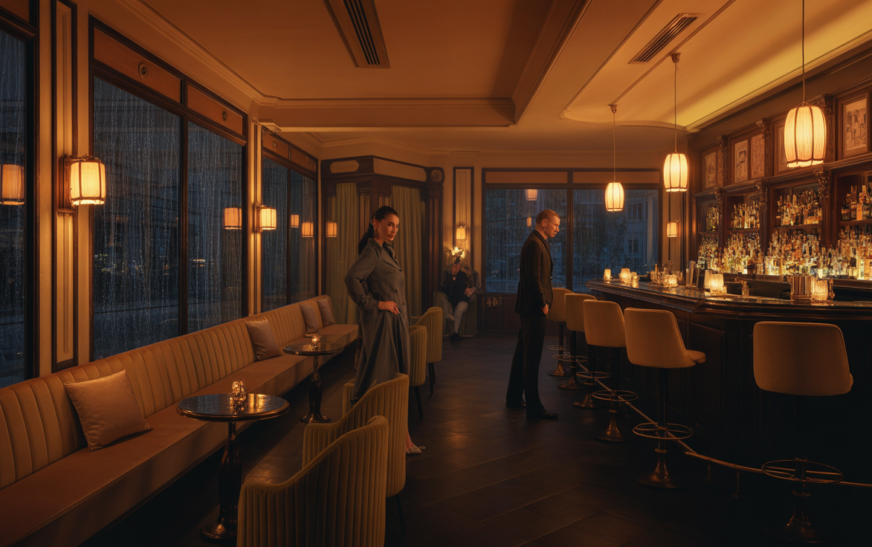
The house on Arden Street stood behind black gates and winter-bare ivy. Its windows glowed through the rain with the soft confidence of money that had never needed to explain itself. Inside, a woman in dark silk took Ivy’s coat and offered champagne before asking whether she knew the others.
“Only by reputation,” Ivy said.
“That is usually enough here.”
The answer should have warned her.
Instead, she stepped farther into the hall and let the evening arrange itself around her. Low music drifted from the drawing room. Firelight touched the brass frames on the walls. Somewhere deeper in the house, laughter rose and softened quickly, as though someone had remembered where they were.
The Host Who Preferred Observers
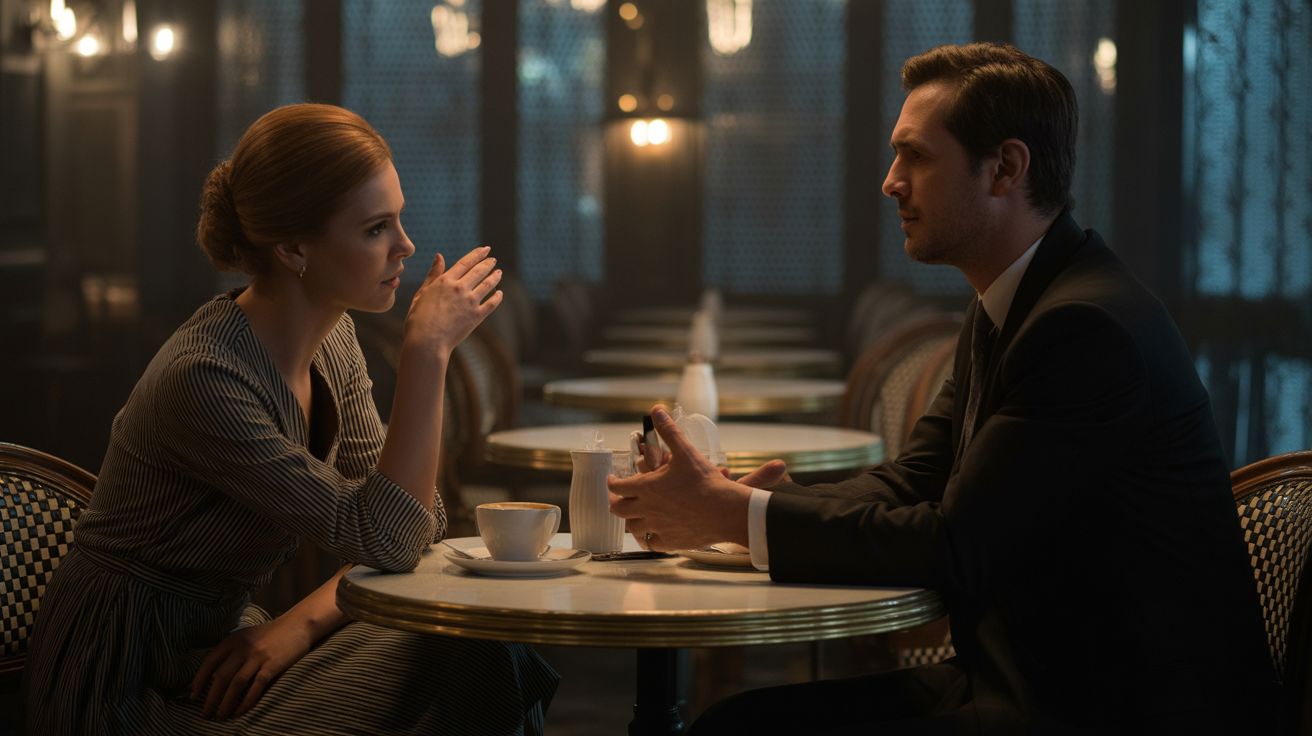
Sebastian found her near the mantel twenty minutes later.
He kissed the air beside her cheek with practiced warmth. “Ivy. You came after all.”
“You make it sound improbable.”
“Everything worth noticing is slightly improbable.”
He looked exactly as he did in photographs, which was disappointing in its own way. Dark suit. Silver at the temples. The composed face of a man who had been listened to for so long that silence now behaved for him automatically.
“You know Helena Price?” he asked, gesturing toward a woman by the fire.
“Only her essays.”
“Good,” he said. “Essays make better first impressions than people.”
Ivy almost smiled. Then she noticed how carefully he watched for it.
Guests gathered in polished clusters around the room. Helena spoke in low, exact sentences to a man from a publishing house. A younger novelist laughed a fraction too eagerly at something no one else seemed to find amusing. Meanwhile, a string quartet recording moved through hidden speakers with enough elegance to make the room feel curated rather than inhabited.
“How many are staying for dinner?” Ivy asked.
“Ten,” Sebastian said. “Small enough for honesty. Large enough for performance.”
“You say that as if you expect both.”
His mouth curved faintly. “I always do.”
The Cards Beside the Glasses
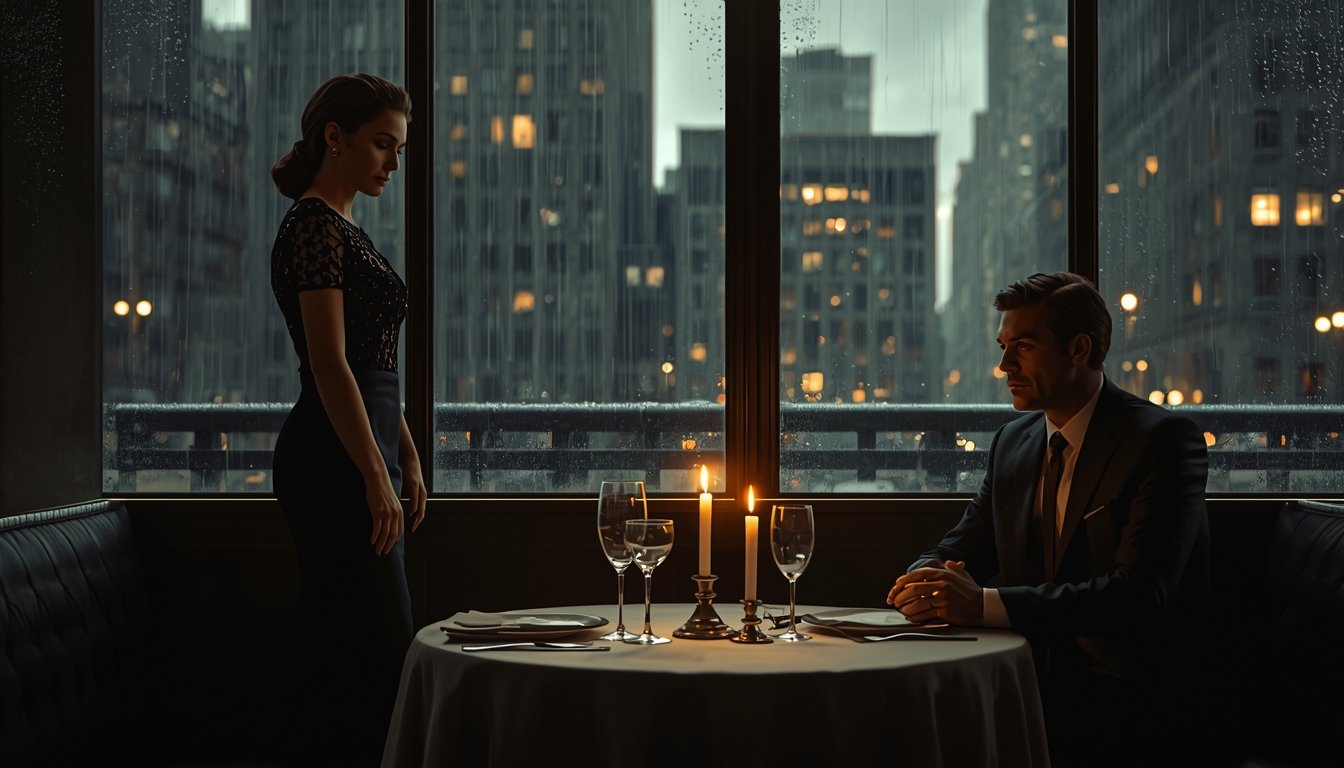
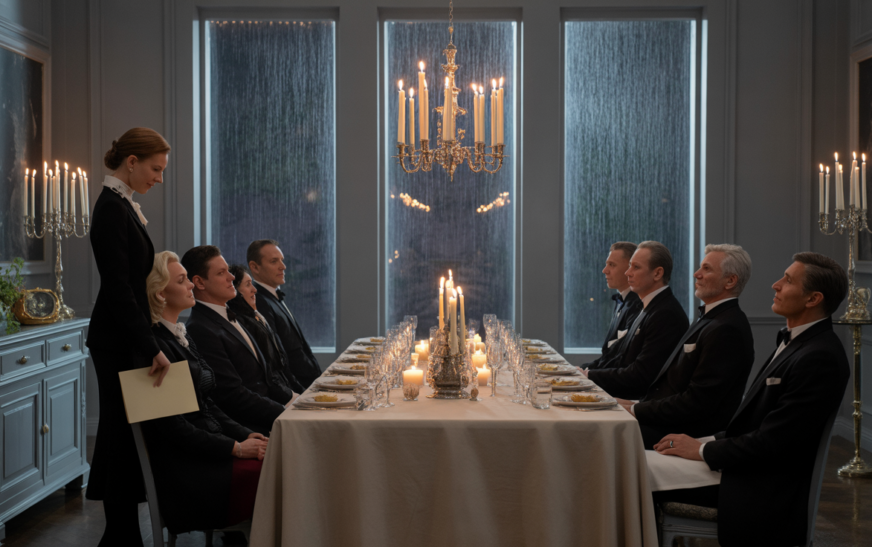
Dinner was served at eight-thirty in a room lined with gray silk walls and candlelight that made everyone look briefly better than they were.
Ivy’s place card stood near the center of the table. Beside it sat a narrow ivory envelope she had not noticed at first.
So had everyone else’s.
There was a murmur of curiosity as the guests took their seats. Silver gleamed. Crystal reflected the flames. Rain touched the tall windows in thin, shifting lines.
Sebastian waited until the first course had been placed before speaking.
“A harmless tradition,” he said, lifting his glass. “At each dinner, I ask my guests for one confidential impression before dessert. Nothing vulgar. Nothing unkind without intelligence. Just a private note about the room as it truly is.”
Helena looked down at her envelope. “You neglected to mention that in advance.”
“Would you have come?” Sebastian asked.
“Possibly,” she said. “But I’d have worn a different expression.”
Light laughter followed. Even so, Ivy felt something cold move through her attention.
“What sort of impression?” asked the publisher to her left.
Sebastian folded his hands. “At the end of dinner, you’ll find a card inside the envelope. Write one observation about one person here. Anonymous, naturally. I’ll collect them, shuffle them, and read a few aloud after dessert.”
There it was: the private vote, though he had dressed it in better language.
“That sounds less like a tradition,” Ivy said, “and more like a trap with candles.”
Sebastian turned toward her, pleased rather than offended. “Only for the insincere.”
The First Course
At first, everyone treated the idea as wit.
Conversation resumed. Wine was poured. Butter softened on the plates. However, the room had changed. Sentences now arrived with a second purpose. Every compliment sounded placed. Every silence acquired shape.
The novelist across from Ivy introduced himself as Felix Marr and asked whether she still worked in arts radio.
“Sometimes,” she said.
“Then you’ve probably had to interview people you despised.”
“Frequently.”
“And did they know?”
“Only if they confused charm with protection.”
Felix laughed. “That is either very kind or very cruel.”
“Those categories overlap more than people admit.”
To Ivy’s right, Helena was telling a story about a curator who had mistaken arrogance for expertise. The guests smiled in disciplined intervals. Meanwhile, Sebastian said very little. He allowed the table to perform around him while his gaze moved from face to face with quiet ownership.
It was not the anonymous notes themselves that unsettled Ivy. It was the anticipation. He had turned ten adults into mirrors angled toward one another, and every person at the table had already begun adjusting posture in response.
The Question Under the Wine
By the second course, the game had become the evening’s hidden architecture.
Felix asked whether Ivy believed first impressions mattered. Helena wanted to know whether she trusted people who made others laugh on purpose. The publisher beside her said he despised social experiments, then spent four full minutes describing why they usually succeeded.
“And you?” Ivy asked him.
“I dislike being judged by people I would not hire,” he said.
“That is wonderfully democratic of you.”
Across the table, Sebastian heard and smiled into his glass.
Rain strengthened outside. Candlelight trembled against the windows. The room felt increasingly sealed, as though weather itself had agreed to collaborate.
Then Helena said, almost casually, “Sebastian always insists anonymity makes people honest. I suspect it only makes them theatrical.”
“Not always,” he replied.
“No?”
“Sometimes it makes them precise.”
His eyes moved briefly to Ivy when he said it.
The moment was tiny. Still, it carried the particular discomfort of being selected without understanding why. She took a sip of wine and reminded herself that men like Sebastian often looked directly at whoever seemed least likely to flatter them. It was how they measured resistance.
The Card Inside the Envelope
When the main course ended, a server refilled the candles and placed coffee cups beside the saucers.
Then Sebastian stood.
“Now,” he said. “If you would indulge me.”
The room obeyed him with visible reluctance. One by one, guests opened their envelopes. Inside each was a cream card no larger than a calling card and a fountain pen with black ink.
Ivy stared at the blank surface in front of her.
Write one observation about one person here.
That was the official version. The real instruction was more intimate than that. Identify weakness. Reward instinct. Wound elegantly.
Felix wrote almost immediately, which made Ivy dislike him. Helena waited, pen idle, then began with the expression of someone signing a legal complaint. The publisher smiled as he wrote, which was worse.
Sebastian remained standing near the end of the table, hands loosely clasped. “No names on the cards,” he said. “Only truth.”
“That is optimistic,” Helena replied.
“No,” Ivy said quietly. “It’s convenient.”
She wrote nothing for several seconds. Finally, because leaving the card blank would have looked frightened and writing something cruel would have made her complicit, she settled for a sentence about Sebastian himself.
He invites honesty only when he controls the lighting.
Then she folded the card once and slid it back into the envelope.
The Reading After Dessert
Dessert arrived like an apology no one had requested. Pear tart. Black coffee. Thin silver forks.
After that, Sebastian collected the envelopes in a lacquered box and brought them to the head of the table. He shuffled them slowly, almost tenderly.
“Only a few,” he said. “The rest remain private.”
“How reassuring,” Helena murmured.
The first card made someone laugh. The second drew an offended smile from the publisher, who then pretended offense had been the point. A third described Felix as “a man who mistakes confession for originality,” which he accepted with visible strain.
Then Sebastian opened another envelope and grew momentarily still.
Ivy noticed the pause before anyone else.
“Interesting,” he said.
He did not read the card immediately. Instead, he looked around the table as though recalculating the room.
“Read it,” Helena said.
He obliged.
“She behaves like someone who has already been humiliated in public and intends never to offer the crowd another clean angle.”
No name. No direct reference. Even so, the sentence struck Ivy with enough force to erase the room for a second.
Felix looked at her before he could stop himself. So did the publisher. Sebastian did not.
That was how she knew.
The Room That Knew Too Much
Ivy set down her fork with perfect care.
Years earlier, during a live radio segment, she had frozen mid-interview when an audio feed failed and a producer whispered panic into her earpiece at the wrong moment. The clip had circulated online for weeks under captions written by strangers who preferred women graceful only when untested. She had left the station six months later.
Few people in the room would know that story in detail.
Sebastian did. Of course he did. He had once interviewed her after the scandal with the bored sympathy of a man polishing cutlery.
“That one was personal,” Helena said into the silence.
Sebastian’s tone remained light. “Only observant.”
“No,” Ivy replied. “Observant would have arrived without an audience.”
Now he turned to her.
The table had gone still in that expensive way people manage when they want drama without responsibility. Rain pressed at the windows. Somewhere in the house, the hidden music had stopped.
“You assume it was written about you,” Sebastian said.
“You assume that denial sounds cleverer than it does.”
Felix looked down at his coffee. The publisher shifted in his chair. Meanwhile, Helena watched Sebastian with the calm attention of someone who had finally found the right kind of fire.
The Second Box
Sebastian rested the card on the tablecloth.
“Perhaps,” he said, “we should leave the rest unread.”
“Because you suddenly discovered ethics?” Helena asked.
He ignored her.
Ivy would have stood then and left with all the dignity available to women in candlelight. However, something on the sideboard caught her eye: a smaller black box, half concealed behind the water carafes.
Its lid stood open by an inch.
Inside were notecards.
Not the blank cream cards from the envelopes. These already carried handwriting.
Understanding arrived with a clean, ugly precision.
He had prepared options.
The private vote had never been fully private. Perhaps some guests had written authentic judgments. Perhaps others had been supplemented, redirected, sharpened. Either way, the cruelty at the table had not been left to chance.
Ivy rose before anyone could stop her and crossed to the sideboard.
“Ivy,” Sebastian said, warning at last.
She lifted the lid fully.
Inside lay at least a dozen prepared cards in the same cream stock, each written in the same dark ink. Some were folded. Others were not. She saw fragments only, but that was enough.
Too eager to be accidental. Makes kindness sound borrowed. Still performing innocence for people who no longer buy tickets.
Helena stood too. “Well,” she said softly. “That is hideous.”
The Vote He Wanted
No one spoke for several seconds.
Then the publisher said, “Sebastian, surely those are old notes.”
“Are they?” Helena asked.
Sebastian remained seated. That composure was the ugliest thing about him now.
“Some evenings need assistance,” he said. “People become timid in groups. Prepared language can help reveal what they’re circling.”
“Prepared language?” Ivy repeated. “You forged the room.”
“I refined it.”
The answer was so polished it almost made her laugh.
“No,” she said. “You wanted the humiliation without the inconvenience of human hesitation.”
Felix pushed his chair back slightly, color rising in his face. “Did you read mine?”
Sebastian looked at him with mild surprise. “I read all of them.”
“Before tonight?” Helena asked.
He did not answer quickly enough.
That silence did the work for him.
Suddenly the dinner felt less like a social ritual and more like an anatomical study arranged by a man who preferred people easiest to admire when they were open on the table.
The Only Honest Moment
Ivy picked up one of the prepared cards and held it between two fingers.
“This is what you like, isn’t it?” she said. “Not honesty. Control dressed as candor.”
Sebastian’s expression barely shifted. “I dislike waste. Rooms like this are full of accurate instincts that die of manners.”
“Manners,” Helena said, “are what stop civilized people from becoming you.”
A sharp breath of laughter moved through the table. Not warm. Not friendly. Relieved.
For the first time that evening, Sebastian looked misjudged by his own design.
Ivy placed the card back in the box. “You built a game where everyone could pretend cruelty belonged to everyone equally. That way no one had to see your hand in it.”
“And yet,” he said, “you all participated.”
It was the right wound to aim for. Several guests looked away. Felix said nothing. The publisher reached for his wine and found the glass empty.
However, Ivy no longer felt the first humiliation. That had burned off. In its place was something steadier.
“No,” she said. “We attended your dinner. That is not the same as consenting to your authorship.”
Helena lifted her napkin from her lap and set it beside her plate. “I’m leaving before he turns repentance into a salon topic.”
The Hall Beyond the Candles
The others rose in uneven stages after that.
Coats were requested. Goodnights were not. Rain still marked the windows, though more lightly now, as if the weather itself had lost interest in the performance. In the front hall, guests avoided one another with the intimacy of people newly aware they had been arranged.
Felix stopped near Ivy while the woman in silk found her coat.
“For what it’s worth,” he said, “I didn’t write that card.”
“I know.”
“How?”
She looked toward the dining room door. “Because it was too efficient. Real cruelty usually wanders first.”
That earned a brief, miserable smile. Then he left.
Helena paused beside Ivy at the threshold. “You handled that well.”
“No,” Ivy said. “I handled it publicly.”
Helena considered her. “Sometimes that is the only version that counts.”
The remark stayed with her as the front door opened and the night air touched the hall. Behind them, Sebastian did not follow. Perhaps he understood that some endings could not be moderated back into elegance once the mechanism was visible.
After Arden Street
Ivy walked home through thinning rain with her coat unbuttoned and her anger cooling into something more useful.
The city looked cleaner after midnight. Streetlamps held steady over wet pavement. Passing cars moved like private decisions through the dark. She knew the evening would travel quickly through the right circles by morning. Sebastian would call it a misunderstanding. Someone else would call it conceptual. A third person would claim everyone had known the risk. People always became literary when they wanted to avoid being moral.
Later, when she reached for fiction shaped by Psychological tension, the elegant cruelty of Mind Games, and the pressure built inside Thriller rooms, she understood why such stories endured. They were rarely about noise. Instead, they turned on timing, exposure, and the quiet violence of being interpreted by someone who mistakes access for ownership. Some evenings drifted toward Secrets & Suspense, while others carried the emotional ache of Drama because humiliation was never purely social.
In the end, the most unsettling moments often begin with a private vote, then sharpen through social manipulation, quiet humiliation, and the pressure of anonymous judgment. Some leave behind emotional control, conversation suspense, or the cold recognition of a hidden motive operating beneath polished manners. Sometimes the darkest person in the room is not the loudest one. It is the one who scripts the silence and asks everyone else to call it truth.