The House Above the Water
Lena accepted the invitation because it was easier than explaining why she disliked invitations that sounded generous.
The retreat belonged to a literary foundation she had worked with once before. Four days on the coast. Small guest list. Private readings. Quiet dinners. Time to write. The email had described the house as restorative, which made it sound like a clinic for tired reputations. Still, her editor had urged her to go, and her apartment had become too full of unfinished pages to defend.
By late afternoon, the car had climbed the last narrow road above the sea.
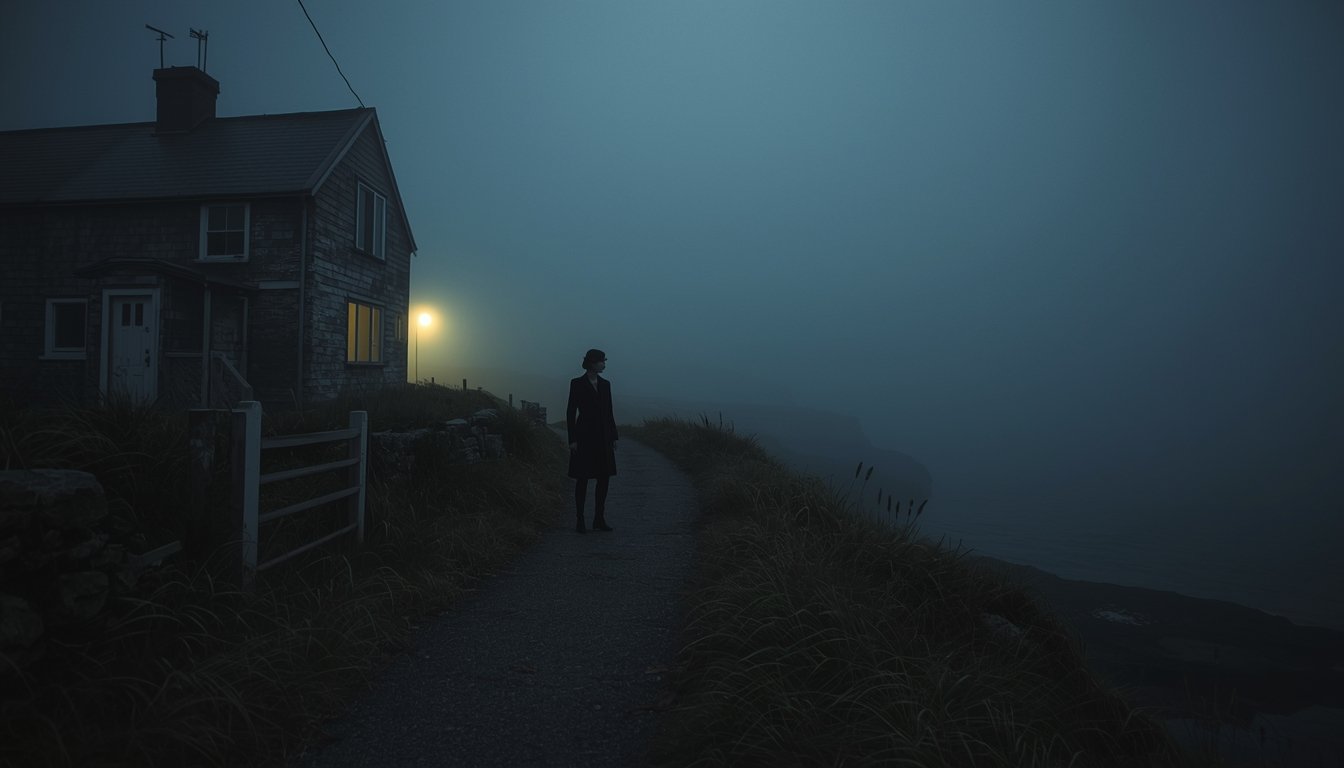
The house stood on a cliff behind iron gates and pale stone walls. Its windows reflected a gray sky and water the color of old silver. Wind moved through the cypress trees with a whisper that never quite became a voice. Below, waves struck the rocks in patient intervals.
A woman in cream opened the front door before Lena reached it.
“Welcome,” she said. “I’m Clara. We’ve been expecting you.”
The entrance hall smelled faintly of cedar and rain. To the left, a long room opened toward the water. To the right, a staircase curved upward beneath a chandelier that looked too delicate for such a severe house.
“There are only eight guests,” Clara said as she took Lena’s coat. “You’ll have peace here.”
Lena glanced at the dark windows. “That remains to be seen.”
The Man at the Window
Dinner began an hour later.
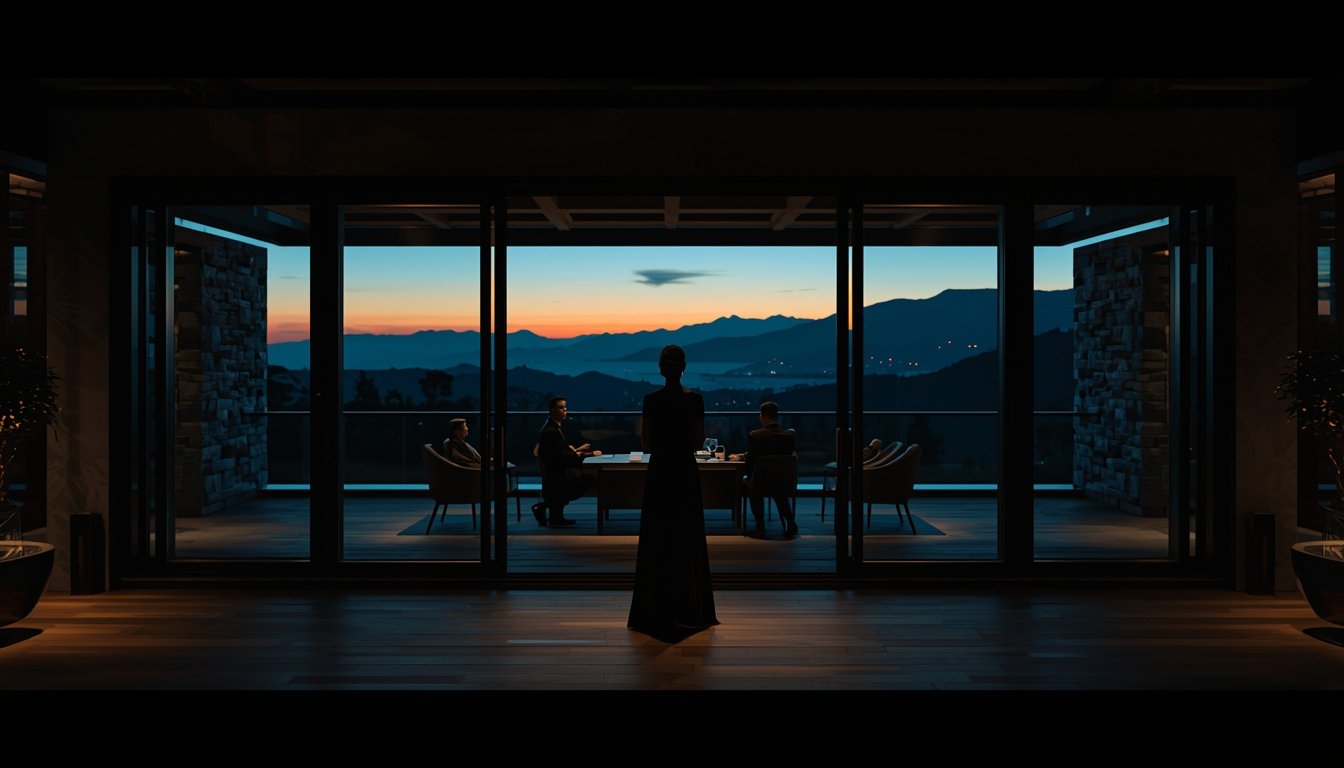
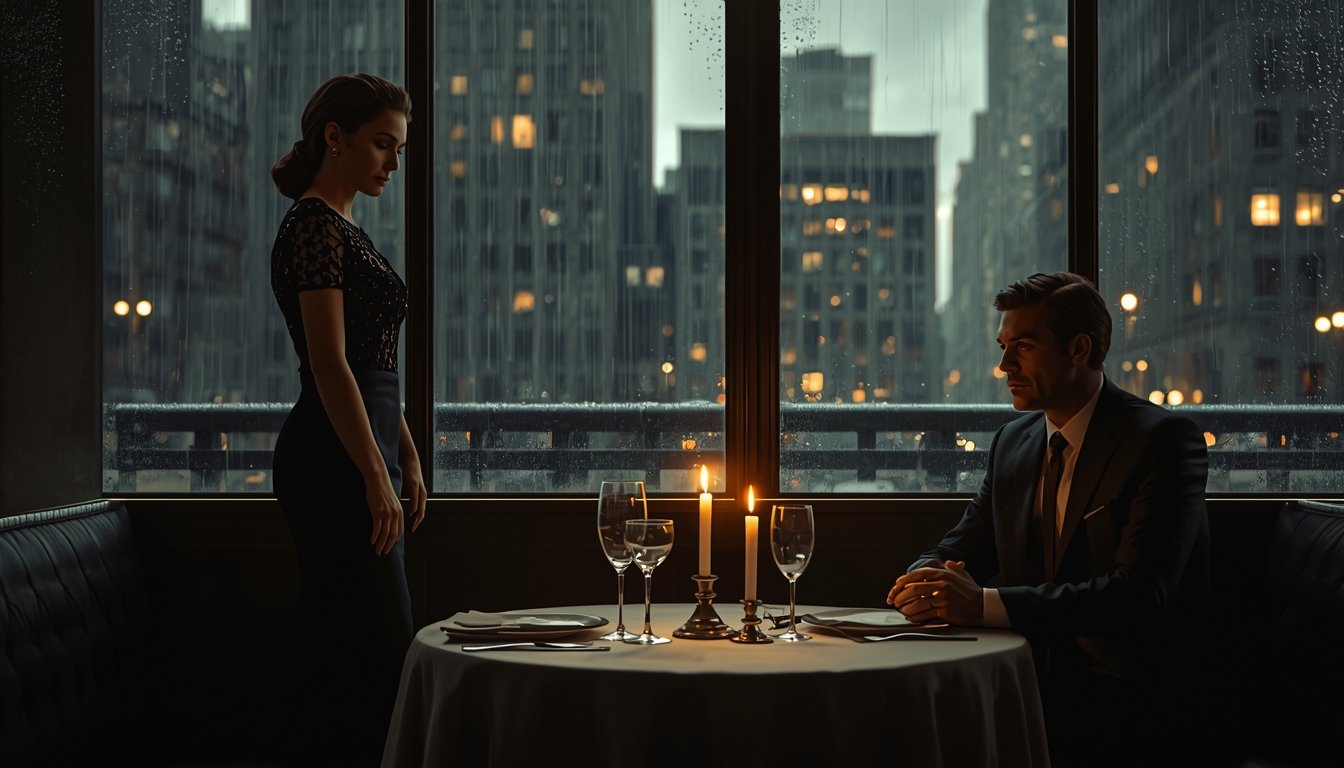
The table was set in a narrow room lined with books and low lamps. Candles burned in silver holders. Rain had started outside, and the glass reflected the guests more clearly than the dark beyond it. Everyone introduced themselves with the careful warmth of people who preferred being observed to being known.
Then the man at the far end of the table spoke.
“You made it through the weather,” he said, as if continuing a conversation she had somehow missed.
He was seated beside the window, one arm resting lightly on the chair. Dark jacket. Open collar. Nothing careless in him, yet nothing stiff either. He looked like the sort of man who understood how much more unsettling ease could be than precision.
“Barely,” Lena replied.
His mouth curved. “Still, here you are.”
Something in the line touched her uneasily. Not because it was intimate. Because it sounded familiar in a place where nothing should have been.
Clara named him before Lena had to ask. “Julian Vale. Essayist. Occasional problem.”
“Only for predictable people,” he said.
Light laughter moved around the table. Lena gave him a polite smile and looked away.
Even so, the sentence lingered with her through the first course. Still, here you are.
She had heard it before. She was almost certain.
The First Echo
At first, Lena blamed fatigue.
Long drives, formal rooms, and strangers with polished voices all had a way of making memory feel theatrical. A phrase could seem familiar simply because the tone resembled someone else. Therefore, she kept her attention on safer things: the sea pressing against the windows, the salt on the butter, the woman across from her whose bracelets clicked softly whenever she reached for her wine.
Julian spoke rarely during dinner. However, when he did, the room bent toward him in subtle degrees. He never dominated. Instead, he left space around his remarks so others could step into them and feel clever for doing so.
Lena distrusted that kind of restraint.
After dessert, guests drifted into the library. Some chose brandy. Others chose the fireplace. Lena chose distance and stood near a shelf of travel memoirs she had no intention of opening.
Julian appeared beside her with two glasses of water.
“You looked trapped by the whisky people,” he said.
“I was managing.”
“Poorly.” He offered her one glass. “Still, here you are.”
Lena went still.
There it was again. The repeated phrase, identical in rhythm, almost light in delivery. He said it as though he had every right to reuse it. As though the line belonged to the room, not to him.
“Why do you keep saying that?” she asked.
His expression did not change. “Saying what?”
“That.”
“Because it fits?”
He sounded mildly amused, nothing more. Yet something cold moved along her spine all the same.
The Reading Room
The next morning, rain held the house inside itself.
Breakfast passed in polite fragments. Clara reviewed the day’s schedule. A morning writing session. Lunch on the lower terrace if the weather cleared. Readings after dinner. Meanwhile, several guests performed irritation at the storm, as if nature had failed to understand the invitation list.
Lena took her coffee into the reading room and worked by the window until the page in front of her became an arrangement of sentences she no longer trusted.
At eleven, Julian entered carrying a notebook and no sign of surprise.
“You found the best room first,” he said.
“Or the emptiest.”
“Those are usually the same room.”
He sat in the chair opposite hers without asking, though not in a way that felt careless. He noticed the pages spread across the table.
“You revise by subtraction,” he said.
Lena looked up. “What makes you think that?”
“Too much white space for optimism.”
The remark was clever enough to annoy her. Then he added, very softly, “Still, here you are.”
The coffee cup touched the saucer harder than she intended.
“Did Clara tell you something about me?” she asked.
He seemed genuinely puzzled. “Should she have?”
“That phrase. You keep using it.”
“It’s not a sacred text, Lena.”
“No. It’s worse than that. It’s familiar.”
Julian studied her for a moment, then leaned back. “Maybe familiarity is doing more work here than I am.”
The Name Beneath the Sentence
That afternoon, Lena searched her own memory like a drawer she had forgotten locking.
The phrase did not belong to family. It did not belong to old friends. Finally, sometime between the second coffee and the third failed paragraph, the truth emerged with brutal clarity.
It had belonged to Daniel.
Not a husband. Not even a lover she had been foolish enough to call permanent. Daniel had been a photographer she spent seven careful months trying not to need. Whenever she hesitated, whenever she arrived late, whenever she changed her mind and came back anyway, he would smile and say it in the same low, patient tone.
Still, here you are.
He had said it on station platforms, outside bars, beneath her apartment window, and once in a hospital corridor when her mother had fallen and Lena had forgotten how to hold herself together.
Daniel had been dead for three years.
The thought hit so abruptly that Lena shut her notebook and stood up at once. Her chair scraped the floor. A woman writing nearby glanced over, startled, then returned to her screen with professional indifference.
Lena walked to the window and pressed her hand to the cold glass.
This was absurd. Julian could not know that phrase mattered. Daniel had never published it into the world. He had only left it behind inside her.
Which meant one of two things. Either coincidence had become cruel, or someone had been told more about her than she remembered giving.
The Terrace Conversation
By late afternoon, the rain thinned to mist.
Guests moved to the lower terrace for lunch beneath tall heaters that hummed faintly in the sea air. Plates arrived with careful beauty. Conversation turned to books no one had finished and cities no one truly missed.
Lena waited until Clara was pouring wine at the far end of the table.
Then she turned to Julian.
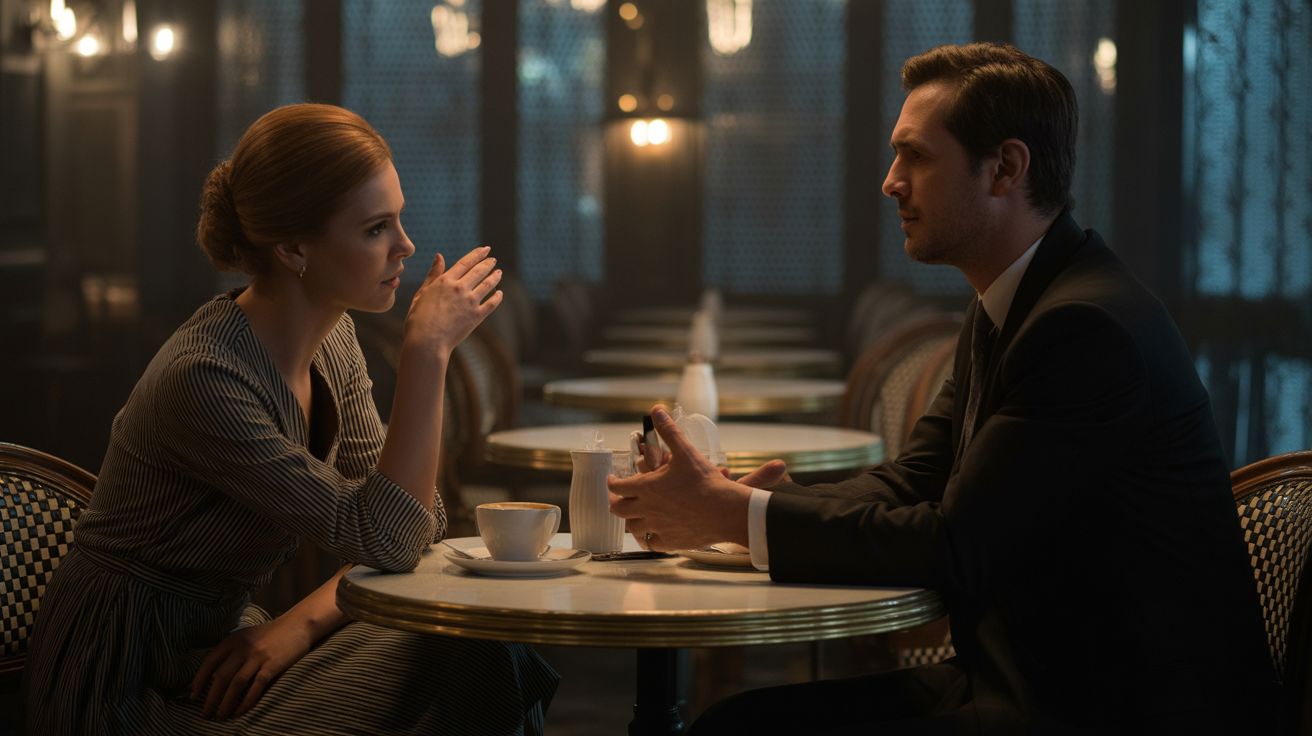
“Did we meet before this?” she asked.
He set down his fork. “No.”
“Are you sure?”
“I’d remember.”
“That sounds vain.”
“Only observational.”
His calm made her angrier than denial would have.
“Then someone told you about me.”
Julian looked briefly toward the sea. “That depends what you think there is to tell.”
“Do not answer a question with another one.”
“Then ask the one you actually mean.”
The terrace seemed to narrow around them. A fork rang against a plate two seats away. Clara laughed at something she had not heard properly.
Lena lowered her voice. “Why are you using a phrase that belonged to someone else?”
For the first time, he did not respond at once.
“Ah,” he said at last. “So that’s the problem.”
“You knew there was one.”
“I knew there might be.”
That answer was so precise it felt like a hand closing.
The Story Clara Forgot
She found Clara in the music room before dinner, arranging programs for the evening reading.
“I need to ask you something,” Lena said.
Clara glanced up with immediate concern. “Of course.”
“What did you tell Julian about me?”
Clara’s hands stilled over the stack of papers. “Very little. Why?”
“How little?”
“Your last novel. That you don’t sleep well before public events. That you nearly declined the invitation twice.”
Lena kept her face blank. “Anything about Daniel?”
Clara’s expression shifted. Not guilt. Recognition.
“Only that he photographed your first jacket portrait years ago,” she said carefully. “Why would Julian know that name?”
Lena did not answer.
Instead, she looked past Clara to the piano in the corner, black and closed beneath the lamp. She remembered Daniel sitting on her kitchen counter, camera hanging loose against his chest, saying the phrase with a smile that made patience sound like fate.
“Did Julian ask about me before I arrived?” Lena said.
Clara hesitated.
That was enough.
“What exactly did he ask?”
“Only whether you still wrote in notebooks first,” Clara said. “And whether you still dislike crowded rooms.”
Lena went cold.
Those details had not come from interviews or author bios. They belonged to older knowledge. Personal knowledge.
Clara seemed to understand too late what her silence had confirmed. “Lena, is something wrong?”
“I’m deciding,” Lena said, “how wrong.”
The Notebook by the Fire
After dinner, the guests gathered for readings. Lena did not go.
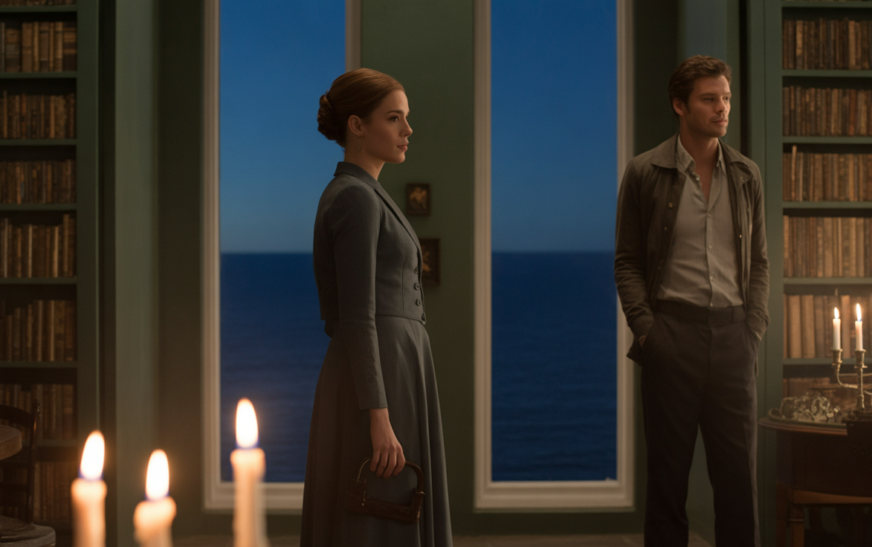
She remained in the library with the lights lowered and the fire speaking softly in the grate. Outside, the sea had turned black enough to erase the horizon. The house felt suspended between weather and intention.
Julian entered halfway through the applause upstairs.
“I thought you might be here,” he said.
“That seems to be your talent.”
He closed the door behind him. “You asked Clara questions.”
“You asked her first.”
“Yes.”
No apology. No performance. Just fact.
Lena stood beside the mantel. “Who are you?”
“Julian Vale.”
“Not enough.”
“Daniel’s brother,” he said.
The fire cracked once, sharply, as if the room itself had heard it.
Lena stared at him. Their faces were not alike enough for immediate recognition. Daniel had been warmer in the mouth, less guarded in the eyes. Still, once she knew where to look, the resemblance arrived all at once and made her angry with herself for missing it.
“Why didn’t you say that?”
“Because names make people leave before they reveal anything useful.”
“Useful to whom?”
“To the dead, sometimes. To the living, unfortunately.”
His gaze held steady. “I wanted to know whether he had changed you the way I thought he had.”
“So you tested me.”
“I gave you a phrase,” he said. “You did the rest.”
The Shape of Control
Anger moved through Lena with surprising clarity.
“You used his words like a key,” she said.
“Yes.”
“And you say that as if honesty excuses it.”
“No. I say it because false innocence would insult you more.”
She took one step toward him. “What did you want? Proof that grief can be reopened on command?”
“I wanted to see whether he had survived anywhere real.”
“He survived in me,” Lena said. “You had no right to touch that.”
For the first time, something unguarded crossed his face. Not regret exactly. Something older and less useful.
“My brother left pieces of himself in many people,” Julian said. “After he died, they all spoke about him as if he had been singular with each of them. Tender. Attentive. Patient. I spent years trying to understand whether that was truth or performance.”
Lena laughed once, and it sounded nothing like humor. “So you became cruel in the name of research.”
“Perhaps.”
“This was never about him. It was about your need to control the answer.”
He did not deny it.
That silence told her more than confession could have.
The Sentence She Returned
Upstairs, applause rose again, thin through the ceiling.
The house had never felt larger. It had never felt less safe.
“You should leave tonight,” Lena said.
Julian watched her in the firelight. “The road is dangerous in this weather.”
“Then enjoy the danger.”
He almost smiled, but thought better of it. “You think I’m like him.”
“No,” Lena said. “I think you are what happens when admiration curdles into method.”
The words landed cleanly. She saw that they had.
He glanced toward the dark window, then back at her. “Did he love you?”
“That is no longer your business.”
“It feels like it has always been my business. He left behind rooms full of people speaking in absolutes.”
“Then let them,” she said. “The dead are not improved by interrogation.”
For a moment, neither of them moved. The fire settled. Wind touched the windows. Somewhere down the corridor, a floorboard answered an unseen footstep.
Then Lena said, very quietly, “Still, here you are.”
He looked at her sharply.
“Do you hear it now?” she asked. “How ownership can become intrusion? How memory sounds when it is spoken by the wrong mouth?”
Julian’s expression changed at last. The control did not vanish, but it faltered. That was enough.
After the Reading
Clara moved Lena to another room before midnight. She did not ask for details once she saw Lena’s face. The foundation car took Julian away at dawn.
By morning, the sea had cleared to a hard blue-gray, and the house looked cleaner than it had any right to.
Lena packed slowly. She left the retreat before lunch and watched the cliff road unwind beneath the car like a thought she no longer wished to keep. Daniel remained where he had always been: not in phrases, not in rehearsed echoes, but in the private architecture of memory that no stranger had the right to enter by force.
Later, when she searched for fiction shaped by Psychological tension, the quiet cruelty of Mind Games, and the precision of Thriller, she understood why such stories lasted. They were not built on noise. Instead, they turned on pressure, timing, and the elegant violence of being known too specifically. Some drifted toward Secrets & Suspense, while others brushed the emotional ache of Romance before darkening into something colder.
In the end, the most dangerous moments are often the quiet ones: a repeated phrase, an act of quiet manipulation, or the first crack in memory doubt. Fear can arrive through emotional control, sharpen into psychological suspense, and leave behind the chill of hidden motive or the ache of unsettling conversation. Sometimes the lasting wound is not what was said, but who chose to say it.