The Dinner at Blackmere House
Vera accepted the invitation because refusing a reunion after twelve years would have looked like guilt.
The message had come from an old university friend she no longer knew well enough to disappoint comfortably. Small dinner, it said. Just a few of us from the literature cohort. Blackmere House. Friday at eight. The note was warm in the way messages often are when they assume time has preserved affection better than reality has.
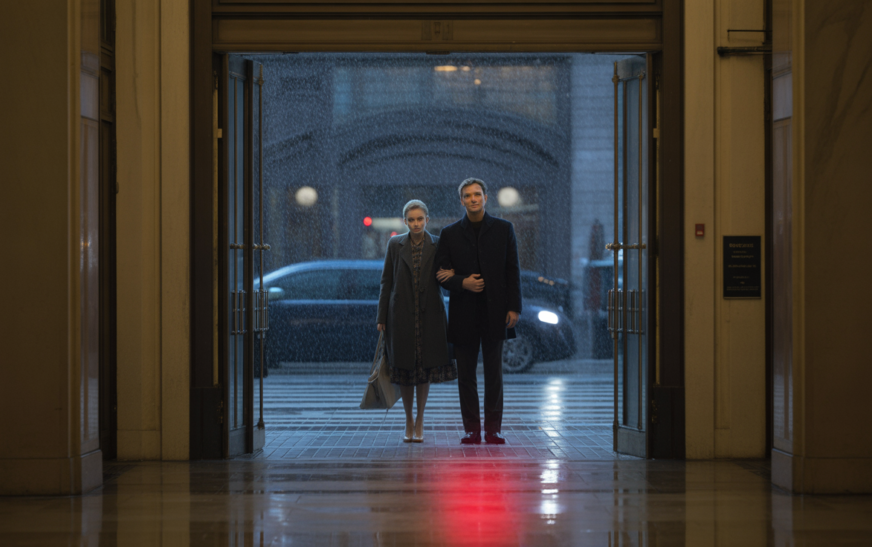
At first, Vera meant to decline. However, the week had already been too full of quiet work, unanswered thoughts, and the brittle sort of solitude that made nostalgia look almost social. Therefore, by a quarter to eight, she was climbing the stone steps of a townhouse lit from within by amber lamps and old money.
Blackmere House stood at the end of a narrow terrace where every window looked privately judgmental. Inside, the hall smelled faintly of cedar, wine, and polished floors. A woman in black silk took Vera’s coat and smiled as if the evening had already arranged itself correctly.
“You’re one of Daniel’s old friends?” she asked.
“Something like that,” Vera replied.
The answer was evasive enough to comfort her.
The Voice Across the Room
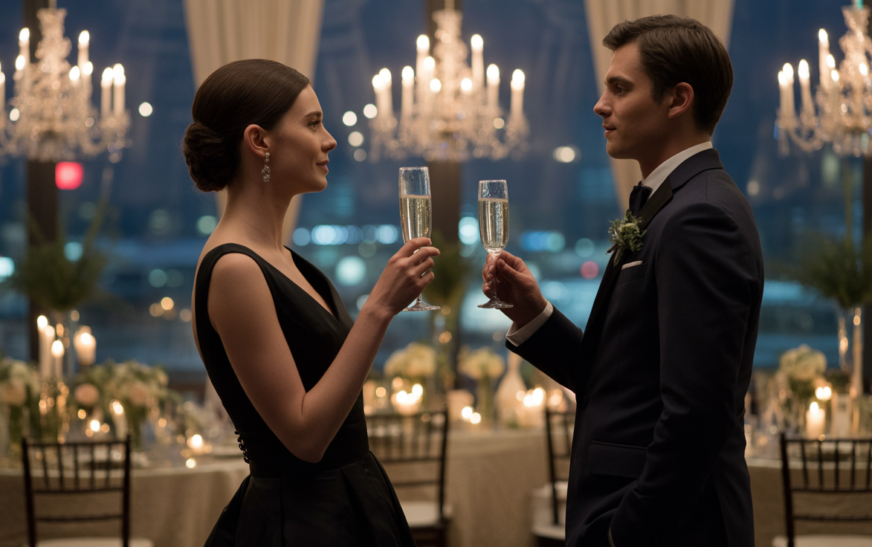
The drawing room held seven guests, low music, and the kind of firelight that made everyone look briefly more forgivable.
Vera recognized faces in softened fragments. Mara, who had once annotated novels as if she were prosecuting them. Felix, who now wore his confidence like an inherited watch. Two others from the department, older in expensive, deliberate ways. Near the mantel stood Daniel Hales, host by implication if not ownership, speaking with one hand in his pocket and the other curved around a glass.
He turned when she entered.
Time had altered him less than it should have. Dark hair, now brushed with silver at the temples. Composed mouth. The same measured attention that once made women feel either especially seen or faintly studied, depending on how long they stayed near him.
“Vera,” he said, as if he had expected her anyway.
“Daniel.”
He crossed the room and kissed the air beside her cheek. The gesture was elegant. The certainty inside it was not.
“You came,” he said.
“That seems to surprise everyone tonight.”
“Not surprise,” he replied. “Revision.”
The word landed oddly, though she could not have said why.
The Story He Corrected
Drinks came first. Then the room divided into small conversations that pretended not to calculate each other.
Vera found herself beside Mara near a bookshelf filled with first editions no one appeared relaxed enough to read. They exchanged the usual updates. Work. Cities. Parents getting older in ways that required new verbs. Meanwhile, Daniel drifted from group to group with the soft authority of a man long accustomed to curating atmosphere.
When dinner was announced, they moved to a narrow room lit by candles and rain-marked windows. Place cards waited beside each glass. Vera’s seat was halfway down the table. Daniel sat opposite her.
At first, the evening behaved itself.
Stories from university surfaced in polished versions. A lecturer who once fainted during a debate. The poetry reading that ended in a broken light fixture. A winter formal nobody had wanted to attend and everyone still discussed.
“You wore that dark green dress,” Felix said to Vera, smiling into his wine. “The one with the square neckline.”
Before she could answer, Daniel said, “No, that was Mara. Vera wore black.”
Vera looked up. “No,” she said lightly. “It was green.”
Daniel held her gaze. “Are you sure?”
It was such a small question that no one else seemed to hear the pressure inside it.
“Yes,” Vera replied.
He gave the faintest smile. “Interesting. I remember black.”
The table moved on. Yet something in her attention did not.
The Wrong Memory Begins
At first, Vera dismissed it.
People misremembered details all the time. Color blurred. Dates shifted. Faces borrowed one another’s histories. However, by the second course, Daniel had corrected her twice more.
Once when she mentioned a seminar held in the north lecture hall. “South wing,” he said.
Again when she referred to a tutor named Elaine. “Evelyn,” he replied gently. “You always confuse them.”
The second correction unsettled her more than the first because it arrived with familiarity, as if he were not merely disputing a fact but restoring a pattern in her.
Mara noticed it before anyone else.
“Does it matter?” she asked, setting down her fork. “Universities are mostly architecture and disappointment anyway.”
Light laughter followed. Daniel smiled. Even so, his eyes stayed on Vera for half a second too long.
“No,” he said. “It doesn’t matter.”
That was the problem. The details did not matter. The corrections did.
By dessert, the evening had acquired a second structure beneath its first. Conversation still moved. Wine still poured. Candles still lowered themselves with expensive patience. Yet Vera felt a quiet pressure gathering around each memory she offered, waiting to see whether Daniel would smooth it into another shape.
The wrong memory, she realized, was becoming the subject of the room.
The Photograph in the Hall
When she excused herself, she did so for air rather than necessity.
The hallway beyond the dining room was cooler and lined with family photographs in dark frames. Vera paused beneath one showing the house in winter, all bare branches and pale windows. For a moment, she simply listened to the muffled rise and fall of voices behind the door.
Then Daniel stepped into the hall.
“Are you all right?” he asked.
“Perfectly.”
“You looked unsettled.”
“Did I?”
He leaned lightly against the wall opposite her, keeping a distance that looked courteous and therefore felt calculated. “You always did dislike being contradicted in public.”
The sentence hit with such familiar confidence that she almost missed what was wrong with it.
“Always?” Vera repeated.
“In tutorials. At parties. Anywhere, really.”
She stared at him. “That isn’t true.”
His expression remained calm. “You don’t remember?”
There it was again. Not disagreement. Placement.
“I remember enough,” she said.
“Do you?”
The hallway seemed to narrow around the word. Rain touched the front windows at the far end of the house. Somewhere upstairs, a floorboard answered no visible step.
“What exactly are you doing?” Vera asked.
“Talking to an old friend.”
“No,” she said quietly. “You’re adjusting me.”
The Year He Preferred
He did not deny it immediately. That told her more than denial would have.
“You were different then,” Daniel said.
“Everyone was.”
“Not in the way I mean.”
She folded her arms. “Then mean something clearer.”
He glanced toward the dining room door, as if checking whether the room still existed in a useful way without him. “In our final year, you trusted your impressions before other people’s versions of you. I admired that.”
“This is a poor method of showing admiration.”
“Perhaps.” His gaze returned to hers. “Later, after the department review and the article in the student paper, you became more careful. You stopped correcting people when they described you inaccurately.”
Memory opened with unpleasant clarity.
The article had been a minor scandal at the time. An anonymous essay about favoritism, written with enough detail to wound the right people and implicate the wrong ones. Vera had been suspected briefly because she had once criticized the same lecturer in public. She had never written it. Still, the suspicion had clung long enough to change how several people looked at her.
“You think this is about that?” she asked.
“I think,” Daniel said, “that you began surrendering facts whenever the room seemed too prepared to resist you.”
His voice stayed soft. That softness made the words worse.
The Glass of Water
Vera could have returned to the table then. She knew that later.
Instead, she stayed in the hallway because anger, once sharpened, often looks too much like curiosity.
“And tonight,” she said, “you decided to test that theory?”
“Not exactly.”
“That sounds dishonest already.”
For the first time, something like tension entered his mouth. Small, but real.
“I wanted to know,” he said, “whether you still noticed when someone moved the edges.”
She laughed once. It held no warmth. “So you misremembered my life on purpose.”
“Only details.”
“That is not a defense.”
“No,” he agreed. “It’s an admission.”
A woman passed through the hall carrying a tray of water glasses. Both of them stepped aside with automatic grace. The interruption made the scene feel stranger, not smaller. Two adults in evening clothes making careful room for each other while one quietly confessed to altering the past for sport.
“Why?” Vera asked when they were alone again.
Daniel looked briefly at the photograph behind her shoulder. “Because once, you told me the most dangerous thing a person can do in a room is define someone else before she notices.”
“I said that?”
“Yes.”
“Then you understood it badly.”
The Room She Reentered
She went back to dinner before he could answer.
The others looked up only briefly, as polite groups do when they sense drama but have not yet secured ownership of it. Mara, however, watched Vera closely enough to count as solidarity.
“We were just debating whether memory improves literature or ruins it,” Felix said as she sat.
“Ruins it,” Vera replied.
“Too immediate,” Mara said.
“Too selective,” said the woman beside Felix.
Daniel resumed his seat opposite Vera and lifted his water glass as if nothing in the hallway had altered the air between them. That composure nearly undid her patience more than open cruelty would have.
Then he said, lightly, “Vera always preferred fiction to recollection. Even at university.”
Four pairs of eyes turned toward her.
The statement was almost true. That made it elegant enough to be dangerous.
“No,” Vera said. “I preferred fiction to people who edited recollection for power.”
The room went quiet.
Mara set down her spoon with precise pleasure.
Daniel’s expression remained calm, but something colder entered the calm. “That sounds personal.”
“It is,” Vera replied. “You’ve been making it personal all evening.”
The Correction at the Table
No one interrupted then. Even the house seemed to wait.
“You’ve corrected three details I know were true,” Vera said. “Not because the details mattered, but because you wanted to see whether I would surrender them for the sake of ease.”
Felix looked from one to the other like a man arriving late to a language he should perhaps have studied. The older publisher at the end of the table reached for his glass and thought better of it.
Daniel folded his hands. “You’re making this theatrical.”
“No,” Mara said quietly. “He did that when he started revising her in courses.”
Vera turned slightly. “You remember?”
Mara’s smile held no softness. “Daniel used to tell women what they meant before they finished speaking. It was considered charm if he did it attractively enough.”
The sentence landed cleanly.
For the first time that evening, Daniel looked less composed and more arranged. It was a subtle difference, but everyone at the table seemed to feel it at once.
“That’s unfair,” he said.
“Is it inaccurate?” Vera asked.
He did not answer quickly enough.
That silence was the only honest thing he had offered all night.
The Wrong Memory Ends
Felix exhaled first. Then the woman beside him laughed into her napkin, not kindly but with the relief of someone watching an expensive illusion crack in the right place.
“Well,” said the publisher, “this explains graduate school better than any archive could.”
No one smiled at him. He retreated into his water.
Daniel stood.
“I think,” he said, “that perhaps the evening has become less useful than I intended.”
“Useful to whom?” Vera asked.
He looked at her directly. “To anyone trying to recover accuracy.”
“Accuracy is not the issue,” she said. “Ownership is.”
That, finally, seemed to reach him. Not with remorse. With recognition.
He gave the smallest nod, almost formal in its restraint, then left the room through the same door he had used to follow her into the hall. No one asked him to stay. The candles continued burning as if elegance could survive anything if the tableware was good enough.
Mara lifted her wine and looked at Vera. “Green dress, by the way.”
Vera laughed then, helplessly and without grace. “Thank you.”
“Square neckline too,” Felix offered.
“Do not participate now,” Mara said.
The room loosened after that, though not entirely. Some evenings do not recover. They merely choose a different shape.
After Blackmere House
Vera left just before midnight and walked home through light rain rather than call a car she did not want to share with her own reflection.
The city had gone silver at the edges. Streetlamps held steady above wet pavement. Behind her, Blackmere House kept its warm windows and curated silence. Ahead, the dark looked cleaner.
Later, when she found herself drawn to fiction shaped by Psychological tension, the elegant cruelty of Mind Games, and the pressure built inside Thriller rooms, she understood why such stories lasted. They were rarely loud. Instead, they turned on tone, repetition, and the small humiliations that arrive disguised as correction. Some nights carried the emotional edge of Drama or drifted toward Secrets & Suspense, because social cruelty always wants witnesses.
In the end, the deepest unease can begin with a wrong memory, sharpen through memory doubt, and settle into subtle manipulation, emotional control, or the quiet sting of unsettling conversation. Sometimes all that remains is quiet humiliation and the knowledge that being corrected is not always the same thing as being wrong.