Nadine noticed the afterparty pass only because she was searching her clutch for a breath mint she did not need. The card slipped between her fingers while donors drifted beneath the museum’s glass atrium and a string quartet tried to make wealth sound tasteful. At first, she assumed it belonged to someone else. Then she saw her own name handwritten across the matte black edge in silver ink, and the whole evening shifted by one quiet degree.
She had not been invited to stay late.
The annual Valmere Museum gala belonged to patrons, trustees, sponsors, and the elegant species of guest who never checked prices on wine lists. Nadine belonged to the events team, which meant she lived in the hidden machinery behind polished nights. She adjusted floral deliveries, soothed donors, corrected seating charts, and rescued speeches from the brink of disaster. Usually, her reward was a pair of aching feet and a taxi receipt submitted on Monday. Therefore, a private afterparty pass with her name on it felt less like a perk than a message she did not yet know how to read.
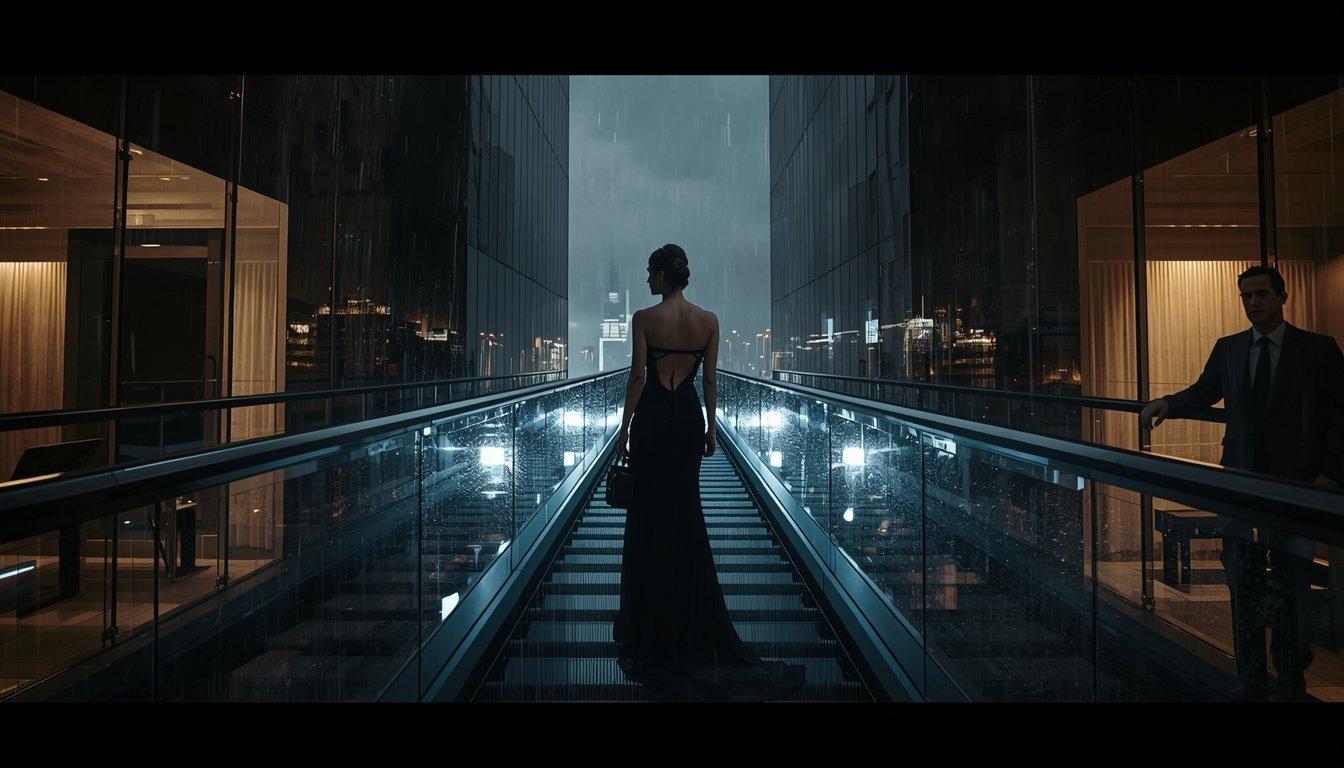
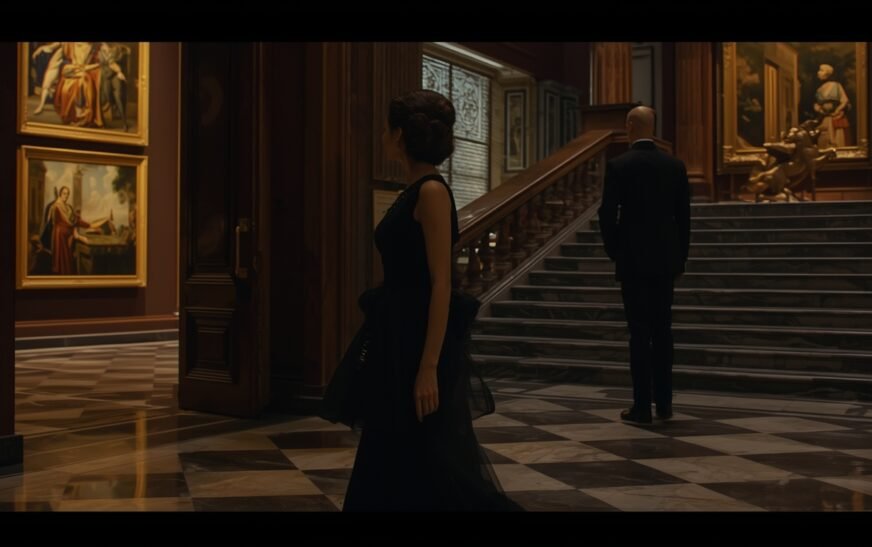
Above the staircase, suspended lights glowed over marble floors in pale gold. Waiters moved past with trays of champagne. Somewhere beyond the Roman sculpture gallery, a trustee was already laughing too loudly. Meanwhile, Nadine stood beside the coat-check arch, staring at the card as if it might explain itself.
Who should have had it
“That’s not yours,” Elise said, appearing at her elbow with a tablet in one hand and a smile in place for no one in particular.
Nadine looked up. “Comforting start.”
Elise leaned closer. “I mean, it probably is yours now. It was meant for one of the sponsors from Norvale Capital, but he canceled an hour ago.”
“Then why is my name on it?”
“Because Luca wrote it there.”
That explained very little. Luca ran donor relations with the kind of tailored ease that made everyone else in the department feel underdressed, even in black tie.
“Why would Luca give me an afterparty pass?” Nadine asked.
Elise glanced toward the staircase. “Maybe because you covered his disaster with the auction catalogs. Maybe because he’s in a rare mood of gratitude. Or maybe because someone asked whether you’d be staying.”
“Someone?”
“Yes.” Elise’s smile sharpened. “Don’t look so suspicious. It ruins the dress.”
Before Nadine could press for more, a donor in emerald satin waved from across the room. Elise lifted her tablet like a shield and vanished into duty.
Nadine slid the card back into her clutch, yet her pulse had already changed.
The man near the marble stairs
The first speech began at eight-thirty. Nadine stood near the side aisle with the rest of the staff, counting timing cues and watching for crisis. That was when she saw Adrian Vale again.
He was not a trustee. He was not a sponsor either. Officially, he was the museum’s outside restoration consultant, brought in after the storm damage to supervise work on several nineteenth-century paintings. Unofficially, he was the man who had spent the last three weeks moving through staff corridors and closed galleries with patient concentration and a voice too calm to ignore.
They had spoken exactly four times before tonight.
Once over a mislabeled crate. Once in the loading bay when the rain had cut power to the freight lift. Once in the conservation lab doorway, where he had asked for a pen and then returned it two days later as if such courtesies still mattered. Then, earlier that evening, he had looked at her from the foot of the marble stairs and said, “You always seem to appear two minutes before a problem does.”
Nadine had answered, “That is because I work here.”
He had smiled without softening the look in his eyes. “I don’t think that’s the only reason.”
Now, during the trustee speech, Adrian stood at the back of the atrium with one hand in his pocket, listening with the grave attention of a man determined not to be overheard by his own thoughts. Black tie suited him too well. However, his stillness remained the more dangerous thing.
At the end of the speech, applause rose around them. Meanwhile, Adrian glanced toward her as if he had felt her looking.
What Luca said later
By contrast, Luca never looked still. He shimmered through rooms in velvet focus, solving problems before they became visible. Nadine found him near the donor wall just after the first course was served.
“Did you put my name on a black card tonight?” she asked.
Luca did not even pretend confusion. “I did.”
“Why?”
He adjusted his cuffs. “Because the sponsor canceled, and because you’ve earned one evening that does not end in loading dock lighting.”
“That sounds suspiciously kind.”
“It can happen.”
Nadine lowered her voice. “Elise implied someone asked if I was staying.”
Luca’s expression went innocent in the most incriminating possible way. “Elise should work for intelligence services.”
“Luca.”
He sighed with theatrical patience. “Adrian asked whether staff were ever allowed upstairs after midnight. I told him usually no. Then he asked whether exceptions existed for people who saved the gala from preventable catastrophe.”
Nadine stared at him. “You gave me an afterparty pass because of that?”
“I gave you one because I approve of selective disruption.” He straightened a place card with fingertips precise as blades. “Also because I’m tired of watching you say no before anyone has made a real offer.”
That sentence landed more sharply than she liked.
The reason she had been saying no
For the last year, Nadine had been living inside a life that looked orderly from the outside and nearly airless from within. Her boyfriend, Graham, preferred plans issued well in advance, dinners booked under his surname, and weekends shaped around the kind of couples’ efficiency that made spontaneity feel juvenile. Nothing about him was cruel. In fact, that had become the problem.
Kind men were hard to leave when they had done nothing dramatic.
Graham had texted an hour before the gala to say he could not attend the public reception after all. A client from Toronto had arrived early, and “you know how these things go.” Nadine did know. She also knew he would ask tomorrow whether the event had been beautiful, whether her dress had been admired, and whether she minded terribly that he had missed it. She would have answered politely in the past. Nevertheless, the thought exhausted her tonight.
Across the atrium, Adrian spoke briefly with one of the curators. Then he looked up and found Nadine again.
Nothing happened after that. No gesture. No wave. Still, her body registered the attention before her mind allowed it a name.
At the table beneath the glass
The gala dinner began under the vaulted ceiling with careful silverware, sculpted centerpieces, and speeches calibrated to sound generous rather than expensive. Nadine was seated at the staff support table near the rear, close enough to intervene if needed and far enough to remain invisible when things ran smoothly.
Adrian was placed three tables away among conservators, junior patrons, and a professor who believed anecdotes were a human right.
During the second course, Nadine’s phone lit under the linen.
How is the performance of gratitude? Graham wrote.
She stared at the message for a moment too long.
Still glittering, she replied.
His answer arrived almost at once. Don’t stay too late. You’ll be exhausted tomorrow.
The sentence should have sounded caring. Instead, it felt managerial, like a note left on an office fridge.
When she looked up, Adrian was listening to the professor at his table while absentmindedly rotating the stem of his water glass. Then, as if some current between them had tightened, his gaze lifted and met hers through a forest of candlelight and donor smiles.
Nadine looked away first.
Before midnight upstairs
Later, after dessert and the final paddle raise, staff began the discreet labor of transition. Donors collected wraps. Trustees moved toward the staircase reserved for those invited to the private rooms above the sculpture wing. Music shifted from quartet elegance to lower jazz threaded through hidden speakers. The museum itself seemed to inhale.
Nadine should have gone downstairs to oversee breakdown.
Instead, she found herself standing near the marble stairs with the black card in her hand.
“You’re considering it very seriously for a woman holding only paper,” Adrian said.
She turned. Up close, the black tie softened nothing. If anything, it made his restraint look more deliberate.
“This is technically plastic,” she said.
“Then your hesitation is impressively thorough.”
Nadine glanced at the stairway. “I work events. We are not trained to wander into our own parties.”
“That seems tragic.”
“It seems efficient.”
He nodded once, as though respecting the distinction. “And are you feeling efficient tonight?”
The question settled between them with disarming precision.
“Not especially,” she admitted.
Something almost warm crossed his face. “Good.”
Why he had asked about her
They did not climb the stairs at once. Instead, Adrian led her toward the long gallery beside the atrium, where moonlit landscapes lined the walls and the crowd noise fell to a softer register.
“Luca told you?” he asked.
“Enough to be annoying.”
“Then I’ll be less evasive than Luca.”
Nadine stopped beside a painting of winter water under a silver sky. “That would be refreshing.”
He stood beside her, not too near. “I asked whether you would be upstairs because every time I’ve seen you here, you’ve looked as if you belong to the building more than the guests do. I wanted to know what you looked like in a room you didn’t have to manage.”
That answer should have felt practiced. However, it arrived too evenly to be performance.
“That is a strange thing to say,” Nadine murmured.
“Probably.”
“And yet you said it anyway.”
“Yes.”
For a moment, she heard only the muted bass of jazz from the atrium and the quiet hum of the climate system protecting old canvases from human weather.
“Why?” she asked.
Adrian looked at the winter painting rather than at her. “Because restraint has started to feel dishonest in your vicinity.”
The room above the sculpture wing
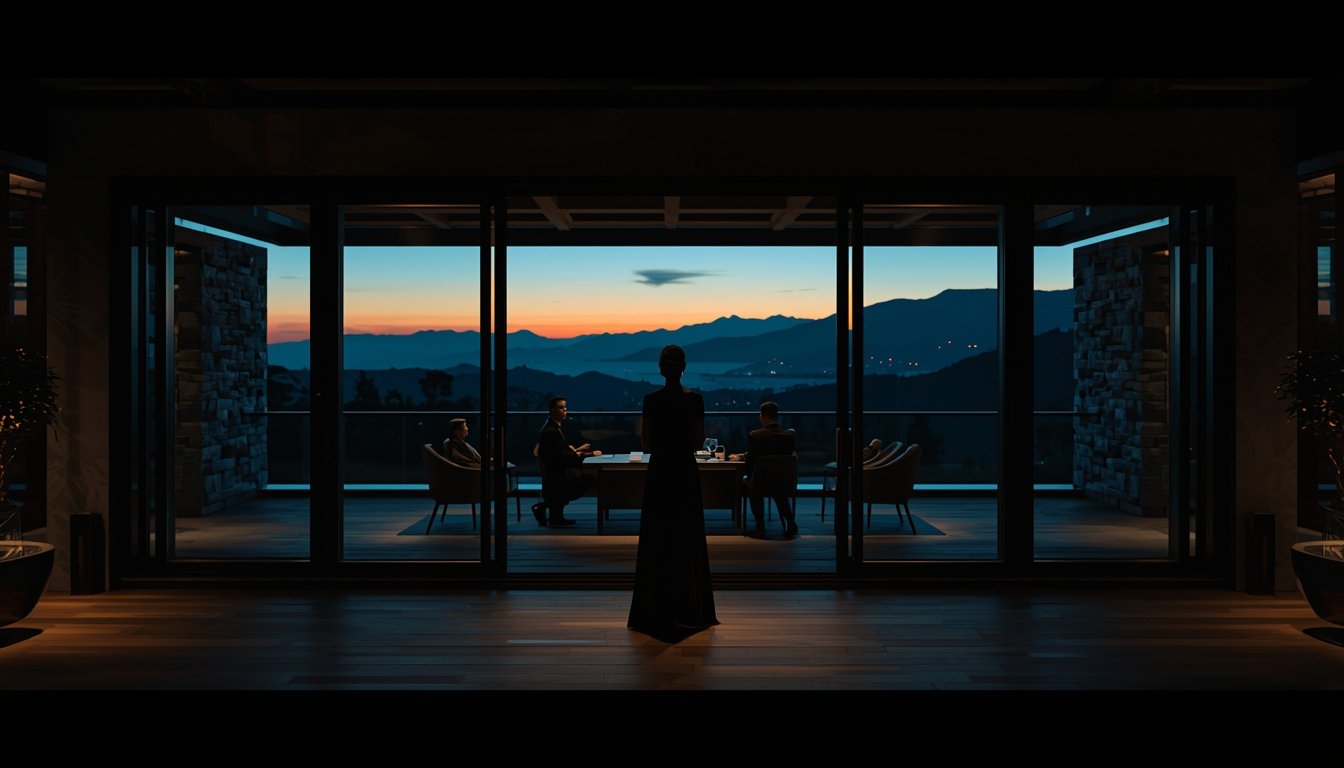
The private afterparty occupied a suite of upper galleries overlooking the city. Fewer than forty guests remained, which changed the atmosphere at once. Downstairs had been performance. Upstairs felt like the hour after masks loosened but before regret began.
Nadine used the afterparty pass at the top of the stairs. The attendant glanced at the silver lettering, then stepped aside. She became suddenly aware of Adrian beside her, of the museum roofline beyond the windows, and of the fact that she had crossed some invisible threshold without fully deciding when.
The room smelled of bergamot, polished wood, and expensive liquor. Small plates moved between clusters of patrons. A pianist near the terrace played something slow enough to alter breathing. Meanwhile, city lights floated below in fractured gold.
“Does it disappoint?” Adrian asked.
“The room?” Nadine looked around. “No.”
He waited.
“My own decision-making process,” she said. “Possibly.”
That drew a quiet laugh from him, brief and real.
They crossed toward the terrace doors. At every turn, someone greeted Adrian with professional respect. He introduced Nadine simply by name, never by department, never as if she were an accessory to his evening. The courtesy unsettled her more than charm would have.
On the terrace in the cold
Outside, the terrace held a line of stone planters and a view over wet black rooftops. The river beyond the museum reflected broken streaks of light. Cool air entered the lungs like discipline.
Nadine rested her fingers on the damp railing. “I should tell you I have a boyfriend.”
Adrian did not flinch. “I assumed there might be someone.”
“That sounds annoyingly calm.”
“Would panic improve the weather?”
She almost smiled. “No.”
For a moment, they stood without speaking. Down below, traffic drew patient lines through midnight. Somewhere behind them, a burst of laughter rose from the piano room and dissolved.
“Are you happy?” he asked at last.
It was not a clever question. That made it more difficult.
Nadine could have offered the respectable answer. Graham was successful. He remembered birthdays. He sent cars when she worked late. He also moved through her life as if comfort and affection were the highest forms of intimacy available to adults.
“I am managed very well,” she said.
Adrian turned toward her then.
“That wasn’t the question,” he said softly.
The cold sharpened everything. Even so, she did not step back.
What she admitted on the terrace
“No,” Nadine said. “I’m not happy. I’m efficient, appreciated, and very well scheduled. Those are not the same thing.”
His gaze did not move from her face. “Does he know that?”
“I think he knows I’ve become quieter.”
“That isn’t the same thing either.”
“No.”
The word left her with more relief than shame.
Inside the room, someone changed the music. A slower melody drifted through the cracked terrace door. Meanwhile, Nadine became aware of how little space existed between confession and consequence.
“I am not asking you for anything reckless,” Adrian said.
“Good,” she replied, though her pulse said otherwise.
“I’m asking whether tonight feels accidental to you.”
She looked over the city, at the wet dark roofs and the river splitting light into fragments. “No,” she said after a moment. “That is the problem.”
His answer came quietly. “It might also be the only honest part.”
When Graham called
Her phone buzzed in her clutch before she could answer.
Graham.
Nadine stared at his name while the city waited below them. Adrian looked away at once, granting her privacy with such immediate instinct that it almost hurt.
She answered. “Hi.”
“You sound cold,” Graham said. “Are you still there?”
“Yes.”
“I told you not to stay too late.”
The sentence entered the night and made everything painfully clear.
Nadine closed her eyes for one second. “I decided not to take instructions this evening.”
Silence. Then Graham laughed once, uncertain whether she was joking. “All right. Long night. I get it.”
“Do you?”
He shifted tone immediately, smoothing the moment. “Nadine, I’m just saying you’ll be tired tomorrow.”
There it was again. Care shaped like administration. Concern with all the windows sealed.
“I’ll talk to you tomorrow,” she said.
“Are you upset with me?”
“I’m finally listening to myself,” she replied, and ended the call before he could reorganize the sentence into something manageable.
After the afterparty pass
The afterparty pass had not given Nadine a new life. It had simply lit the old one from a less forgiving angle. Upstairs, above the sculpture wing, she could suddenly see the shape of what she had been calling stability: a polished arrangement in which she remained agreeable, useful, and slightly dimmer than her own appetite.
Adrian waited until she looked up. He did not ask what the call meant. He did not step closer. Nevertheless, the restraint between them felt charged enough to alter the air.
“What happens now?” he asked.
Nadine let out a slow breath. “Now I stop being polite in the wrong direction.”
That answer seemed to settle something in him.
“And after that?”
She smiled, though the night still felt dangerous. “After that, I decide whether this conversation survives daylight.”
“Reasonable.”
“You sound disappointed.”
“Not disappointed,” he said. “Interested in your daylight version.”
The line should have been smoother to count as flirting. Instead, its plainness made it impossible to dismiss.
The descent from the terrace
Later, they returned inside and moved through the last of the upstairs crowd with the peculiar awareness of two people who had not touched and had still crossed something undeniable. Nadine accepted one final drink she barely tasted. Adrian told her a story about restoring smoke-dark varnish from a seascape until the hidden light beneath it reappeared. She laughed more easily than she had all month.
At one-thirteen, the pianist stopped. Guests began collecting wraps and murmuring practical goodnights. The museum regained its after-hours hush, all high ceilings and guarded shadows.
Nadine stood at the top of the marble staircase with the black card still in her hand.
“You’re thinking again,” Adrian said.
“I do that occasionally.”
“I’ve noticed.”
She looked down into the atrium where staff were already dimming lights in sections, returning glamour to architecture. “This was a dangerous use of museum property.”
He smiled. “You used the afterparty pass responsibly.”
“That is not how it felt.”
“No,” he said. “It isn’t.”
For a moment, neither moved. Then Nadine slid the card into his breast pocket with two careful fingers, a gesture so small it still changed the whole night.
“Keep that,” she said. “As evidence that I stayed.”
His hand rose, not to touch her, only to rest briefly over the pocket. “I was already going to remember.”
The night outside the museum
They left together but not as a couple. That mattered to her. On the museum steps, the city air smelled of wet stone and taxi exhaust. A line of cars waited by the curb. Across the avenue, a florist’s shutters were half down, their brass handles gleaming under streetlight.
Nadine could have gone anywhere then: home to the apartment that no longer fit cleanly around her, to a sleepless drive through the river roads, to some late café where she could rehearse honesty before morning arrived. Instead, she stood beneath the museum lights and allowed herself one unedited minute.
Readers who love flirty stories often stay for the ache in dating fiction, the elegance of romantic tension, the darker pull of dark romance, and the quiet pressure inside secrets and suspense.
Meanwhile, this night carried traces of museum gala, slow attraction, social elegance, restrained desire, city night tension, private threshold, and emotional awakening that had nothing to do with innocence and everything to do with clarity.
Adrian stepped back first, as if he understood the dignity of ending a night before it became easy. “Goodnight, Nadine.”
She met his gaze beneath the museum lamps. “That depends on what comes after it.”
Then she turned toward the street, still carrying the feeling of the afterparty pass like a small, illicit warmth she had no intention of misnaming again.