The Message Before Dessert
Sabine knew the date was over before the waiter poured the water.
Her phone lit beside the candle with a message so polished it felt prewritten. I am so sorry. Something urgent came up. Rain check?
There was no explanation after that. No clumsy detail. No convincing lie. Just a small, courteous failure placed gently in her hands.
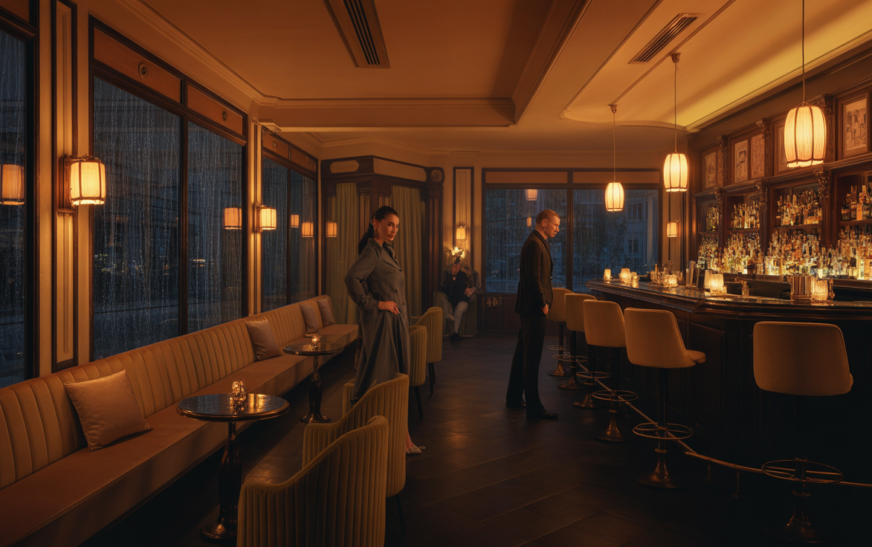
Across the restaurant, couples leaned toward each other over low light and dark glasses. Near the bar, someone laughed too loudly. Meanwhile, rain moved against the front windows in silver streaks and made the whole room look briefly untrustworthy.
Sabine set the phone facedown.
She had spent forty minutes deciding what to wear and another twenty deciding not to care. The black dress had won because it did not beg for approval. Her lipstick was dark enough to suggest a better evening than the one she was having.
The waiter approached with professional caution. “Will someone be joining you?”
“Not anymore,” she said.
His expression softened by half a degree. “Would you like to keep the table?”
For a moment, pride nearly said yes. However, pride was expensive in candlelit restaurants. “No,” Sabine replied. “Just the bill for the water, apparently.”
That earned a sympathetic smile she did not want but accepted anyway.
The Rain Outside Vale Street
By the time she stepped outside, the weather had become personal.
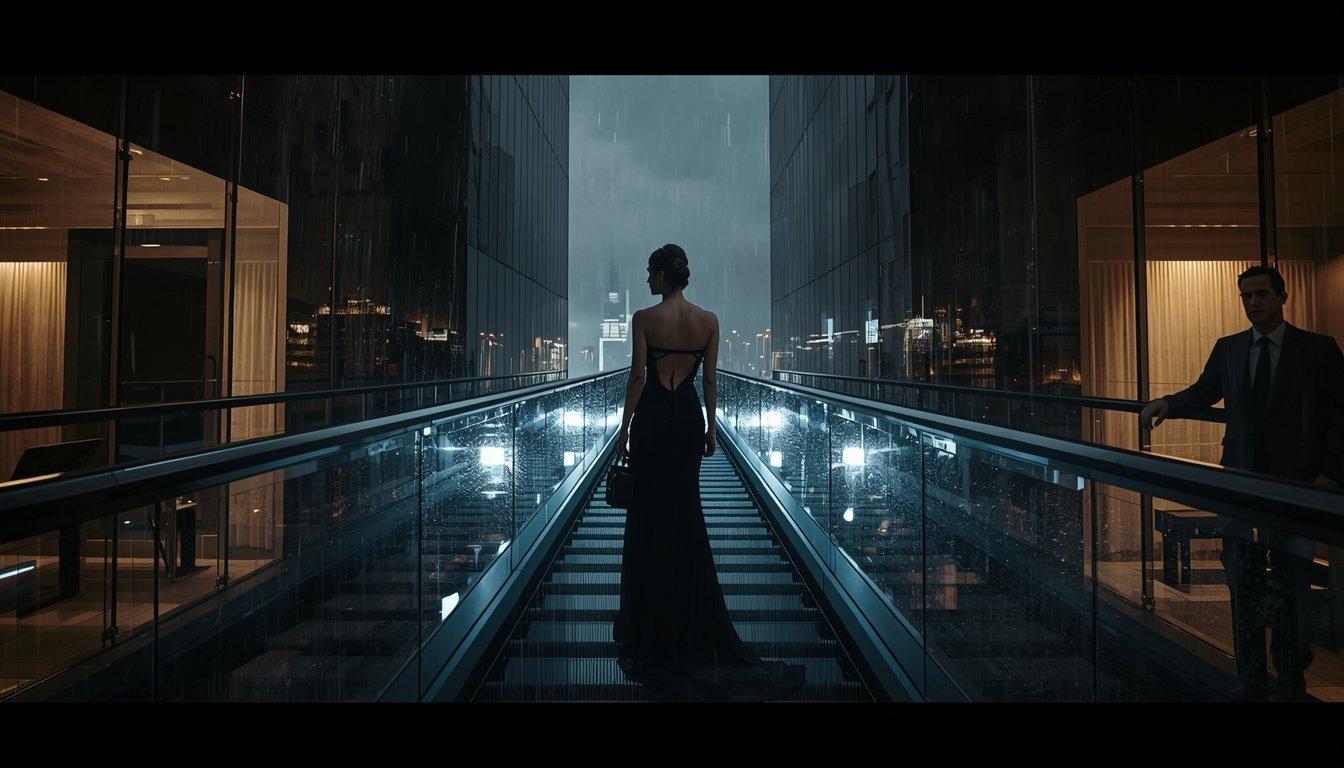
Rain struck the pavement hard enough to blur the streetlights into trembling gold. Taxis moved past already occupied. The awning above the restaurant entrance kept only the narrowest strip of dry ground, and even that felt temporary.
Sabine stood there with her coat buttoned and her disappointment arranged into something quieter.
She disliked scenes. She disliked public misery even more. Therefore, she waited beneath the awning as if she had somewhere else to be and had simply chosen not to hurry there yet.
“You can have this if your dignity allows it.”
The voice came from her left.
A man stood near the brass planter by the door, holding out a black umbrella with a curved wooden handle. He was tall without seeming to use it for effect, dressed in a dark coat dampened at the shoulders. There was nothing careless about him. Still, the ease in his posture kept him from looking rehearsed.
Sabine glanced at the umbrella, then at him. “That depends. Is it yours?”
“Borrowed,” he said. “From the stand inside.”
“So you’re offering me stolen property.”
“Temporarily relocated weather protection.”
Against her better judgment, she almost smiled.
“Why?” she asked.
“Because the rain is unpleasant, and you look like someone who would rather dissolve elegantly than ask for help.”
That should have annoyed her. Instead, it landed too close to true.
The Borrowed Umbrella
She took the borrowed umbrella because refusing would have required conversation, and conversation had already begun.
“Thank you,” Sabine said.
“You’re welcome.”
He did not step away after that. The rain thickened at the curb. Somewhere farther down the block, a siren passed and vanished.
“Do I owe the restaurant a signed confession?” she asked.
“Probably not. I told them I’d bring it back.”
Sabine looked up. “Then why am I holding it?”
“Because I thought you might prefer walking with company to being pitied by valets.”
“That is a bold assumption.”
“It is,” he agreed. “You can hand it back and prove me wrong.”
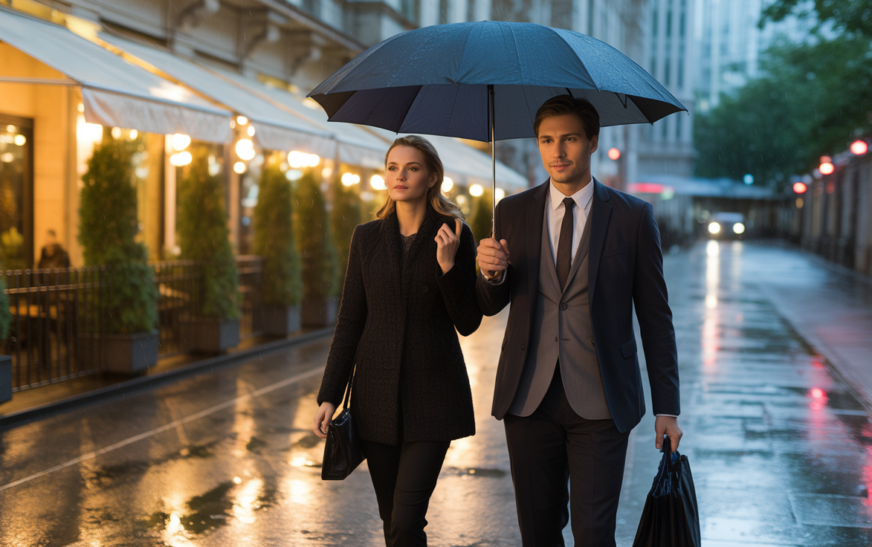
Instead, she opened the umbrella. The black canopy lifted between them with a soft mechanical sigh.
“You’re very calm for a man stealing hospitality items,” she said.
“Only accessories. I have standards.”
She glanced at him more fully then.
He was handsome in the restrained way that becomes more dangerous the longer you look at it. Dark hair touched with rain. Serious mouth. Eyes that seemed less interested in performing warmth than in noticing what warmth cost other people.
“Did your evening also collapse,” Sabine asked, “or are you simply charitable to strangers in distress?”
He considered that. “A little of both.”
The Walk He Did Not Rush
They left the awning together because standing still had started to feel more intimate than walking.
The umbrella was large enough for two, though it required a certain nearness the empty street made difficult to ignore. Sabine kept one hand on the handle. The stranger matched her pace without trying to lead.
Water shone across the pavement in blurred ribbons. Shop windows reflected light and shadow back onto the wet street. Meanwhile, the city seemed to soften under the storm, as if every hard edge had agreed to wait until morning.
“Did you know him well?” the man asked after a block.
“Who?”
“The one who didn’t arrive.”
“Not at all.”
“That’s useful.”
“Is it?”
“Much easier to lose a stranger than a history.”
Sabine looked sideways at him. “You say that like experience.”
“I say it like weather. Some things are true whether or not they improve the evening.”
That answer was better than she wanted it to be.
“And your date?” she asked.
He gave a brief smile. “She arrived. Which was considerate.”
“That sounds ominous.”
“She informed me after the first drink that I seemed difficult to surprise.”
“Were you?”
“Not at that moment.”
Sabine laughed softly despite herself. The sound disappeared quickly into the rain.
The Corner Pharmacy
At the next corner, they stopped beneath the green glow of a pharmacy sign while traffic hissed through the intersection.
“You haven’t asked my name,” Sabine said.
“No.”
“Why not?”
He adjusted his grip lightly on the umbrella shaft, careful not to touch her hand. “Because you had an evening stolen from you already. I didn’t want to begin by taking more.”
The answer left her quiet for several seconds.
“That is either thoughtful,” she said, “or extremely well-constructed.”
“You can decide later.”
The light changed. They crossed.
She became aware, then, of the unusual absence of pressure. He was not filling silence to impress her. He was not asking questions in fast succession as if attention were a contest. Instead, he let the walk breathe.
That made him more unsettling, not less.
“All right,” Sabine said. “My name is Sabine.”
“Elias.”
“I should have guessed something restrained.”
He glanced at her. “That sounds like criticism.”
“It isn’t. I distrust loud names.”
“Understandable.”
“Do you distrust anything?”
“People who apologize too elegantly,” he said.
She thought of the message still waiting on her phone. “That seems specific.”
“Specific things usually are.”
The Window With Blue Light
They passed a closed record shop where blue light from the display spilled weakly onto the pavement.
“You saw the message,” Sabine said.
“Only your face after it.”
“That is still inconveniently observant.”
“I was sitting by the window.”
“Alone?”
“No. Briefly accompanied.”
Sabine nodded. That felt fairer somehow.
Rain tapped steadily above them. Her shoulder brushed his sleeve once when the wind shifted, and the contact seemed to hold more than it should have.
“What did she mean?” Sabine asked. “About you being difficult to surprise?”
He was quiet long enough that she expected him not to answer.
“I think,” he said finally, “some people confuse steadiness with absence.”
“And are they wrong?”
“Not always.”
The honesty of that changed the shape of him slightly. Until then, Elias had seemed composed in a way that invited curiosity. Now he seemed composed in a way that had likely cost him something.
“You make disappointment sound polished,” Sabine said.
“You make it sound ceremonial.”
“That’s because I practice privately.”
“I noticed.”
She should have minded that. Instead, she only tightened her hold on the borrowed umbrella and kept walking.
The Bookshop Arcade
The rain worsened near the old bookshop arcade where the pavement narrowed and the gutters overflowed.
Elias guided the umbrella lower against the wind without crowding her. The movement was practical, almost impersonal. However, the nearness it created made her aware of his voice differently when he spoke.
“You were going to leave before he canceled,” he said.
Sabine turned sharply. “What?”
“You had your bag on your lap. Your coat was buttoned. You kept looking at the door, but not hopefully.”
“You are very comfortable making things up.”
“Am I wrong?”
She did not answer at once, which answered enough.
The truth was embarrassing. Ten minutes before the message arrived, she had already decided that waiting felt worse than leaving. The cancellation had only spared her the performance of choosing herself in public.
“Why does that matter?” she asked.
“Because being abandoned is one kind of loneliness,” Elias said. “Realizing you wanted to go before someone disappointed you is another.”
Sabine felt the words settle more deeply than the evening deserved.
“That,” she said quietly, “was uncomfortably exact.”
“Yes.”
“Do you do this often?”
“Walk strangers home with restaurant property?”
“Read people as if it costs you nothing.”
He looked ahead into the rain. “No. It usually costs the evening.”
The Underpass Light
They reached the station underpass, where fluorescent light turned the rainwater on the steps pale and metallic.
This, Sabine knew, was where the walk should end. Public place. Clean exit. Enough shared distance to classify the evening as an anecdote rather than a mistake.
Instead, they paused at the top of the stairs.
“I can take it from here,” she said.
“Of course.”
He made no move for the umbrella.
“You’re meant to return this,” she said.
“I am.”
“Then you should probably take it back.”
Elias glanced at the black canopy above them, then at the rain beyond it. “You could keep it until tomorrow.”
Sabine studied him. “That sounds suspiciously like a plan.”
“Not a very ambitious one.”
“Still a plan.”
“All right,” he said. “A modest plan.”
She laughed, and this time the laugh stayed.
Below them, a train arrived with a tired metallic rush. People emerged from the tunnel carrying wet umbrellas and private expressions. None of them looked at Sabine and Elias long enough to matter. Still, the anonymity of the crowd made the moment feel sharper.
“What if I don’t return it?” she asked.
“Then I’ll know you preferred theft to optimism.”
“And if I do?”
His gaze held hers with a steadiness that did not beg for anything. “Then I’ll know the evening improved after it was ruined.”
The Thing She Almost Said
Sabine could have left with a neat answer. She could have handed him the umbrella, thanked him for his kindness, and kept the walk preserved in rain the way women often preserve nearly-lovely things: without testing them in daylight.
However, the night had already begun badly. There was freedom in that.
“Tomorrow,” she said, “I work until six.”
Elias waited.
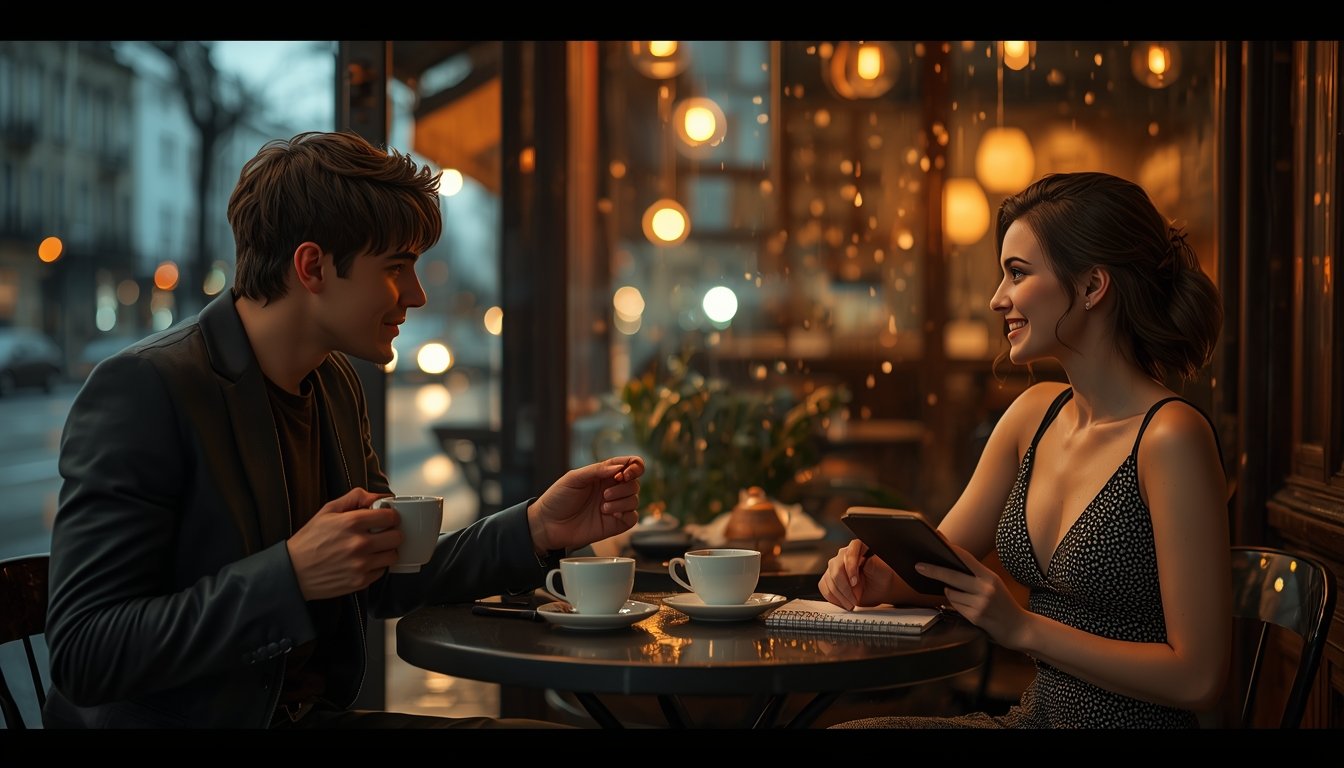
“There’s a café opposite the river,” she continued. “Small, bad lighting, no dramatic candles. They close late.”
“That sounds almost like an invitation.”
“Do not make me regret my character development.”
“Would seven be too optimistic?”
“Slightly.”
“Then seven fifteen.”
She nodded once. “Bring the receipt for your crime.”
“I thought we’d agreed it was relocation.”
“Temporary. Do keep up.”
A faint smile touched his mouth, quieter than triumph and therefore more dangerous.
Sabine lowered the umbrella and stepped back into the rain for a second before opening it again over herself alone. The loss of his nearness felt immediate enough to notice.
“Goodnight, Elias.”
“Goodnight, Sabine.”
Then she went down into the station with the borrowed umbrella above her and the strange, unwelcome certainty that the worst part of the evening had not been the cancellation.
It had been discovering how quickly disappointment could make room for hope when hope arrived dressed more carefully.
After the Walk
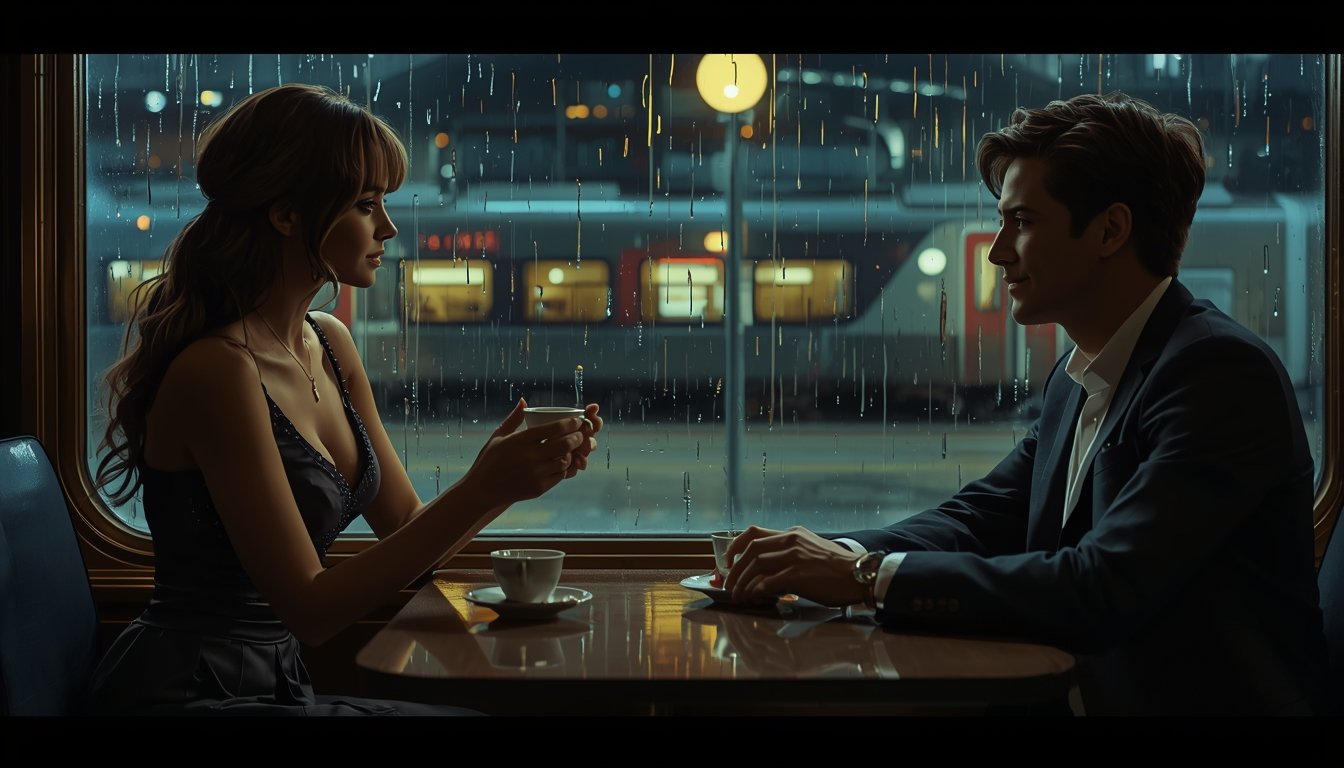
On the train home, rainwater trembled along the umbrella’s edge and darkened the floor by her shoes.
Sabine sat by the window and watched the city slide past in reflected light. She should have felt foolish. Instead, she felt alert in a way that was almost elegant. The canceled date had already thinned into irrelevance. Meanwhile, the walk remained vivid: the steadiness in Elias’s voice, the patience of his silence, the way he had not once mistaken attention for entitlement.
Later, when she found herself reaching for fiction shaped by Romance, uneasy beginnings in Dating, and the charged restraint of Flirty Stories, she understood why such stories lasted. They often began with small damage. A failed plan. A wet street. A stranger who arrived after disappointment and therefore had to compete with reality instead of fantasy. Other nights leaned toward Drama or the emotional edge of Psychological tension, because attraction rarely traveled alone.
Some evenings turn on a borrowed umbrella, the ache of a canceled date, or the first flicker of rainy romance where none was expected. The rest unfold through quiet charm, sharpen into romantic tension, and linger as uneasy chemistry long after the weather clears. Sometimes the most intimate thing a stranger can offer is not rescue. It is cover from the rain and one more reason not to go home unchanged.