By the sixth Thursday, Sera had started arranging the last ten minutes of her shift around the closing hour.
The ritual embarrassed her. Even so, she kept doing it.
At 8:47, she wiped the brass edge of the pastry case. At 8:50, she stacked the ceramic cups with more care than necessary. Then, just before 8:55, she glanced toward the front window of the bookshop café and waited for the door to open.
It always did.
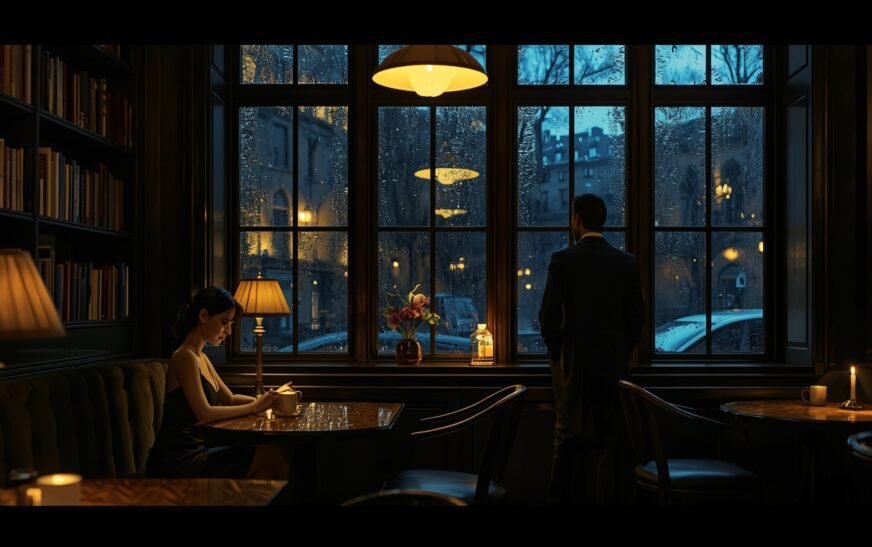
The same man entered with rain or cold on his coat, paused as though adjusting to the warmth, and chose the small round table beneath the literature shelves. He never ordered more than black tea. He never stayed past nine. More importantly, he never looked like a man passing time by accident.
“You’re watching the door again,” Lina said on the sixth week.
Sera reached for a clean spoon. “I’m doing my job.”
“Your job does not usually involve that expression.”
“What expression?”
Lina smiled without mercy. “The one people wear when they hope something repeats.”
When He Started Appearing
The café occupied the back half of an old independent bookshop, all dark shelves, green lamps, and narrow aisles that encouraged quiet. During the day, students filled the tables. By evening, the room belonged to solitary readers, tired office workers, and couples too careful to call themselves couples yet.
Sera had worked there for three years. Therefore, she trusted routine more than charm. Routine paid rent. Routine protected dignity. Routine also made unusual things visible very quickly.
The man had first appeared on a wet Thursday in late autumn. He came in seven minutes before the closing hour, asked for tea in a low voice, and sat beneath the shelves labeled Modern Poetry. At first, she barely noticed him. However, he returned the next week. Then again after that. Always Thursday. Always just before closing. Always that same table.
Meanwhile, he never flirted. He did not try for small talk or leave a number on a receipt. If anything, his restraint made him harder to dismiss.
Once, during her break, Sera scrolled through the Romance archive on her phone and thought how easy fiction made repetition look. Real life was less polished. Real life involved damp umbrellas, burnt fingertips, and a man who might mean absolutely nothing.
The Table Beneath the Shelves
On the seventh Thursday, he arrived two minutes later than usual.
That small delay unsettled her more than it should have. By contrast, his face remained composed, almost apologetically calm, as he removed his gloves and placed them beside the saucer.
“Black tea?” she asked.
He looked up. His eyes were darker than she had first thought. “Please.”
This time he added, “And the apricot tart, if there’s one left.”
Sera nodded, then carried the plate over herself instead of letting Lina do it.
“Thank you,” he said.
It was a simple sentence, but his voice held that rare quality of sounding careful without sounding weak. She noticed his hands next: not soft, not rough, but marked in the way hands are when they belong to someone who repairs things instead of replacing them.
Later, while polishing glasses, she found him watching the rain move across the front windows rather than reading the book he had brought. The cover stayed closed on the table. He seemed less like a customer than a man waiting for a signal no one else could hear.
The Week She Asked His Name
By the ninth Thursday, curiosity had become its own form of restlessness.
The shop was quiet. A law student packed his notes near the counter. An older woman in a red coat drifted through the history aisle. Near nine, Sera carried over the bill and said, “You come in at the exact worst time for proper service.”
To her surprise, he smiled.
“I know.”
“Yet you keep doing it.”
“Yes.”
She set the receipt down. “That sounds deliberate.”
“It is.”
His honesty altered the air around the table.
For a moment, Sera considered retreating. Instead, she said, “Then I deserve a name, at least.”
He glanced at the clock over the register before answering. “Adrian.”
“Sera.”
“I know.”
That should have felt presumptuous. Instead, it felt inevitable. He rose, thanked her again, and left precisely at the closing hour, as if the minute itself had dismissed him.
After he was gone, Lina leaned across the counter. “That was either romantic or alarming.”
“Helpful,” Sera said dryly.
Still, she did not sleep easily that night.
What Repetition Does to a Room
Repetition changes places before it changes people.
By the eleventh Thursday, Sera could feel Adrian’s absence before confirming it. The café grew strangely ordinary without him. Chairs looked merely stacked. Lamps looked merely lit. Even the closing hour lost some of its tension, becoming what it had once been: a practical end to a practical shift.
Then he came in, and the room gathered around that fact.
Customers noticed him too, though perhaps not consciously. One evening, a pair of women at the front table fell quiet as he passed. Another time, Lina said, “He carries silence like he paid for it.” Sera laughed, but the line stayed with her.
What unsettled her was not attraction alone. Attraction was manageable. More dangerous was the sense that Adrian had built his visits around a private rule, and that she was now standing close enough to feel its shape without understanding it.
After closing one night, she wandered through pieces in Dating and Flirty Stories, hoping the labels might make her situation look simpler. They did not. Nothing about Adrian felt playful, and nothing about him felt casual enough for modern advice.
The Thursday He Did Not Come
On the twelfth Thursday, the door stayed shut.
At 8:52, Sera told herself trains ran late. At 8:56, she told herself she was ridiculous. By 9:00, she was angry enough to wipe the espresso machine with unnecessary force.
“So he’s mortal after all,” Lina murmured.
Sera gave her a flat look. “Please find a hobby.”
However, the absence stayed with her long after the lamps were switched off. It followed her home through wet streets and into the narrow apartment she rented above a tailor’s shop. Because disappointment dislikes dignity, she ended up opening her phone in bed and scrolling tags like repeated meetings, quiet longing, and timing-based tension.
The next morning, she hated herself a little.
A week later, he returned.
There was rain on his shoulders and apology in the set of his mouth. Before she could decide whether to punish him with indifference, he said, “I missed Thursday.”
“I noticed.”
“I’m sorry.”
Sera folded a napkin twice. “That suggests I was meant to.”
For the first time, he looked uncertain.
The Reason He Chose Closing Hour
That evening, the last customer left early. Rain threaded down the windows in silver lines. The bookshop owner was upstairs doing inventory. For once, the room offered them privacy without kindness.
Adrian stood by his table but did not sit.
“I owe you an explanation,” he said.
Sera kept a cup in her hand so he would not see how still she had become. “That depends on what story you think you’ve been telling.”
He accepted the blow. “My sister used to work here.”
The sentence landed oddly, not dramatic enough for the tension it carried.
“Years ago,” he continued. “Before the café expanded. Before the back wall was painted green. Thursday was her late shift. I used to meet her at the closing hour and walk her to the station.”
Sera said nothing.
“She died last winter,” he said quietly. “Not suddenly. There was time. That made some parts easier and the rest worse.”
The café seemed to lose sound around them.
He looked toward the poetry shelves. “I came in once after the funeral because I couldn’t pass the street. Then I came again. After that, Thursday turned into a habit I didn’t know how to stop.”
What He Left Out
Grief explained the ritual. It did not explain her.
“And me?” Sera asked.
Adrian met her gaze. At last, he looked like a man whose composure had cost him something. “You were not part of the habit at first.”
“Comforting.”
“No,” he said. “Only true.”
She waited.
“By the fourth week, I knew your schedule better than I should have. By the sixth, I was timing my day to get here before the closing hour. Missing last Thursday felt wrong in two different ways. That was when I understood I was no longer only coming back for her.”
For a moment, Sera forgot the cup in her hand.
Outside, a bus passed in a wash of reflected light. Upstairs, boxes shifted faintly under the owner’s steps. Ordinary sounds. Safe sounds. None of them made the moment smaller.
“You could have asked me out,” she said.
“I know.”
“Instead, you built a shrine out of tea and timing.”
He almost smiled. “That is not unfair.”
The Last Ten Minutes
They spoke for forty minutes after closing, with chairs still upside down on half the tables.
Not flirtatiously. Not elegantly. The conversation moved in careful starts, as if both of them distrusted anything too smooth. Adrian told her his sister’s name was Celia. Sera admitted she had spent three weeks inventing terrible explanations for him. He said he had considered leaving a note. She told him notes were for cowards and widowers in old films.
“I’m neither,” he said.
“Good,” she replied. “Those men are exhausting.”
That made him laugh for the first time, and the sound changed him. The reserve remained, yet something warmer moved beneath it now, something less ceremonial and more alive.
Later, while she counted the till, he waited by the door without pressing the moment further. That restraint reached her more deeply than charm would have.
Before leaving, he said, “I don’t want to keep meeting you only at the closing hour.”
“That sounds promising,” Sera said.
“It may also sound slow.”
“Slow is not the worst thing a person can sound like.”
Saturday in Daylight
They met two days later at a small museum café across the river.
Daylight made Adrian easier to read and somehow more dangerous for that reason. He was not glamorous. He was precise, attentive, and occasionally very dry. He asked questions and listened to the answers fully. Meanwhile, Sera found herself relaxing in increments she did not trust.
They spoke about ordinary things first: her work, his restoration business, the city, bad coffee, trains, winter. Eventually, however, Celia entered the conversation without overwhelming it. That mattered. Grief was present, but it did not sit between them demanding worship.
At one point he said, “I nearly stopped coming after I realized I was waiting to see you.”
“Why?”
“Because I disliked the possibility that something good might be growing in a place built for a different kind of devotion.”
Sera traced the rim of her glass. “That’s the most unsettlingly decent thing anyone has said to me in months.”
He smiled. “Is that in my favor?”
“Moderately.”
By late afternoon, she understood that attraction had been the easy part. Trust would take longer. Even so, some beginnings are more believable because they arrive with difficulty.
After the Lights Went Down
The following Thursday, Sera worked as usual.
At 8:47, she wiped the brass edge of the pastry case. At 8:50, she stacked the ceramic cups. Then she looked at the door and did not wait in quite the old way.
Adrian entered at 8:54, rain-dark coat over one arm.
“You’re late,” Lina whispered from the register.
Sera ignored her and took the tea over herself.
He looked up. “Still black tea.”
“Still predictable.”
“I have been called worse.”
“Not by me,” she said, then regretted how intimate that sounded.
Yet he only answered, “There’s time.”
The line should have felt too bold. Instead, it felt earned.
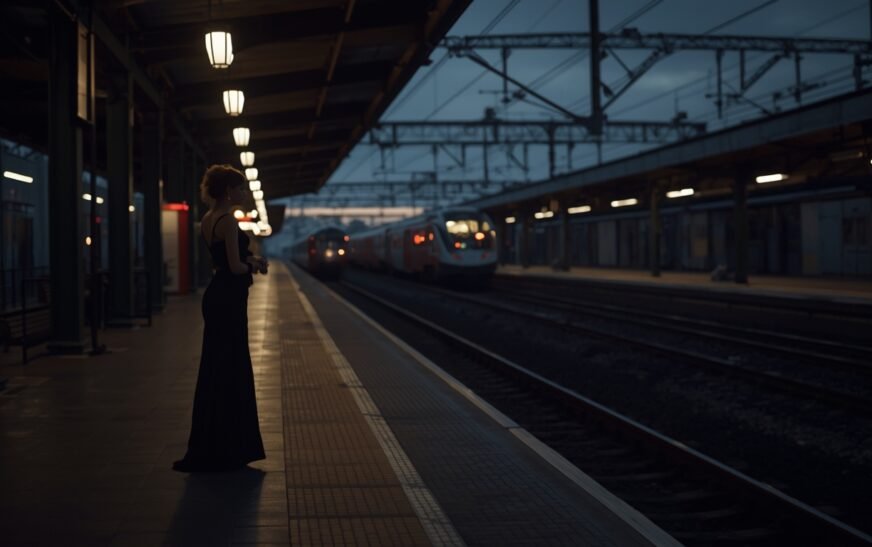
At the closing hour, Sera switched off the lamp above his table, and together they stepped out into the blue-cold street. Nothing dramatic happened. He did not take her hand. She did not offer him certainty. Nevertheless, they walked side by side toward the station under one umbrella, moving at a pace that made room for the living as well as the dead.
Behind them, the bookshop darkened. Ahead, the streetlights came on one by one. For the first time in weeks, the closing hour no longer felt like an ending disguised as ritual. It felt like the narrow, careful beginning of something that had chosen not to arrive beautifully, only honestly.