The Seats Beneath the Balcony
Lina chose the concert hall because a fire alarm seemed more likely than genuine conversation.
Dinner dates asked too much from strangers. They demanded eye contact, immediate chemistry, and opinions on things no one had earned the right to ask yet. A concert, however, offered structure. Music could do the heavier work. Silence could pass for elegance. Therefore, when her friend suggested she meet Daniel Mercer at the Hallen Theatre for a chamber performance, Lina said yes mostly because violins required less improvisation than candlelight.
The theatre glowed at the end of the avenue like a polished secret. Rain had fallen earlier, and the pavement still held the city in trembling gold reflections. Inside, velvet carpets softened footsteps. People climbed the staircase in dark coats and low voices, each carrying the expensive seriousness that always gathered around classical music.
Lina found her seat in row G beneath the balcony.
Daniel was already there, standing to let her pass with a courtesy so careful it made her instantly suspicious.
He was taller than she expected, though not in a way that asked to be admired. Dark coat. Charcoal tie. A face composed enough to look restrained rather than cold. When he smiled, it arrived quietly, like something offered instead of performed.
“Lina,” he said. “I’m relieved you came.”
“That sounds ominous.”
“Only because I’ve started to distrust optimism on first dates.”
The answer was dry enough to earn him one point.
The First Movement
At first, the evening behaved exactly as she had intended.
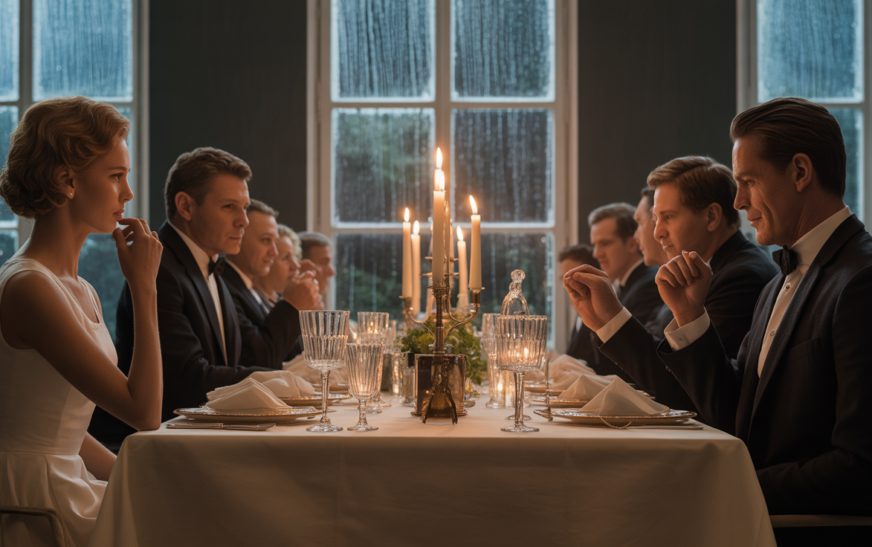
The house lights dimmed. Programs folded closed. Then the quartet appeared beneath a wave of polite applause and began something aching and precise that immediately removed the burden of personality from the room.
Lina liked Daniel most when he was not speaking.
That thought was unkind, but not entirely inaccurate. During the brief conversation before the music began, he had seemed intelligent in a disciplined way. He asked thoughtful questions. He listened without interrupting. Even so, his answers arrived as if they had already been revised once in private.
Now, however, he sat beside her in stillness, eyes on the stage, one hand resting lightly on the program in his lap. The music moved through the hall in dark, elegant lines. Meanwhile, the audience held itself in a single collective breath.
It was easier, then, to notice smaller things.
The steadiness of his posture. The fact that he did not fidget. The way his expression changed by fractions with the music, as though he distrusted bigger reactions in public. Lina understood that instinct more than she liked.
By the second movement, she had almost relaxed.
The Intermission Glass
Intermission undid that.
The foyer filled at once with people trying to look as though they had always intended to stand in loose, elegant clusters near expensive wine. Daniel returned with two glasses without asking whether she wanted one.
“White,” he said. “I gambled.”
Lina took it. “That was reckless.”
“I’m trying to expand my range.”
They stood beside a marble column while conversation moved around them in tasteful waves.
“Do you come here often?” Daniel asked.
She nearly smiled. “You know that question sounds tragic in a concert hall.”
“A little.”
“Then why ask it?”
He glanced into his glass. “Because all my better questions sounded too personal for minute nineteen.”
That answer was honest enough to make her look at him more directly.
“Such as?” she asked.
He hesitated. “Why you chose this instead of dinner.”
“And if I answer?”
“Then I’ll have to answer the same question about myself.”
Lina considered the crowd around them. A woman in emerald silk laughed with one hand on a man’s wrist. Two older men disagreed about tempo with the intensity of people who needed art to excuse temperament. Meanwhile, the foyer windows reflected everyone back at themselves with slight distortion.
“Fine,” she said. “I chose this because silence feels kinder than small talk.”
Daniel nodded once. “I chose it because music gives people a third thing to look at when they’re disappointed.”
That was the first moment she wanted the date to become stranger instead of ending neatly.
The Fire Alarm
The second half never began.
Five minutes after intermission ended, the hall darkened once, brightened again, and then surrendered to the shrill mechanical scream of the fire alarm.
The sound split the room open.
Audience members jerked upright. Someone dropped a program. The quartet vanished backstage almost instantly, which felt practical and therefore rude. Red lights began flashing along the side aisles, staining the theatre’s velvet dignity with panic it had not been designed to wear.
“Well,” Daniel said over the noise, “there goes our structured evening.”
Lina laughed in spite of herself. “That’s an appalling thing to say during an evacuation.”
“And yet not incorrect.”
Ushers moved everyone toward the exits with professional calm. The audience shuffled into the stairwells in a river of black coats, perfume, irritation, and low outrage. Outside, cold air met them at once.
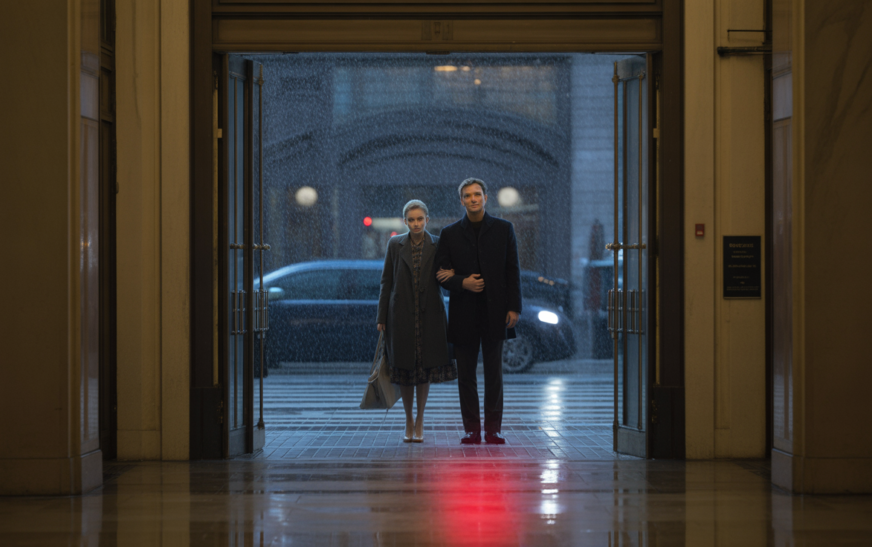
The whole crowd gathered on the pavement beneath the theatre marquee while rain began again in a soft, indecisive mist.
No flames appeared. No smoke followed. Just uncertainty, and the expensive resentment of people whose evening had been interrupted before the proper emotional conclusion.
Daniel stood beside Lina under the awning and looked up at the blinking red light above the theatre doors.
“Do we wait,” he asked, “or accept that the universe has staged an intervention?”
“That depends,” Lina said. “Was the date improving?”
For the first time, he looked genuinely amused. “Dangerously, yes.”
The Street Outside the Theatre
They left with the others but did not follow them far.
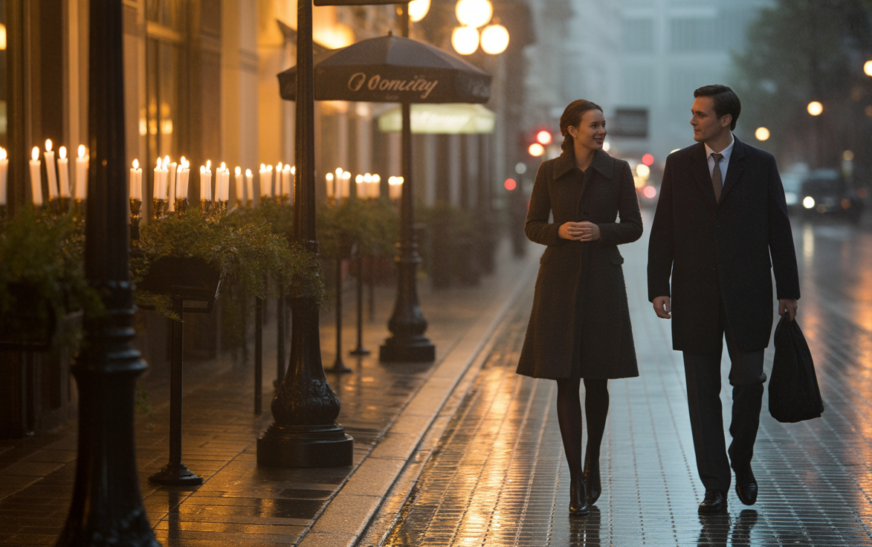
Some people crowded near the entrance, demanding updates. Others drifted toward taxis, already reshaping the interruption into anecdote. Meanwhile, the street beyond the theatre opened into a darker stretch of shops and old facades washed silver by the weather.
Lina and Daniel walked without deciding to.
“You don’t seem upset,” she said.
“By the alarm?”
“By any of it.”
He slipped his hands into his coat pockets. “I’m disappointed about the music.”
“But not the date.”
“I was trying not to flatter either of us too early.”
The answer arrived with such careful restraint that it landed harder than a smoother line would have.
“That sounds practiced,” Lina said.
“No,” Daniel replied. “Practiced would have sounded easier.”
They passed a closed bookshop where gold lettering glowed faintly in the rain. Somewhere farther down the avenue, a bus sighed at the curb and moved on. The city felt briefly gentler after the disruption, as if the alarm had broken more than the evening’s structure.
“All right,” Lina said. “One honest thing since the theatre already humiliated us.”
“Only one?”
“For now.”
He nodded. “I nearly canceled tonight.”
She stopped walking for half a step. “Why?”
“Because blind arrangements always feel like being introduced to a version of myself I didn’t approve.”
That answer interested her more than it should have.
The Café With No Music
A narrow café near the corner was still open.
Its windows were fogged. Its lighting was plain. No one inside looked rich enough to argue about quartets. Therefore, it felt immediately more trustworthy than the theatre had.
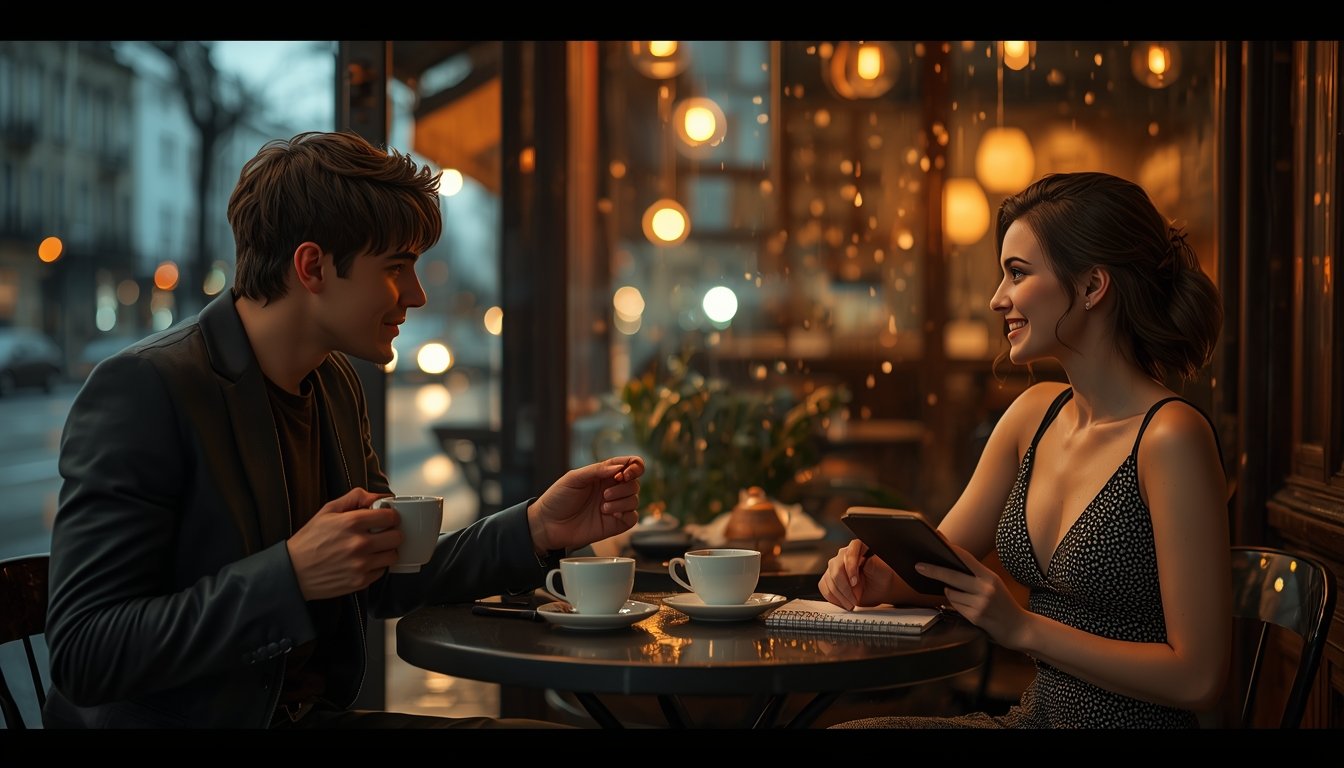
They took a small table near the back and ordered coffee neither of them really wanted. Rain ticked softly against the glass. The place smelled faintly of cinnamon, wet coats, and the kind of quiet labor that survives midnight.
“Your turn,” Daniel said.
Lina wrapped both hands around her cup. “I almost left during intermission.”
“I know.”
Her eyes lifted. “How?”
“You had your bag on your lap. Your body was angled toward the aisle. You kept looking at the foyer doors the way people look at exits when politeness is losing.”
That should have embarrassed her. Instead, it felt weirdly intimate to be observed without being cornered by it.
“And you stayed anyway,” he said.
“Only because I was curious whether you disliked the evening as much as I did.”
“That’s unexpectedly flattering.”
“No,” Lina replied. “It’s unexpectedly honest.”
For the first time that night, he laughed fully. Not loudly. Just enough to make the plain little café feel warmer than the theatre ever had.
The Reason He Chose Music
“Why chamber music?” Lina asked after a moment.
Daniel looked out at the rain-smeared street before answering.
“Because dinner rewards people who are immediately easy,” he said. “I’m not.”
She stayed quiet.
“In rooms like restaurants,” he continued, “I can become very good at seeming calm. Thoughtful. Reliable. Men like that are often trusted too early.”
“And you dislike that?”
“I dislike being mistaken for simple.”
That sentence changed him slightly in her eyes. Until then, Daniel had seemed reserved in a way she recognized but did not fully trust. Now he seemed reserved because he understood exactly how impressions hardened into expectation.
“That sounds expensive,” she said.
“It has been.”
“You talk like someone who’s had practice disappointing people.”
He met her gaze steadily. “No. More like someone who knows disappointment arrives faster when first impressions are too polished.”
Lina felt the truth of that settle into the table between them.
“That’s why you chose a concert,” she said.
“Partly. And partly because in the dark, people reveal what they listen to instead of what they advertise.”
“That is almost romantic.”
“I was trying for careful.”
The Honest Part of Her
She smiled into her coffee before answering.
“My reason was less elegant,” Lina said. “I chose a concert because if the date failed, at least there would be something beautiful in the room.”
Daniel did not reply at once.
“That sounds lonelier than elegant,” he said quietly.
“Yes.”
The simplicity of the answer surprised them both.
Lina had become skilled at handling disappointment before it fully arrived. She chose restaurants with easy exits. She scheduled dates near train stations. She carried wit like a concealed blade and used it before anyone could mistake her patience for need. However, the fire alarm had torn through the usual architecture of the evening and left behind something more difficult: directness.
“I’m not very good,” she said, “at allowing a first impression to stay unfinished.”
“Nor am I.”
“That should worry me.”
“It probably should.”
Yet nothing in his expression asked her to be less careful than she already was. That made the caution itself feel less exhausting.
The Walk Back to the Station
They left the café just before midnight.
The rain had thinned again, leaving the pavement slick and reflective under the streetlamps. Far behind them, the theatre still glowed through the mist, and a few stranded concertgoers lingered near the entrance like abandoned punctuation.
“Do you think there was ever a real emergency?” Lina asked.
Daniel considered it. “No.”
“That certainty sounds suspicious.”
“I simply think most genuine disasters are less elegantly timed.”
She laughed once, then let the sound fade into the wet air.
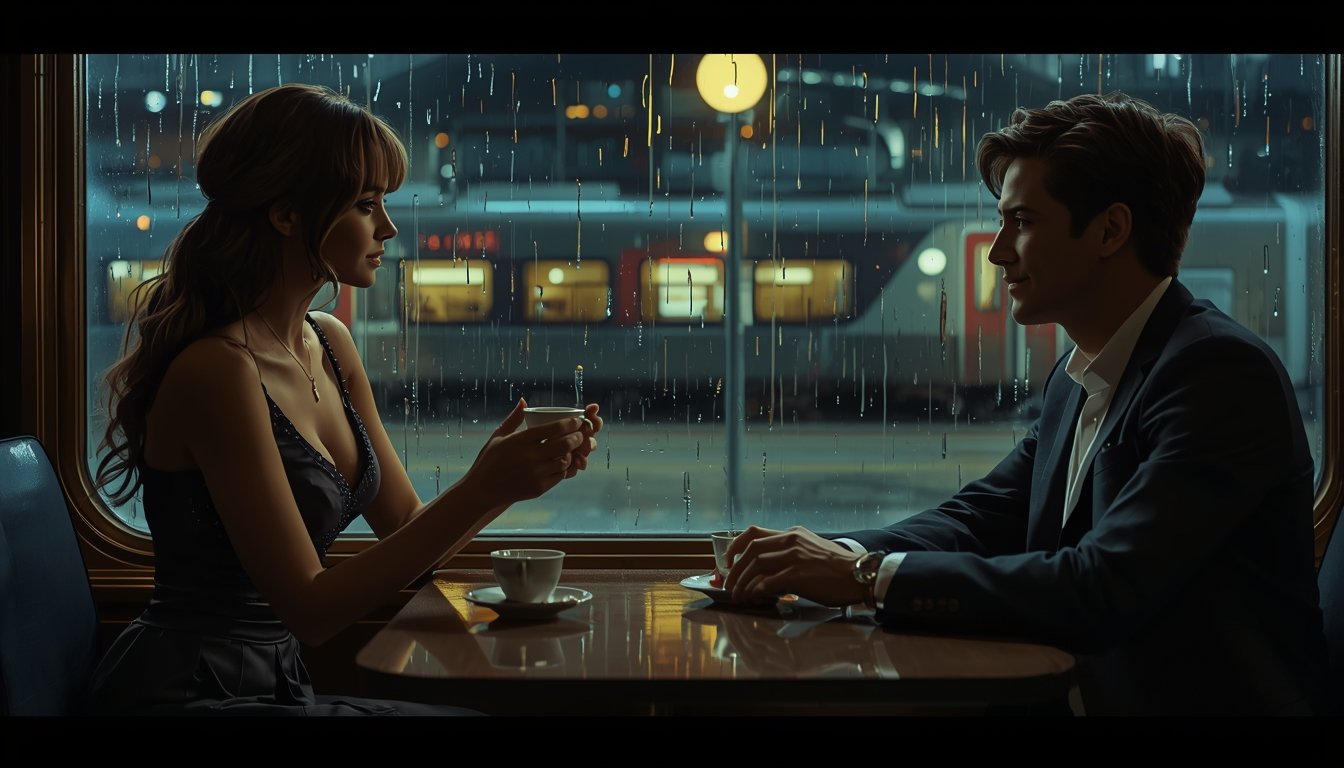
At the station entrance, they stopped under the iron awning. The city kept moving around them in softened reflections and passing headlights. Nothing dramatic happened. No sudden confession altered the weather. Even so, the moment held the careful tension of something that had become more dangerous precisely because it had not tried to rush.
“This,” Lina said, “was a very strange first date.”
“Yes.”
“Possibly a failed one.”
“Also yes.”
“And yet.”
Daniel’s gaze stayed on hers. “And yet.”
That was the point at which she understood the evening had succeeded only after it stopped trying to. Some nights required collapse before they could become honest.
After the Alarm
On the train home, Lina watched her reflection slide through black windows and thought about how thin the line was between interruption and rescue.
The fire alarm had ruined the performance and improved the night. It had emptied the theatre, embarrassed the crowd, and forced two careful strangers into weather, plain coffee, and the kind of conversation that elegant rooms rarely allowed. By the time she reached her stop, she no longer cared whether the quartet had resumed without them. The unfinished music felt appropriate.
Later, when she found herself reaching for fiction shaped by Romance, the uncertain beginnings inside Dating, and the charged restraint of Flirty Stories, she understood why those stories lasted. They often began with failure. Then they sharpened through timing, candor, and the relief of meeting someone after the first script had already burned away. Some nights darkened into Psychological tension or carried the emotional edge of Drama, because honesty could be as unsettling as attraction.
In the end, a fire alarm can interrupt a room, deepen into first date tension, and leave behind quiet honesty, romantic tension, or the ache of uneasy chemistry. Sometimes the most memorable beginning arrives disguised as inconvenience. Other times it sounds like an alarm, empties the theatre, and leaves two people alone with the version of themselves they had hoped not to meet so soon.