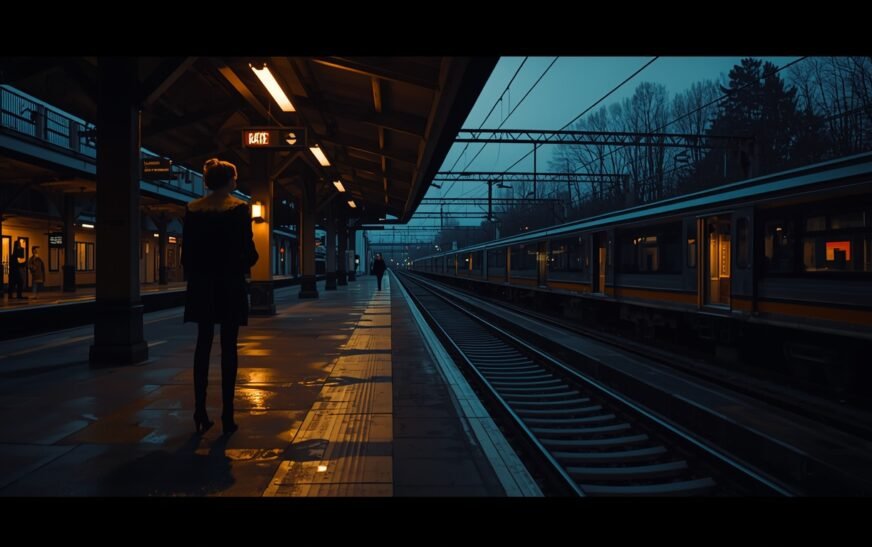
The 6:22 train pulled away without her. Iris reached the platform just as the doors closed, her breath visible in the cold evening air, her hand still raised in a futile gesture. She had run from the office. She had ignored the elevator’s sluggish crawl and taken the stairs instead. However, the train did not wait. It never did. Dating had taught her that lesson long ago—timing was everything, and hers was perpetually off.
She stood at the edge of the platform, watching the red taillights disappear into the tunnel. Forty minutes until the next one. Forty minutes of standing in the cold, replaying the day’s small failures, counting the ways she had fallen behind. Meanwhile, the platform emptied around her. Commuters who had made the train vanished into the evening. Those who remained dispersed toward the exits or the small heated waiting area near the ticket machines.
One other person stayed.
He leaned against a concrete pillar near the schedule board, hands in the pockets of a dark wool coat. His posture suggested patience rather than defeat. He was not checking his phone. He was not pacing. Instead, he simply stood there, looking toward the empty tracks as if the missed train were a minor detail rather than a disruption. Consequently, Iris noticed him. She noticed the quiet stillness of him. And she noticed that he was watching her, too.
The Platform After the Train Leaves
The silence of a missed train is a particular kind of quiet. It carries the echo of departure, the residue of hurry, and then nothing. Iris had always hated this silence. It made her feel left behind. Yet tonight, the quiet did not press against her in the usual way. Perhaps it was the cold air sharpening her senses. Perhaps it was the presence of the stranger by the pillar, sharing the same waiting, the same forty minutes. Place-based discomfort had a way of softening her usual defenses.
She walked toward the schedule board, which was conveniently located near his pillar. A transparent move, but she committed to it. The board showed the next train at 7:02, then another at 7:18, and a third at 7:34. Forty minutes felt longer when displayed in bright orange digits.
“The 6:22 is always early,” he said.
Iris turned. His voice was low and even, with a faint rasp that suggested he had not spoken in a while. Up close, she saw the details she had missed from across the platform. Dark hair, slightly disheveled by the wind. Eyes that were neither brown nor green but something in between. A faint scar near his left eyebrow, old and faded.
“It left exactly on time,” she replied. “I was late.”
“So was I.” He tilted his head toward the tracks. “By about ten seconds.”
A small laugh escaped her. “I had fifteen seconds. I watched the doors close.”
“Then you win. Or lose, depending on perspective.”
Because his tone held no mockery, only a dry acknowledgment of their shared misfortune, Iris found herself smiling. “I think we both lost.”
“Fair enough.” He extended his hand. “Elliott.”
“Iris.”
His palm was warm despite the cold. The handshake lasted a beat longer than strictly necessary. After that, they stood side by side, facing the empty tracks like two strangers waiting for the same delayed future.
The Forty Minutes That Followed
The first ten minutes passed in small talk. Elliott worked in historic preservation, restoring old buildings that the city had forgotten. He spoke about his work with a quiet passion, using words like molding profiles and original sash weights as if they were poetry. Meanwhile, Iris listened in a way she rarely allowed herself to listen. She was not planning her response. She was not scanning for exits. Instead, she simply absorbed the sound of his voice against the cold air.
When he asked what she did, she hesitated. “Corporate strategy. It sounds more interesting than it is.”
“I doubt that.”
“Mostly spreadsheets and meetings about meetings.”
“Still. You shape the direction of something. That matters.”
She looked at him, surprised by the generosity of his interpretation. Most people nodded politely and changed the subject. Elliott, however, seemed genuinely interested. Therefore, she found herself telling him more than she usually told anyone. About the parts of her job she actually loved—the problem-solving, the moment when a complex plan finally clicked into place. About the parts she tolerated because they paid for the rest.
The Warmth of a Shared Waiting
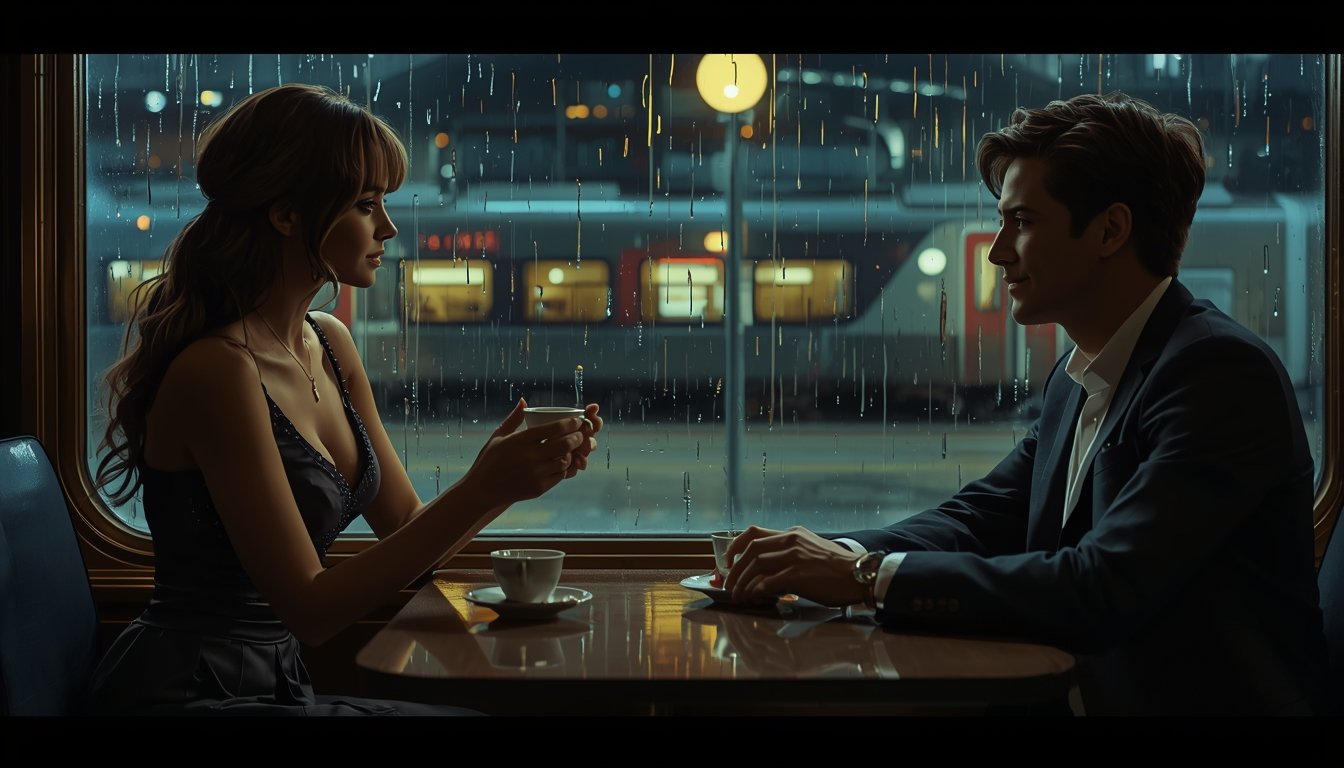
By the twenty-minute mark, the cold had begun to seep through her coat. She shivered once, involuntarily. Without a word, Elliott shrugged out of his scarf—a dark gray wool that looked expensive and smelled faintly of cedar—and held it out to her.
“I’m fine,” she said automatically.
“You’re shivering. I run warm.” He did not withdraw his hand. “Take it.”
She took it. The wool was soft and still held the heat of his body. Wrapping it around her neck felt like accepting something more than warmth. It felt like permission. Emotional restraint had been her default for so long that small kindnesses often went unrecognized. But this one landed.
“Thank you.”
He nodded. “Where are you headed?”
“Cedar Park. Three stops past the usual.”
“I’m two stops before that. Mill Street.”
The announcement crackled overhead. The 7:02 train was approaching. They had fourteen minutes left. Iris felt an unexpected pang of disappointment. Forty minutes had seemed like a sentence when the 6:22 pulled away. Now it felt like a window that was closing too soon.
The Train Arrives Too Soon
The headlights appeared in the tunnel, twin points of white growing larger by the second. The platform vibrated beneath their feet. Other commuters materialized from the waiting area, clutching bags and coffee cups, positioning themselves near the yellow line.
Elliott turned to her. “I’m glad I missed the 6:22.”
She met his eyes. “So am I.”
The train screeched to a halt. Doors opened. People pushed past them, eager for warmth and seats. But Iris and Elliott lingered at the edge of the platform, suspended in the last moment of their accidental forty minutes. Timing-based tension had built something fragile and real in the space between departures. And neither of them wanted to break it.
“Can I sit with you?” he asked. “On the train.”
“Yes.”
They boarded together. Found two seats near the back, away from the fluorescent glare of the center aisle. The train lurched forward, and the platform slid away into darkness. Iris kept his scarf around her neck. He did not ask for it back.
The Short Journey Home
Mill Street arrived too quickly. Elliott stood, but he did not move toward the doors immediately. Instead, he looked down at her with an expression she could not quite read—somewhere between reluctance and resolve.
“I don’t usually do this,” he said. “But I’d like to see you again. Not on a platform. Not by accident.”
Iris’s heart beat faster than the train’s rhythm. “I don’t usually do this either.”
“And yet.”
She smiled. “And yet.”
They exchanged numbers. He wrote his on the back of a receipt from his pocket—a coffee shop she recognized, near the historic district where he worked. She typed hers into his phone, her fingers clumsy with cold and something else. Then the doors beeped their warning.
“The scarf,” she said, reaching to unwrap it.
“Keep it. Give it back next time.”
He stepped onto the platform. The doors closed. Through the window, she watched him raise a hand in a small wave. She waved back. And then the train pulled away, carrying her toward Cedar Park with a stranger’s warmth around her neck and a receipt clutched in her palm.
Slow burn connection did not require grand gestures. Sometimes it required only a missed train, a shared forty minutes, and the courage to say and yet.
The Next Evening
The following day, Iris stood on the same platform at 6:15. She was early. Deliberately, consciously early. Her coat was buttoned, her hands were warm in her pockets, and Elliott’s scarf was folded in her bag—washed and ready to be returned. The 6:22 approached right on time. But this time, she was not running.
She boarded anyway.
He was already there. Same pillar, same patient posture. When he saw her step onto the platform before the train arrived, his face broke into a slow, genuine smile. It transformed him. The quiet stillness was still there, but beneath it now was something warmer, something that had been waiting for permission to surface.
“You’re early,” he said.
“I didn’t want to miss it again.”
“The train?”
She shook her head. “No.”
Understanding passed between them. He fell into step beside her as the train pulled in. And this time, when they sat down together, it was not an accident. It was a choice. Romance had not been part of her plan. But then, the best things rarely were.
Psychological walls lowered without force. Drama had no place on this quiet platform.