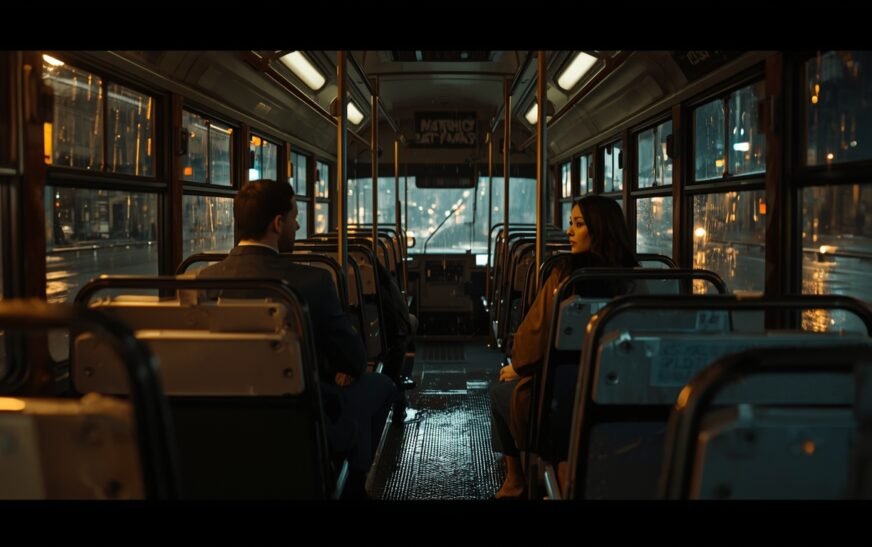
The night bus arrived at 9:47 every Tuesday, give or take the traffic on Mercer Street. Meanwhile, Mara had learned its rhythm the way she learned everything now—carefully, from a distance, without expectation. She boarded at the stop outside the community college extension building, damp air clinging to her coat, and took the same seat four rows from the back, window side. After all, she had been doing this for eleven weeks.
The man got on two stops later. Always. Caledonia Avenue, just past the shuttered laundromat with the flickering O in its sign. He paid in coins, never a card, and then walked past her row without glancing over. He sat five rows behind her, aisle seat, and stayed there until his stop on Hartwell Road. Therefore, the pattern remained unbroken.
That was the entire arrangement. Eleven weeks of silence, eleven Tuesdays of near proximity, and not a single word exchanged. Still, Mara told herself she preferred it that way. Words complicated things. Words led to questions about why a thirty-four-year-old woman was taking night classes in archival studies after a decade in corporate compliance, about the divorce she never mentioned, about the apartment that still smelled faintly of someone else’s coffee grounds. However, the night bus asked nothing of her. Dating had not been part of the plan.
He was tall, she knew that. Dark hair, kept short. Moreover, he had a quiet face—not brooding exactly, but settled, like someone who had already done his worrying earlier in the day and was now simply moving through the remaining hours. He carried a worn leather bag, the kind with brass buckles, and once she had seen a corner of sheet music sticking out. Or perhaps it was a technical manual. She looked away before she could be sure.
The Rain Begins to Fall
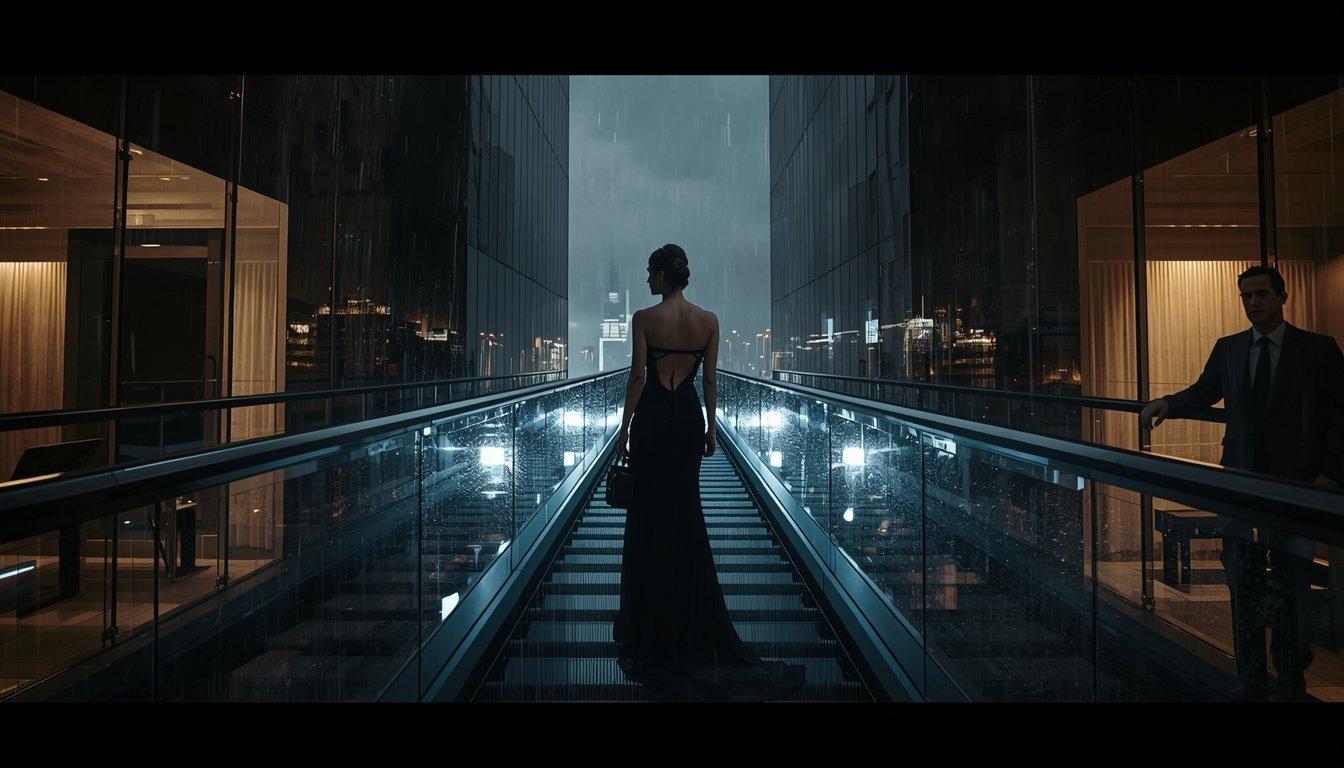
Meanwhile, the weather had turned sometime during her lecture on preservation environments. Rain streaked the bus windows in diagonal lines, smearing the city lights into long amber streaks. The driver, a woman with silver braids and a permanently patient expression, slowed at each intersection as the rain intensified. At the same time, the wipers beat a steady rhythm. Mara watched her own reflection in the glass, half-transparent, and behind it the blurred shape of the man five rows back, also watching the rain.
They had almost reached Hartwell Road when the bus shuddered. A deep mechanical groan rose from somewhere beneath the floorboards, followed by a sharp hiss and the sudden loss of forward momentum. The driver guided the night bus to the curb with practiced calm, engaged the parking brake, and reached for her radio. Consequently, the interior lights flickered once, then held steady.
“Apologies, folks,” the driver called out, her voice carrying easily through the near-empty vehicle. “Hydraulics are done for the evening. Dispatch is sending a replacement, but it’ll be forty minutes minimum in this weather. You’re welcome to wait here or find alternate transport.”
Mara exhaled slowly. Forty minutes on a stalled night bus in the rain. She could call a ride share. She could walk—Hartwell was only six blocks east, and her apartment another four beyond that. The rain was steady but not violent. Besides, she had an umbrella, a small black one buried at the bottom of her tote.
She was still considering when the man rose from his seat. He moved down the aisle with the same unhurried gait he always used, and for a fraction of a second his gaze met hers in the darkened window reflection. Then he was past her, stepping down onto the wet sidewalk, collar turned up against the rain.
Mara watched him go. Quiet attraction had a way of feeling like a language she’d forgotten how to speak. Nevertheless, she gathered her tote, pulled out the umbrella, and stepped off the night bus into the rain.
The Walk That Wasn’t Planned
The rain was colder than it looked. It found the gaps in her collar almost immediately, sliding down the back of her neck in thin, insistent trails. She opened the umbrella, heard the familiar click of its cheap mechanism, and began walking east on Hartwell. The street was mostly residential here—older brick buildings converted into apartments, a corner bodega still lit, a dry cleaner’s dark behind its security gate.
Meanwhile, he was a block ahead. She could see his silhouette moving through the rain, shoulders hunched slightly, no umbrella. He walked with a steady, unbothered pace, as though the weather were merely an inconvenience he had long ago decided not to fight. The leather bag was tucked under one arm.
Because the route to her apartment passed his stop anyway, she did not immediately feel like she was following him. It was simply the same direction. Still, her footsteps slowed, creating distance. The night bus had been a neutral container. This—the empty sidewalk, the shared direction, the rain—felt like something else entirely.
At the corner of Hartwell and Loomis, he stopped. Not at a crosswalk or a doorway, but mid-block, facing a low iron gate that led into a narrow alley between two buildings. He stood there for a long moment, rain darkening his shirt, and then he turned and looked back up the street.
Directly at her.
Mara’s grip tightened on the umbrella handle. She was perhaps thirty feet away, close enough that pretending not to see him was absurd. His expression was not hostile or even particularly curious. Instead, it was simply present. He raised a hand—a small, almost tentative gesture—and pointed toward the alley.
Beneath the Corrugated Roof
“There’s a covered walkway,” he called out, his voice carrying clearly despite the rain. “Cuts through to the next street. Saves you the long way around Loomis.”
Mara blinked. Eleven weeks of silence on the night bus, and his first words to her were directions to a shortcut. She found herself walking forward, umbrella tilting, until she stood a few feet away from him at the mouth of the alley.
“I didn’t know this was here,” she said.
“Most people don’t. It’s an old service lane. The buildings on either side put up that corrugated roof years ago for deliveries.” He gestured overhead, where a patchwork of metal sheeting created a narrow, dripping tunnel. “It’s not pretty, but it’s dry.”
She stepped under the roof and lowered her umbrella. The rain drummed against the metal above them, loud and close, but the space beneath was quiet in the way that small sheltered places always are. Meanwhile, he remained near the entrance, not crowding her, water running from his hair down his temples.
“You take the night bus every Tuesday,” she said. It was not a question.
He nodded. “You too. 9:47.”
“I didn’t think you noticed.”
He looked at her then, directly, and for a moment the rain seemed louder. “I notice.”
The First Honest Words
There was a pause. Not awkward, but full. The kind of pause that holds something unspoken at its center.
“I’m Mara,” she said finally.
“Ellis.” He shifted the leather bag on his shoulder. “I teach piano. Studio on Caledonia, late lessons on Tuesdays. That’s why I’m always on the night bus at that stop.”
Sheet music, then. Not a technical manual. She filed that away. “I’m taking an archival studies certificate. Tuesday night lectures.”
“Archival studies.” He said it like he was tasting the words. “Preserving things.”
Because the observation landed closer than he could know, she looked away, toward the far end of the alley where streetlight filtered through the rain. “Something like that.”
Later, she would wonder why she asked what she asked next. Perhaps it was the rain, the strange intimacy of the covered walkway, the eleven weeks of silence on the night bus that had built a foundation neither of them had acknowledged. Or perhaps it was simply that she was tired of being careful.
“Why do you sit so far back?” she asked. “On the bus.”
Ellis was quiet for a moment. Water dripped from the edge of the metal roof in a thin curtain. “Because if I sat closer, I would have wanted to talk to you. And I didn’t know if you wanted to be talked to.”
The honesty of it caught her off guard. On the night bus, she had constructed an entire narrative of mutual indifference. Two strangers sharing a route, nothing more. Yet here he was, admitting that the distance had been deliberate restraint rather than disinterest. Emotional restraint she understood. It was practically her native language.
“I didn’t know if I wanted to be talked to either,” she said. “I’m still not entirely sure.”
He nodded, as if that were a perfectly reasonable answer. “Fair enough.”
They stood there for another minute, the rain steady above them, the city muted and soft. Then Ellis glanced toward the far end of the alley. “I’m heading to Hartwell and Decker. If that’s your direction, the covered part goes another block.”
“It is.”
Walking Together Under One Umbrella
They walked together through the narrow passage, footsteps echoing strangely off the wet brick on either side. The corrugated roof ended abruptly at a small courtyard, where the rain resumed, and Mara opened her umbrella again. Without discussion, Ellis stepped under it beside her, his shoulder brushing the edge of the fabric. He was taller up close, and he smelled like rain and something faintly like rosin—the powder violinists use on their bows, she remembered from a college boyfriend who played.
“Decker’s just up there,” he said, pointing. “I’m the building with the blue door.”
“I’m four blocks further. The Meridian.”
They walked to his door in silence, sharing the umbrella, their paces matched without effort. At the blue door, he stopped and turned to face her. The rain fell around them, caught in the glow of the streetlamp overhead.
“Next Tuesday,” he said. “The night bus. I’ll sit closer.”
She almost smiled. “How much closer?”
“Maybe two rows back instead of five. We’ll see.”
Because the night had already broken every rule she had quietly constructed, Mara said, “You could sit in the row next to mine. It wouldn’t be the end of the world.”
He looked at her for a long moment, rain catching in his lashes. Then he nodded, once, and the corner of his mouth lifted—not quite a smile, but something adjacent to one. “Next Tuesday, then.”
He disappeared through the blue door, and Mara stood alone under her umbrella for a full thirty seconds before continuing home. Romantic tension was not supposed to feel like this—quiet, patient, unforced. But then, nothing about the night bus had ever been what she assumed.
The Following Tuesday Arrives
By the next Tuesday, Mara had convinced herself at least six times that nothing would change. He would board at Caledonia, walk past her row, sit five back, and the entire rainy conversation would become a strange, isolated memory. She prepared herself for that outcome. She was good at preparing for outcomes.
The night bus arrived at 9:49. She took her usual seat, window side, four rows from the back. The rain had stopped days ago, leaving the city clean and cold. Meanwhile, she watched the familiar streets slide past, her reflection ghostly in the dark glass.
At Caledonia Avenue, the doors hissed open. Coins dropped into the fare box. Footsteps moved down the aisle.
And then Ellis stopped. Not at the fifth row. Not at the fourth. Instead, he stopped directly beside her row, gestured to the aisle seat next to her, and said, “This one taken?”
Mara looked up at him. His leather bag hung at his side, and his expression was calm, almost neutral, but there was a warmth behind it she recognized now. The same warmth that had stood under her umbrella in the rain.
“No,” she said. “It’s not taken.”
He sat down. The night bus pulled away from the curb, and for the first time in eleven weeks, the silence between them was not an absence. It was a beginning.
Because some connections are not built in grand gestures or dramatic confessions. Instead, they are built in small, repeated choices—the same route, the same time, the same seat slowly moving closer. Timing-based tension had kept them apart for months. And now, quietly, it had brought them together.
Outside the window, the city blurred past in streaks of light. Inside the night bus, two people who had spent a very long time guarding their hearts sat side by side, finally facing the same direction.
Romance had not been part of the plan. But then, the best things rarely were. Drama had no place here. Psychological barriers were finally lowering.
Walking Home Alone, But Not Really
When the night bus reached Hartwell Road, Ellis stood and looked down at her. “Walking?” he asked.
She nodded. “Always.”
“I’ll walk with you. If you want.”
Because the night had already shifted something fundamental, Mara said, “Yes.”
They stepped off the night bus together, into the cold November air. The city was quieter now, late enough that even the corner bodega had dimmed its lights. They walked side by side, not touching, but close enough that the space between them felt intentional rather than accidental. Slow burn connection had a rhythm all its own.
At his blue door, he paused. “Next Tuesday?”
“Next Tuesday,” she agreed.
He smiled then, fully, and it changed his whole face. “Goodnight, Mara.”
“Goodnight, Ellis.”
She walked the remaining four blocks to the Meridian alone, but the word felt different now. Less like a condition and more like a temporary state. After all, the night bus would come again. And when it did, there would be someone sitting beside her.
Sometimes a place-based discomfort—a rainy walk, a covered alley, a stalled bus—is exactly what is needed to move two guarded people out of their carefully maintained routines. The night bus had broken down. And in the space created by that disruption, something quiet and patient had finally been given room to begin.