By the third Thursday, Leona had started measuring her week by the night lesson.
At first, the booking had seemed practical.
After the divorce, she had discovered that certain ordinary things became strangely difficult. Supermarkets at dusk felt too bright. Restaurants full of couples felt designed to mock her posture. Driving after dark, however, was the worst of it. Therefore, when her therapist suggested rebuilding confidence through adult evening lessons, Leona laughed, then booked six immediately.
The school occupied the back corner of a retail parade after most of the shops had closed. By seven, the bakery shutters were down, the pharmacy sign was dimmed, and only the driving office remained lit in a tired amber glow. Each Thursday, Leona arrived ten minutes early, sat in the waiting area with a paper cup of bitter machine coffee, and told herself not to leave.
That was where she first noticed him.
He always sat by the window with a folded jacket across one knee and a level of composure she found irritating. Unlike the teenagers who came for intensive packages, he never scrolled his phone with panic or joked too loudly about parallel parking. Instead, he watched the street as if the traffic had once mattered to him in a way it no longer did.
“You’re here for Marco?” the receptionist asked Leona on the first week.
Leona nodded. “Unfortunately.”
The man by the window looked over then, and the corner of his mouth moved.
Later, she would decide that was how the whole thing began: not with charm, but with a reaction too quiet to trust.
Why She Needed the Night Lesson
Leona had not always been afraid of the road.
For years, she drove everywhere. She drove to work, to her mother’s flat, to late dinners, to coast roads in summer, and to furniture warehouses on Sundays with men who claimed not to care what sofa they bought. Then marriage reduced distance. Her husband preferred driving. He preferred choosing routes. He preferred speaking over directions even when he did not know them.
After the marriage ended, she discovered she had surrendered more than companionship. Confidence had gone with it, quietly and without ceremony. By contrast, the world expected her to feel liberated immediately. Friends sent cheerful messages. Colleagues said she seemed lighter. Meanwhile, she stood at pedestrian crossings watching headlights turn and thought, I do not trust myself after sunset anymore.
That admission embarrassed her enough to keep it private. Even so, embarrassment rarely cures fear.
One night, while avoiding emails, she drifted through the Romance archive and then into Dating, searching for fiction in which women recovered in beautiful, efficient ways. Those stories irritated her on sight. Real life was less polished. Real life involved overcorrecting at junctions and gripping the wheel too hard.
So she booked the night lesson package and promised herself she would not quit after the first stall.
The Man by the Window
His name took two weeks to arrive.
Until then, Leona called him the calm one in her mind. He was older than the students who came in clusters, though not dramatically. Mid-thirties perhaps. Dark hair. Serious face. The kind of stillness that made other people lower their voices without meaning to. On the second Thursday, he held the office door when she came in from the rain.
“Thanks,” she said.
He gave a small nod. “You’re learning with Marco too?”
“Is my dread that visible?”
That earned her a proper smile. “A little.”
“Comforting.”
“Sorry. I’m Elias.”
She told him her name, and then Marco appeared with keys in one hand and indifference in the other. The moment ended there. Nevertheless, it stayed with her through forty minutes of left turns and overthinking.
During that lesson, Marco kept saying, “Relax your shoulders,” in the tone of a man who had never once considered how. By the time she returned to the lot, Elias was gone. Even so, his absence altered the waiting room in a way she disliked.
After that, she started arriving even earlier.
The Waiting Room Ritual
By the fifth week, the waiting room had acquired its own rhythm.
At 6:48, the receptionist locked the stationery cabinet. At 6:50, the kettle clicked. By 6:53, Elias usually came in carrying night air on his coat. Then Leona pretended not to have noticed the exactness of his timing.
They never flirted in any obvious way. That was part of what made the atmosphere more dangerous.
Elias asked whether Marco still used roundabouts as moral instruction. Leona asked whether his own instructor remained as silent as a priest. He told her the answer was yes. She told him silence in a passenger seat should be regulated by law. Meanwhile, other students came and went around them with the clumsy transparency of ordinary life.
One evening, the receptionist glanced between them and said, “You two are the only adults who make this place look elegant.”
Leona laughed. Elias looked briefly pained.
“That’s a higher standard than this office can support,” he said.
“Still,” the receptionist replied, “I admire ambition.”
Afterward, while Marco adjusted mirrors with militant precision, Leona caught herself smiling at the windscreen for no good reason. That was when she understood the problem. The night lesson had stopped being merely about driving.
What He Seemed to Understand
The strange thing was not attraction. Attraction had visited her before, and usually with less dignity.
What unsettled Leona was recognition. Elias never asked for confessions. He did not lean into wounded topics with opportunistic gentleness. Instead, he seemed to understand the shape of guardedness from the outside. If she joked, he let the joke stand. If she fell silent, he did not decorate the pause with false ease.
On the sixth Thursday, rain pinned half the students indoors after their sessions ended. Marco vanished into the office to complain about scheduling software, and Leona ended up trapped under the awning with Elias while water moved down the car park in silver channels.
“How bad was it tonight?” he asked.
“I nearly cried at a right turn.”
He considered that. “Urban right turn or emotional one?”
She looked at him. “That was annoyingly good.”
“I know.”
The answer should have sounded smug. Instead, it sounded tired.
For a moment, the rain made privacy possible. Then again, privacy can sharpen things faster than touch. Leona found herself studying his face in the reflected light of the office sign and wondering what had taught him to speak so carefully.
Later that night, she drifted through Flirty Stories and then into Drama, as if the correct shelf might explain why one man under an awning now occupied more of her thoughts than was reasonable.
The Night Lesson in Rain
The seventh Thursday went badly from the first minute.
A van cut across her lane. Leona braked too hard. Marco inhaled in that theatrical way instructors use when they want to remind you that life itself is a favor. Then, halfway through the route, he asked whether she had “considered daytime instead,” which was exactly the wrong thing to say.
“The entire point is that I need the night lesson,” she replied.
“I’m only saying we could build confidence in easier conditions.”
“And then what? Avoid evenings forever?”
Marco wisely stopped talking.
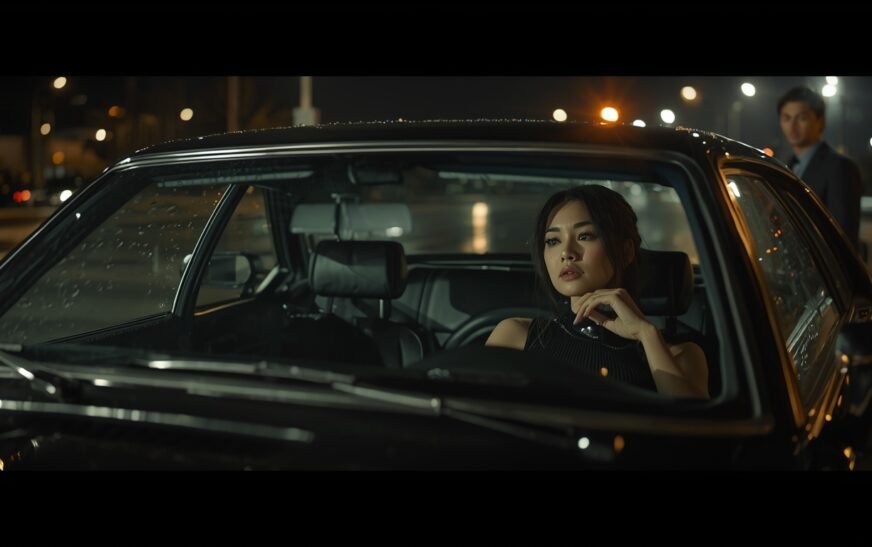
When the car rolled back into the lot, Leona switched off the engine and stared through the windscreen until the dashboard lights went dark. She knew she looked ridiculous. Even so, the humiliation of nearly giving up in front of a man who evaluated her by mirror checks and steering control felt bigger than it should have.
Outside, Elias was leaning against the low wall by the office window. He straightened when he saw her.
“Bad?” he asked.
“Catastrophic in a modest, adult way.”
Instead of answering quickly, he opened the passenger door and bent slightly so his voice would not carry. “Walk with me to the crossing,” he said. “You don’t have to talk.”
She should have refused. However, refusal would have required more steadiness than she had left.
The Crossing at Red Light
The road outside the school was not beautiful. There was a takeaway two units down, a shuttered nail bar, and a bus stop lit with cruel honesty. Yet something about that walk mattered more than elegant places usually do.
They stood at the crossing while traffic hissed through shallow rain.
Leona looked straight ahead. “This is the part where you say everyone feels like this.”
“No,” Elias said. “That line is rarely helpful.”
“Good.”
The signal remained red.
After a moment, he said, “I stopped driving three years ago.”
She turned then.
“Why?”
The cars moved through amber light, then thinned. “Because my wife died in a collision I survived.”
The sentence was delivered without theatre. Precisely because of that, it reached her in full.
“Elias,” she said quietly.
He watched the traffic rather than her. “I wasn’t driving. That made things more complicated, not less. Everyone kept telling me it wasn’t my fault. Meanwhile, I still couldn’t sit in the passenger seat without hearing glass.”
The light changed to green, and neither of them moved at once.
“So why come back now?” Leona asked.
“Because grief can become a profession if you let it.”
There was no answer to that which did not sound naive. Therefore, she crossed beside him in silence.
What She Told Him Back
They stopped beneath the awning of the closed bakery instead of saying goodbye immediately.
Rain tapped the metal shutter behind them. Across the road, the driving school office had gone dim except for the desk lamp near the till.
“I was married to a man who made every mistake sound educational,” Leona said at last.
Elias looked at her, waiting.
“Not violent,” she added. “Nothing dramatic enough for people to organize themselves around. He was simply exhausting. If I hesitated, he explained. If I succeeded, he improved it. By the end, I trusted his corrections more than my instincts.”
She laughed once, without humor. “Now I sit at red lights wondering whether turning right is a moral failure.”
“That sounds familiar in a different key,” Elias said.
“There’s the romance of modern adulthood,” she replied. “Trauma, but administrative.”
That made him laugh softly, and the sound changed him. Some of the careful distance left his face then. Not all of it. Enough.
Before they parted, he said, “Come next week.”
“That sounded like an instruction.”
“A request, then.”
Leona tucked damp hair behind her ear. “All right.”
On the walk home, she opened tags she had saved almost mockingly in past weeks: quiet longing, repeated meetings, emotional restraint, and late evening routine. The phrases felt less foolish now. They also felt dangerously close to true.
When He Did Not Come
The following Thursday, Elias was not in the waiting room.
At 6:50, Leona blamed traffic. At 6:54, she blamed herself for noticing. By 6:58, annoyance had turned embarrassingly personal.
Marco emerged with the keys. “You look distracted.”
“That’s because I’m here.”
“Charming.”
“You charge for inspiration separately.”
He rolled his eyes and led her outside.
The lesson itself went better than usual. Perhaps anger steadied her. Perhaps disappointment gave her somewhere else to look. She handled the ring road without panic, parked between two cars without apologizing, and only stalled once near the mini-roundabout. Marco called that progress. Leona did not argue.
Back in the office, she found a paper cup by the kettle and a folded receipt tucked beneath it.
On the back, in careful handwriting, was a single line: Had to go to the hospital with my mother. I did not want you to think I vanished.
Nothing in that sentence should have warmed her as much as it did.
Nevertheless, it did.
The Route He Chose
He returned the week after, looking more tired than usual and less composed by choice.
“Is she all right?” Leona asked before saying hello.
His expression altered. “Improving. Thank you.”
“You left me a note.”
“I thought not explaining would be rude.”
“That depends on whether you believe absence requires manners.”
“I do.”
They looked at each other for a beat too long. Then the receptionist coughed loudly at nothing, and both of them stepped back into acceptable posture.
After the lesson, Elias said, “Would you like to drive the long way to the river next week?”
Leona frowned. “I’m fairly sure you’re not licensed to redesign Marco’s route.”
“I meant afterward. On foot. There’s a café near the bridge.”
The invitation was almost comically restrained. For that reason, it reached her more deeply than charm would have.
“Yes,” she said.
Relief did not make him brighter. Instead, it made him quieter, as if he took even hope seriously. That, more than anything, made her trust the answer she had given.
After the Lesson Ended
A week later, her final night lesson finished under a sky the color of wet slate.
Marco signed the last page of her progress card and said, “You no longer drive like someone negotiating with ghosts.”
“That is almost a compliment.”
“Take it while available.”
Leona left the car smiling despite herself. The retail parade looked different that evening: less like a holding area, more like a place where something had quietly changed shape. The bakery was still closed. The pharmacy still glowed faintly behind its shutters. Yet the whole road seemed less accusatory now.
Elias was waiting by the crossing, hands in his coat pockets.
“How did it go?” he asked.
“Apparently I now negotiate with fewer ghosts.”
“High praise.”
Together they walked toward the river café under streetlights that turned the wet pavement into strips of gold and black. No one rushed. No one pretended this was casual in the empty way that word is often used. Instead, there was only the careful fact of beginning.
Leona did not know whether this would become love, or merely a season of being understood at the right hour by the right person. Even so, the uncertainty no longer frightened her in the old way. Some roads do not promise safety. They only promise movement, which is sometimes enough.
Behind them, the driving school lights went out one by one. Ahead, the river held the city in broken reflections. For the first time since the divorce, the night lesson no longer felt like punishment disguised as improvement. It felt like the strange, adult elegance of learning how to continue.
Later, when she searched subtle chemistry, vulnerable beginnings, and second-chance feeling, the words no longer seemed like categories meant for other women. They looked, finally, like directions.