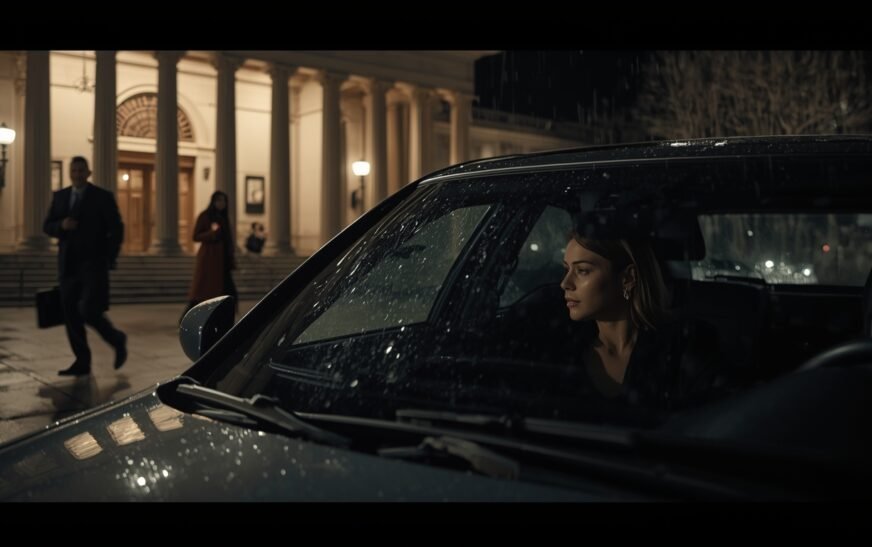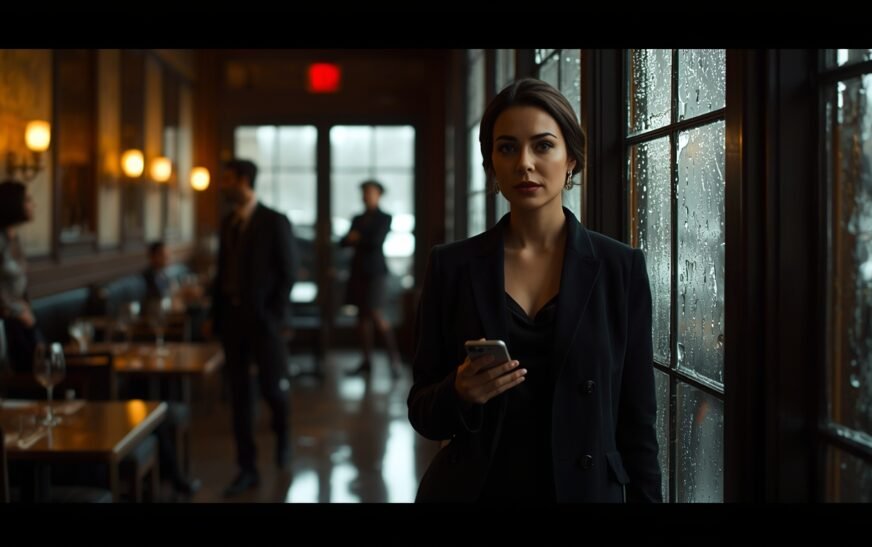
Lina accepted the spare invitation because saying no would have required more honesty than she had left for that week. Her friend Nora had fallen ill two hours before a private gallery fundraiser, and the message arrived with a laughing apology, a dress suggestion, and a promise that the crowd would be harmless. By the time Lina stepped into the black car Nora sent for her, she had already decided the evening would be useful. The event would be polished, brief, and forgettable.
Instead, the first ten minutes felt like walking into a conversation that had started without her.
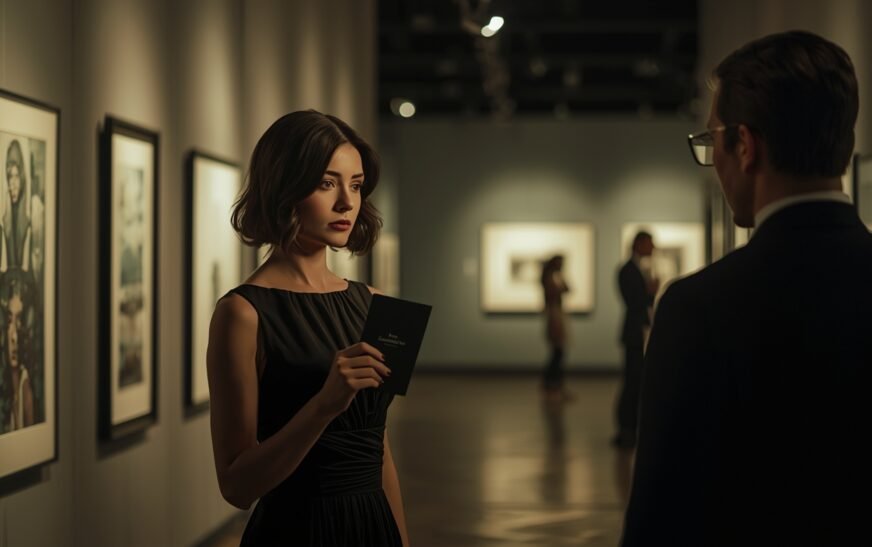
The gallery rose above a quiet street of shuttered boutiques and pale stone facades. Inside, white walls held large storm-dark canvases under careful lighting. Through the rooms moved waiters with silver trays, carrying the scent of lilies and old wood with them. Meanwhile, donors in tailored black and deep jewel tones spoke in soft, expensive voices that made every sentence sound deliberate.
Lina handed over her card at the entrance.
The attendant glanced at it, then at her. “Ah,” he said, with a flicker of recognition she could not place. “Your spare invitation has already caused some interest.”
“I’m sorry?”
He smiled politely, as if he had said too much. “Enjoy the evening.”
At first, Lina assumed he had mistaken her for someone else. Nevertheless, the comment stayed with her as she crossed into the first room and accepted a glass of sparkling water she did not want.
The room with too much attention
Nora’s name still opened doors in half the city. Lina knew that. She did not, however, expect strangers to look at her with quick curiosity and then away again, as if deciding whether to approach.
Near the sculpture plinth, a woman watched her for a moment before turning back to her companion. By the auction display, a man lifted his brows when Lina passed. Even the pianist in the corner seemed to notice her, though perhaps that was imagination working too hard.
Later, while she studied a painting of a shoreline under impossible light, a voice beside her said, “You’re the replacement.”
Lina turned.
The man who had spoken looked almost formal enough to disappear into the room: black suit, dark tie, white shirt without theatrical flair. Yet something in his stillness made the rest of the guests appear overdressed. He held no drink. His attention remained direct, but not careless.
“That is a bleak way to introduce someone,” Lina said.
“True.” A faint smile touched his mouth. “Then let me correct it. You’re the woman with the spare invitation.”
“That sounds only slightly better.”
“Adrian.”
“Lina.”
He glanced at the painting. “Nora usually avoids marine pieces. You don’t.”
“Should I be alarmed that you know her habits?”
“Only moderately.”
His answer should have felt rehearsed. Instead, it landed with a calm precision she found immediately dangerous.
Adrian did not crowd the silence
Some men filled empty space because they feared it. Adrian seemed to respect silence as part of the architecture. More than his face or his voice, that quality made Lina remain where she was.
“How do you know Nora?” she asked.
“Through the foundation.”
“That sounds incomplete.”
“It is.”
Lina almost laughed. “And do you make a habit of speaking in unfinished lines?”
“Only when the room is listening.”
She looked around then. Near the far wall, two women were pretending not to glance over. Meanwhile, a server slowed visibly before continuing on. At once, the sensation from the entrance returned with sharper edges.
“Why would the room be listening to us?” Lina asked.
Adrian tilted his head. “Because some people enjoy prediction more than art.”
“Prediction of what?”
For a moment, he said nothing. Then he nodded toward the next room. “Walk with me. It will look less interesting than standing here.”
Lina should have declined. However, the night had already taken on the kind of polished unease she secretly preferred to dull certainty. Therefore, she set down her untouched glass and followed him.
The auction cards
The second gallery held smaller works and a long table of silent-auction cards. Guests leaned over them with elegant concentration, writing numbers in sleek black ink as if generosity improved with beautiful handwriting.
Adrian stopped beside a photograph of an empty train platform at dawn.
“Nora was supposed to come with me,” he said.
Lina looked at him. “You invited her?”
“I offered her the extra place a week ago.”
“She told me a sponsor sent the invitation.”
“That is not technically untrue.”
Something in his restraint sharpened her attention. “Are you the sponsor?”
“One of them.”
Lina let out a slow breath. “Then the room is listening because?”
“Because Nora enjoys creating patterns and then leaving other people inside them.”
That felt absurdly plausible.
Still, Lina kept her voice level. “You’re saying she set this up?”
“I’m saying she told three different people she was curious what would happen if you came instead.”
Lina stared at the auction card in front of her without seeing the numbers. Nora, with her bright malice and expensive shoes, had always treated social evenings like chess played under flattering light. Even so, this felt unusually intimate.
“Why would she do that?” Lina asked.
Adrian’s expression did not change. “You’d have to ask her.”
“And you agreed?”
“I didn’t agree to a performance.” He looked at Lina then, finally with something close to candor. “I agreed to an extra seat.”
The first honest answer
They moved on before anyone could drift too near. Later, Lina would think the evening changed in that narrow corridor between rooms, where the sound of the piano dulled and the city lights appeared through tall glass like submerged stars.
“Should I leave?” she asked.
Adrian considered the question instead of flattering it away. “Do you want to?”
“That is not an answer.”
“No,” he said. “It isn’t.”
The corridor smelled faintly of rain from a balcony door not fully sealed. Somewhere behind them, soft applause rose and faded. Meanwhile, Lina became uncomfortably aware of the black card still tucked in her hand.
“You knew who I was the moment I arrived,” she said.
“Yes.”
“And you said nothing.”
“At first, I wanted to see whether you already knew.”
“I didn’t.”
“I can see that.”
His tone was not mocking. If anything, it carried a note she did not trust herself to name. Concern, perhaps. Or interest held too carefully in place.
Lina leaned one shoulder against the wall. “You’re very calm for a man apparently dropped into a social experiment.”
“That depends on where you’re looking.”
Only then did she notice that his cuff had been fastened twice through the same buttonhole, slightly crooked. Such a minor imperfection should not have affected her. Instead, it made him feel abruptly real.
On the balcony
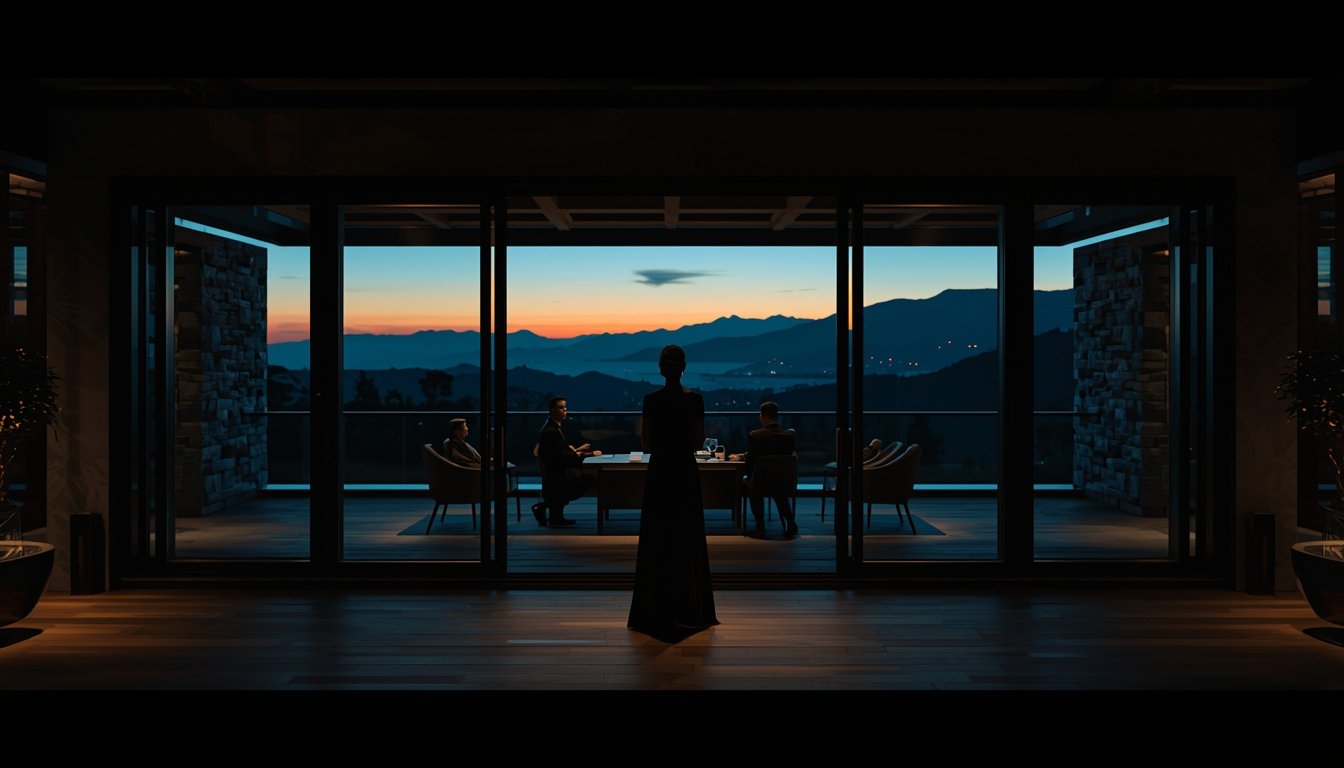
A waiter pushed open the balcony door to pass through, and cool air entered the corridor in a silver rush. Adrian stepped aside, then held the door when Lina glanced toward the terrace.
“Two minutes outside won’t ruin the evening,” he said.
The balcony overlooked the river, the lamps along the embankment, and a cluster of dark roofs beyond. Rain had fallen earlier, leaving the stone rail damp and the night polished. Below, traffic moved in slow ribbons of reflected light.
Lina stood near the edge. Adrian remained a respectful distance away. For a moment, the quiet felt private rather than strategic.
“Nora thinks I need more interesting evenings,” Lina said.
“Do you?”
“I think Nora confuses disruption with improvement.”
That earned a real smile. “That sounds accurate.”
Lina studied the river. “And what exactly did she tell you about me?”
“Enough to make me suspicious of her motives.”
“Which were?”
“That you are difficult to impress. That you leave early when men become theatrical. That you dislike being observed while deciding anything important.”
Lina turned toward him. “That is an alarming amount of information.”
“I didn’t ask for a character file.”
“Yet you accepted it.”
He did not deny that. Instead, he said, “She also said you would hate this event, which I’m beginning to suspect was another test.”
“For me or for you?”
“Possibly both.”
By contrast, most flirtation depended on speed. This felt slower, stranger, and far more difficult to resist because neither of them was pretending it was innocent.
What he asked instead of flirting
When they returned inside, the gallery seemed louder. A donor with a lacquered smile intercepted Adrian near the staircase. He excused himself with practiced ease, though his glance found Lina again before he turned away.
Lina could have used the interruption to leave. Instead, she wandered toward the final room, where a triptych of winter trees hung over a low bench. The air there was quieter. A pair of women discussed brushwork in low voices. Behind a curtain, someone laughed too brightly.
Adrian joined her a few minutes later.
“You stayed,” he said.
“You sound surprised.”
“I am.”
Lina faced the winter trees. “Perhaps I dislike letting Nora win.”
“That would explain part of it.”
“Only part?”
He rested one hand against the back of the bench, not touching her. “Yes.”
The room seemed to contract around that single syllable.
Lina had expected charm from him eventually, some smoother line to justify the attention. However, Adrian only asked, “Are you happy in the life everyone assumes you want?”
The question unsettled her more than praise would have.
“That is an invasive thing to ask at a fundraiser,” she said.
“True.”
“You do this often?”
“No.” He held her gaze. “That’s the difficulty.”
For a moment, she could think only of how careful he remained, how little he reached for the easy version of this conversation. Desire lived there anyway, not announced but unmistakable. Therefore, it felt more dangerous than open pursuit.
The answer she gave him
Lina looked back at the painting before speaking.
“I have a respectable job,” she said. “I answer messages on time. I attend the dinners I’m meant to attend. People describe me as steady, which is usually a compliment given when they mean predictable.”
Adrian listened without interrupting.
“There’s a man,” she continued, “who may eventually ask me to become part of his very organized future. He is kind. My mother would sleep better if I said yes. My friends would call it sensible. Meanwhile, every room I enter with him feels slightly airless.”
“And tonight doesn’t?” Adrian asked.
“Tonight feels like a bad idea in expensive lighting.”
That drew another brief smile. Then he said, “Bad ideas are overrated. Accurate ideas are rarer.”
“Which is this?”
“I don’t know yet.”
Lina should have found the answer insufficient. Instead, it steadied her. After all, certainty from a man she had met less than an hour ago would have been a kind of insult.
From the doorway, a volunteer announced the final bidding call. Guests began drifting toward the central hall. The evening was tilting toward its polished conclusion.
The woman who arranged it all
Nora called just as Lina stepped into the hall. Her name lit the screen like a joke with good tailoring.
Lina answered at once. “You are a difficult friend.”
Nora’s voice arrived warm and theatrical despite the obvious illness in it. “Did you wear the black dress?”
“You sent me into a room where people knew I was your substitute.”
“Only some people.”
“Nora.”
“Fine,” Nora said. “I was curious.”
“About what?”
“About whether you would look alive for once.”
Lina said nothing.
On the other end, Nora softened. “I’m not trying to be cruel. You’ve been drifting toward a life that looks beautiful from the curb and empty through the window. Adrian notices things. I thought perhaps you might, too.”
“You do not get to arrange people like place settings.”
“No,” Nora said lightly. “But I do know when someone needs a different room.”
Lina ended the call before forgiveness could enter too early.
When she looked up, Adrian was watching from a measured distance, giving her the dignity of privacy while making no attempt to vanish. The gesture affected her more than it should have.
Before the evening closed
The auction ended. Glasses changed hands. A final speech rose near the staircase, full of gratitude and civic language. Nevertheless, the real pressure of the night had narrowed to a smaller space.
Adrian crossed the room once the applause began.
“Was that the author of our circumstances?” he asked.
“Unfortunately.”
“And?”
Lina let out a breath. “Apparently she wanted me to look alive.”
“Do you object to the result?”
The question arrived so quietly that it left no easy way to avoid it.
“I object to the method,” Lina said.
“Reasonable.”
“The result,” she added, “is still under review.”
For the first time all night, something open and unmistakably warm entered his expression. It did not dissolve the tension between them. If anything, it made the restraint around it feel more deliberate.
Near the stage, someone called Adrian’s name. He ignored it for one beat longer than politeness allowed.
“There’s a supper room downstairs after this,” he said. “You should not go if you want a simple ending.”
“And if I don’t?”
He looked at her as though he had been careful with that answer for longer than the evening required. “Then come downstairs and tell me something true before midnight.”
After the spare invitation
The spare invitation had brought Lina into the gallery. It had not, however, made the decision waiting under everything else. That part belonged entirely to her.
Applause rose again as the director concluded her speech. Guests began flowing toward the staircase, toward black coats, and toward private tables below. Meanwhile, Lina remained still beneath the chandelier light and let the moment become legible.
She thought of the sensible man with the airless future, of Nora’s meddling, of the river beyond the balcony, and of Adrian’s crooked cuff. More than that, she thought about how different the night had felt from the life she kept defending out of habit.
Then, finally, she smiled.
Not at Adrian. Not at the room. Rather, she smiled at the sudden clean fact that wanting something was not the same as ruining herself.
He waited without approaching. More than anything else, that restraint made her trust the shape of the choice.
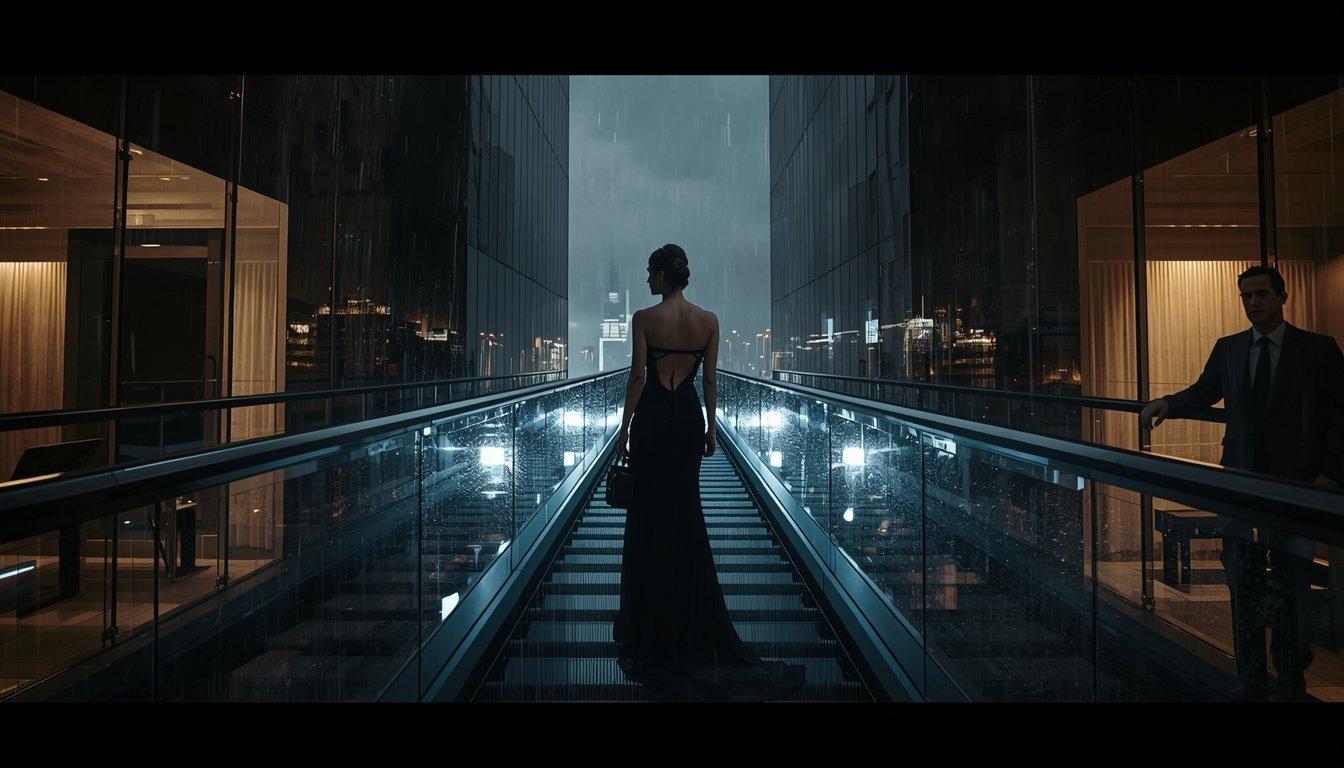
The staircase below
Lina crossed the hall slowly, passing a column of donors, a tray of untouched champagne, and the desk where the attendant had first recognized her card. At the staircase, she paused near a display of event brochures, aware that another version of herself would still leave politely and call the evening strange.
Instead, she looked back once.
Across the room, Adrian’s gaze met hers.
“One true thing,” she said when he reached her.
“Yes?”
She held up the black card between two fingers. “I’m glad I took the spare invitation.”
Something changed in his face then, not triumph, not surprise, but a quieter form of relief.
Later, there might be consequences, explanations, and the untidy labor of altering a life from the inside. For now, there was only the staircase descending into softer light and the low sound of music below.
Together, but not touching, they started down.
It was not a promise. It was not innocence either. Ultimately, it was something more elegant and more dangerous: the first honest step toward a night neither of them intended to waste.
And for Lina, finally, that felt very much like being alive.
Readers who love flirty stories often stay for the slow tension in dating fiction, the emotional restraint of romantic stories, the ache inside dark romance, and the elegant unease of secrets and suspense.
Meanwhile, the evening carried traces of gallery nights, social tension, slow-burn attraction, elegant strangers, city night romance, private invitations, and emotional restraint without ever needing to name the feeling too early.