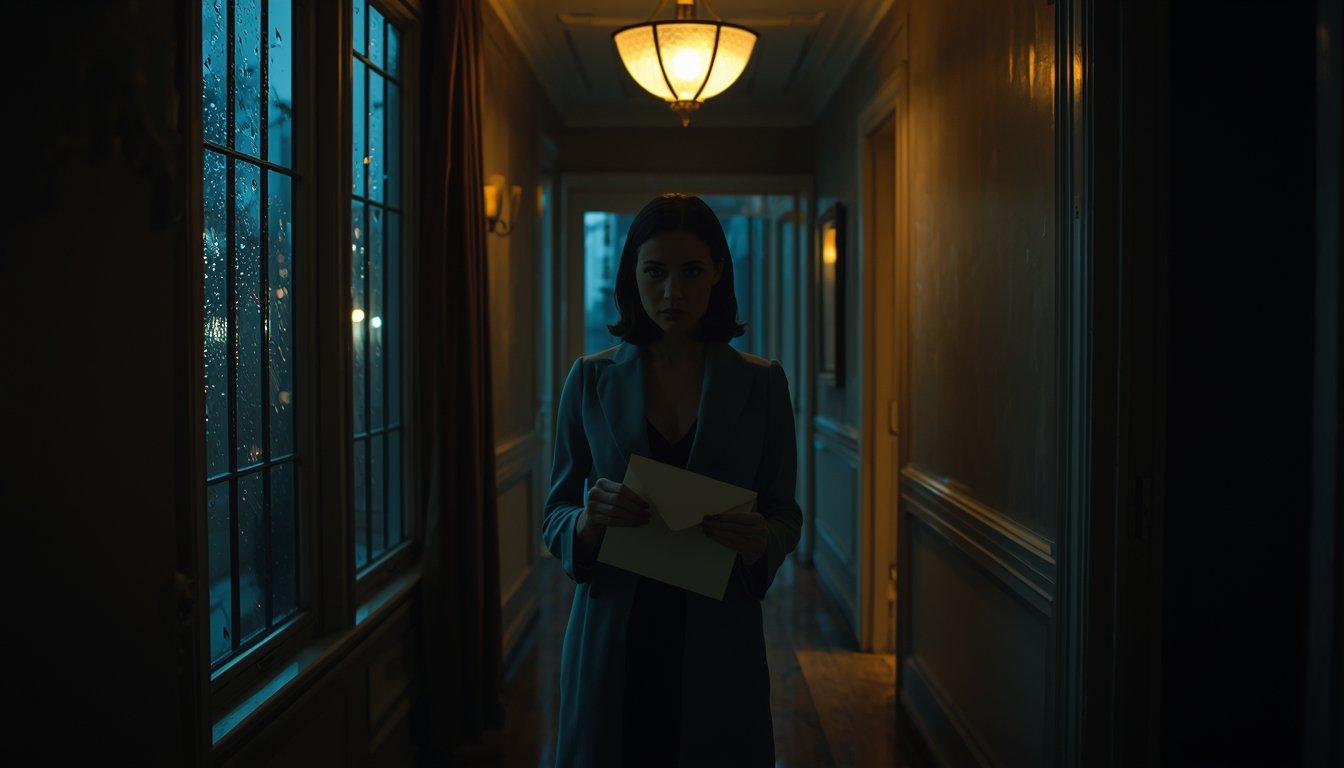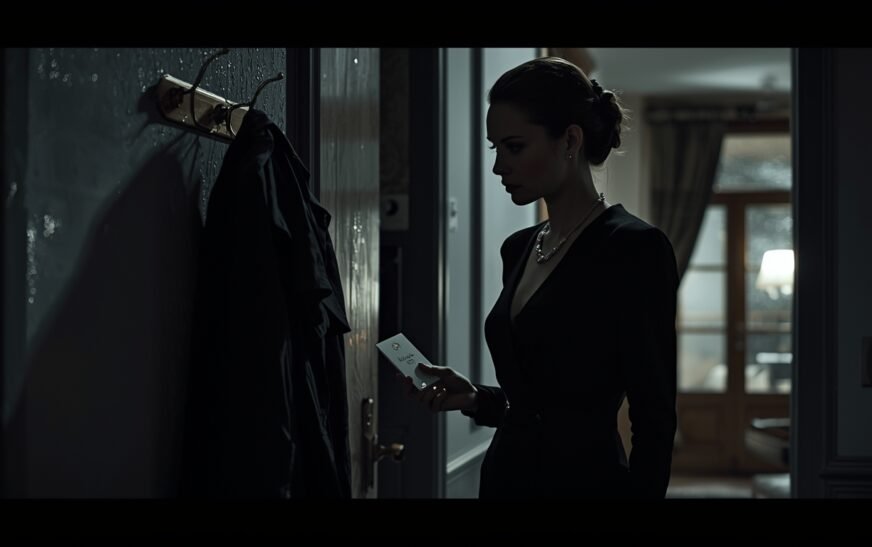
Lena found the visitor badge at 12:18 a.m., while hanging her husband’s coat on the brass hook behind the apartment door and wondering why it smelled faintly of hotel soap instead of rain. The evening had already been wrong in quiet ways. Owen had come home late from a charity dinner he said ran long. Earlier, he had kissed her cheek, apologized with unusual softness, and gone straight to shower before finishing the tea she made him. None of that was dramatic. However, when something small and laminated slid from the inner pocket and landed face up on the hallway floor, the whole night sharpened around it.
The badge was white with a silver strip and the name Halcyon House printed across the top in restrained serif lettering. Beneath it, in block capitals, appeared one word: VISITOR. There was no room number, no host name, only a date stamp from that afternoon and a barcode meant for doors Lena would never normally think about.
For several seconds, she only stared at the visitor badge. Owen had not mentioned Halcyon House. Instead, he had said the dinner was at the Marlowe Foundation rooms near the river, crowded and tedious, all speeches and donor smiles. Halcyon House was a private medical-administration building on the west side of the city, the kind of place people entered with appointments, consulting contracts, or reasons they explained only after being asked twice.
From the bathroom came the sound of running water.
What he had said at dinner
At first, Lena told herself there might be an easy explanation. Charity events used overflow spaces. Guest lists shifted. Sometimes administrators borrowed conference rooms from neighboring buildings. Nevertheless, Owen had become too careful in recent months for coincidence to feel innocent.
He had been kind lately. That was part of the problem.
When their marriage was healthy, Owen could be messy, distracted, and genuinely alive inside his own moods. Under strain, by contrast, he became precise. He remembered every errand. If he was ten minutes late, he texted. He bought the olive bread she liked without writing it down. Meanwhile, some central part of him seemed to withdraw behind the excellent manners.
Earlier that evening, before leaving for the dinner, he had stood in the kitchen knotting his tie while Lena reheated soup.
“Will this be late?” she asked.
“Probably not.” He had smiled into the dark reflection of the window. “If it gets unbearable, I’ll escape early.”
“That doesn’t sound very charitable.”
“It sounds married,” he replied, then crossed the room to kiss her forehead with a tenderness so accurate it had almost felt rehearsed.
Now the apartment smelled of steam, tea leaves, and the cold plastic edge of a secret she had not asked for.
The date on the badge
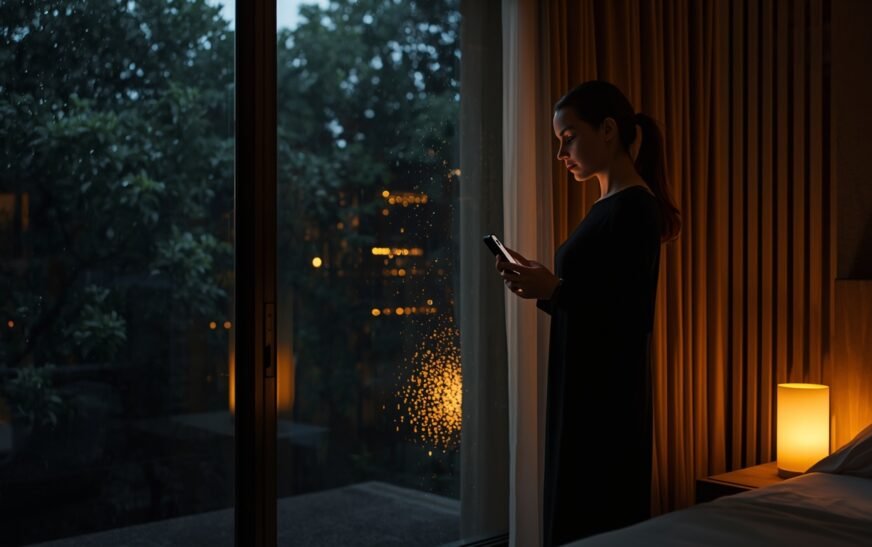
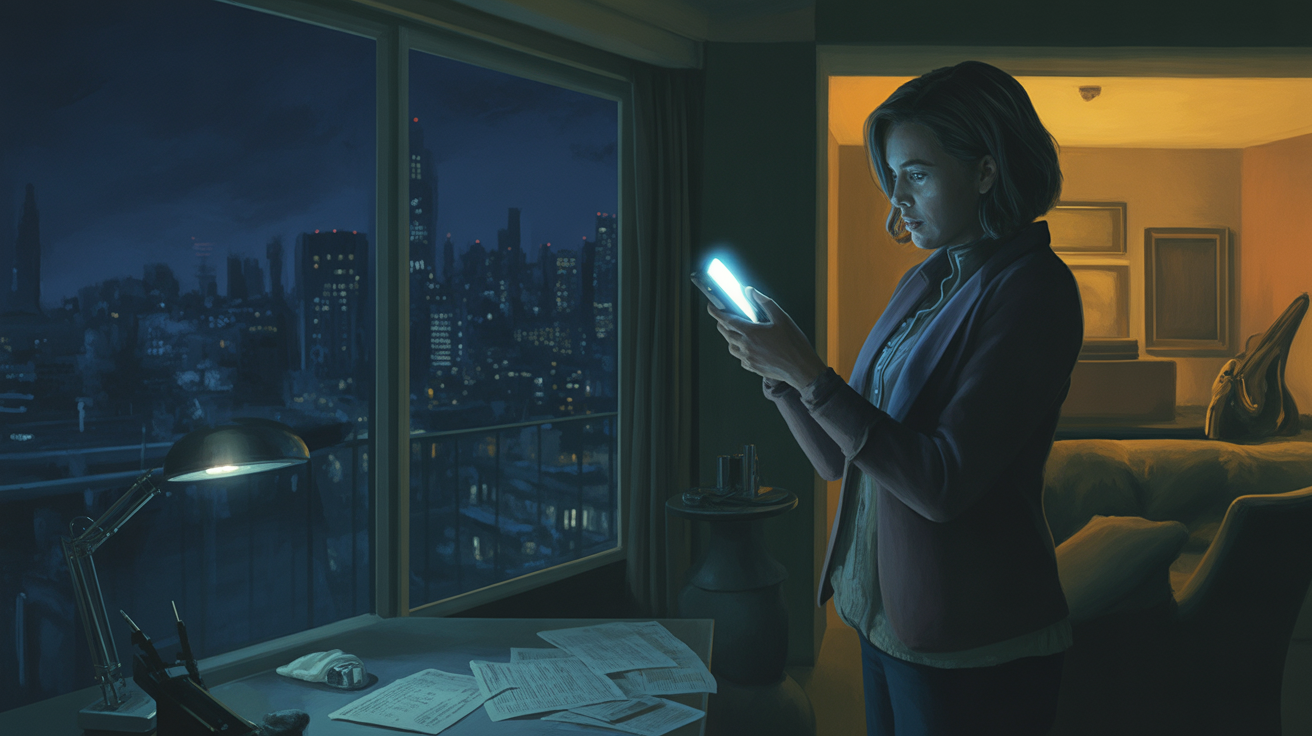
Lena carried the visitor badge into the living room and set it beside her phone under the lamp. Rain blurred the windows into black glass. Beyond them, the city held its breath in scattered amber squares.
She turned the badge over.
On the back, in smaller print, it read: Please return to reception upon departure.
He had not returned it.
That detail felt stranger than the badge itself. Owen did not forget small institutional rules. He was the kind of man who stacked parking receipts by month and carried a pen that actually worked. Therefore, the only plausible options were simple. Either he had left in a hurry, or he had carried the thing home without noticing because his mind had been elsewhere in a way that mattered more.
Her phone showed no messages. The bathroom door remained closed. Water still ran.
Lena picked up the badge again and searched the building name. The website loaded slowly. Halcyon House Medical Suites. Outpatient consults. Executive health assessments. Private counseling rooms. Specialist diagnostics.
Nothing about charity dinners.
When he came out of the bathroom
Owen stepped into the hallway toweling his hair, wearing gray sleep trousers and the expression of a man hoping the rest of the night would require very little from him. Then he saw the badge in her hand.
He stopped.
That pause was all the confirmation she needed.
“What is this?” Lena asked.
He looked at the visitor badge, then at her. “Where did you find it?”
“In your coat. Which is not an answer.”
For a moment, his face seemed to move through several possible versions of the truth. None settled. Finally, he said, “I meant to tell you.”
“When?”
“Soon.”
Lena almost laughed. “That word is becoming useless in this marriage.”
Rain tapped harder against the glass. Somewhere in the apartment above them, a chair scraped across the floor with prolonged irritation.
“It’s not what you think,” Owen said.
“You don’t know what I think yet.”
He exhaled once. “I went there after the dinner.”
“Why?”
“Because someone asked me to.”
The name he avoided
At first, Owen would not say who. He moved into the kitchen, reached for the kettle, then stopped when he realized how absurd it would look to make tea in the middle of being discovered. Lena stayed in the doorway and watched him fail to appear casual.
“Who asked you?” she said again.
He leaned both hands against the counter. “Mara.”
The name landed oddly, not because Lena knew it intimately, but because she knew it just enough. Mara Bell was an old university friend of Owen’s, the kind who surfaced every few years through holiday cards, professional congratulations, and occasional messages about people Lena had never met. Owen described her as sharp, restless, and impossible to summarize in one sentence.
“Mara asked you to go to a private medical building after dinner,” Lena said.
“Yes.”
“And you thought that did not deserve immediate context?”
“I thought it deserved context I hadn’t figured out yet.”
That answer chilled her more than denial would have.
Because context meant complication, it also meant duration. More than that, it meant he was no longer choosing between truth and lies, but between drafts of disclosure polished to injure her least while serving him most.
What he said it was
Eventually, he told her Mara had called two weeks earlier. She was in the city temporarily. She was “going through something.” She did not want family involved. Instead, she needed help with paperwork after a medical consultation and said Owen was the only person she trusted not to dramatize it.
Lena listened without interrupting.
“I met her once for coffee,” he said. “Then today she asked if I could come by after the dinner because she’d had a procedure and shouldn’t leave alone.”
“What procedure?”
His silence was immediate and careful.
“She didn’t tell me everything.”
“Did you ask?”
He looked down. “Not directly.”
Lena understood something then that made her stand straighter. This was not simply secrecy. Rather, it was chosen intimacy. Whether he had slept with Mara or not mattered less, suddenly, than the fact that another woman had been granted a version of his steadiness while Lena was left managing the official story at home.
“How long has she been back?” Lena asked.
“A month.”
He said it too softly, as if volume could reduce the duration.
The month he had edited out
A month.
That meant four weeks of altered schedules, improved manners, and late replies that came with just enough warmth to seem unthreatening. Lena began collecting the pattern at once. There was the Thursday he had gone out “for a walk” after dinner and returned smelling of expensive lobby flowers. Then there was the lunch he canceled because of a “client complication” but came home strangely alert. Finally, there was the new habit of keeping his phone turned face down without ever appearing defensive about it.
“You’ve been seeing her,” Lena said.
“Not like that.”
“That is not an answer people trust.”
He pushed a hand through his damp hair. “I’ve met her three times.”
“And didn’t mention one of them.”
“I knew mentioning her would upset you.”
Lena’s expression did not change. “Interesting defense. You hid the truth because my reaction would have made the truth inconvenient.”
He flinched.
For a moment, neither moved. The refrigerator hummed. The rain softened. Meanwhile, the apartment held the kind of careful silence that appears when two adults are speaking in voices designed not to wake the neighbors while their entire structure shifts anyway.
The visitor badge and the sink light
Lena set the visitor badge on the kitchen counter between them. Under the sink light, its silver strip looked almost elegant.
“Did anything happen between you?” she asked.
“No.”
“Do you want something to happen?”
This time, the hesitation came before the answer rather than after it. That was worse.
“I don’t know,” he said.
There it was. Not confession, not even desire named plainly, but the softened corridor leading toward it.
Lena folded her arms. “And while you don’t know, I’m expected to carry the version of you that still comes home with donor stories and apologetic kisses?”
“That’s unfair.”
“No,” she said. “Unfair is outsourcing your emotional confusion to another woman while asking me to keep the household tone calm.”
The line struck him. Good. He had been too well insulated by his own gentleness.
What the building really meant
At first, Lena thought Halcyon House might be the story. A clinic. A consultation. Some dramatic medical explanation that would rearrange everything into a shape where secrecy became noble. However, the building soon revealed itself as only the setting, not the wound.
The wound was access.
Mara had called him from a place of vulnerability, and he had gone. Owen had stepped into her fear, her paperwork, and her private aftermath. In other words, he had entered a room designed for bad news and recovery, then carried home the badge by accident because what truly occupied him was not the object but the emotional corridor it represented.
“You were there for her,” Lena said quietly.
Owen looked at her and, fatally, did not deny it.
“She was alone.”
“So am I, apparently. I just had better lighting.”
He closed his eyes. “Lena—”
“No. You do not get my name like a bandage.”
The call log she did not need
He reached for his phone as if evidence might help him now. It did not. Lena could already see what would be there: clustered calls, apologetic gaps, messages trimmed into plausible friendship. Therefore, proof in the legal sense had become irrelevant. The structure of the betrayal was already visible.
“Show me if you want,” she said. “It won’t improve the architecture.”
He set the phone back down without unlocking it.
“I was trying to understand what it meant before I hurt you with it,” he said.
Lena shook her head slowly. “You were hurting me while understanding it. That is the part men like you always fail to calculate.”
His face changed then, not toward defense, but toward exhausted recognition. Perhaps he had hoped secrecy would preserve kindness. Instead, it had only made the timing crueler.
Outside, a siren passed somewhere far below the windows. Then the city went quiet again.
What he could not fix that night
By one o’clock, the conversation had narrowed into a colder honesty. Owen admitted he had looked forward to seeing Mara. He admitted he felt “more necessary than he should.” He also admitted he had not known whether the feeling was old history returning or simply the narcotic pull of being wanted in the right tone by the wrong person.
“Did she ask you to leave me?” Lena said.
“No.”
“Did you imagine it anyway?”
That time, he could not answer at all.
Lena turned away and looked out at the city, now reduced to rain-black glass and a few stubborn lights. She thought of all the stories inside marriage and secrets, the quiet fractures in emotional drama, the pressure of psychological tension, the elegant unease in secrets and suspense, and the measured dread of dark thriller fiction. Somehow, her life had become one of those rooms without announcing when it crossed the threshold.
Meanwhile, Owen remained behind her, present and useless in equal measure.
After the visitor badge
The visitor badge stayed on the counter until morning.
Lena left it there on purpose. She wanted at least one visible object in the apartment to tell the truth without editing itself for comfort. By contrast, everything else still looked composed: the dish rack, the framed print above the radiator, the folded throw at the end of the sofa. Ordinary life had not yet caught up to disclosure.
She slept in the guest room with the door locked, not because she feared him, but because she no longer wished to be reached accidentally. Dawn arrived gray and thin. When Lena finally stepped into the kitchen, Owen was gone. A note waited beside the badge.
Went for coffee. I’m sorry. We’ll talk when you’re ready.
She read it once and set it down.
Readers drawn to hidden access, quiet betrayal, polished deception, emotional migration, private meetings, partner withdrawal, and silent realization will recognize the colder kind of suspense that enters domestic life through one small item no one was meant to bring home.
What remained with her was not the note, nor even Mara’s name. Instead, it was the badge itself, light in the hand and heavy with unauthorized passage. Ultimately, that was the true shape of the night. Owen had been entering private rooms elsewhere while asking her to keep believing in the public map of their marriage.
And now, finally, she knew exactly what kind of door he had been practicing how to open.